Relative Strength, Absolute Conviction: Reading Oil’s Rise Before It Happened – Fat Tail Daily
Were there clues for investors that an oil price spike was on the horizon in 2026?
Well, let’s start from the top…
The world’s leading global financial firm, the largest bank in the US, with over $3.3 trillion in assets, JPMorgan.
Did this investment giant have some inside cues about what was set to happen to oil prices?
Not at all!
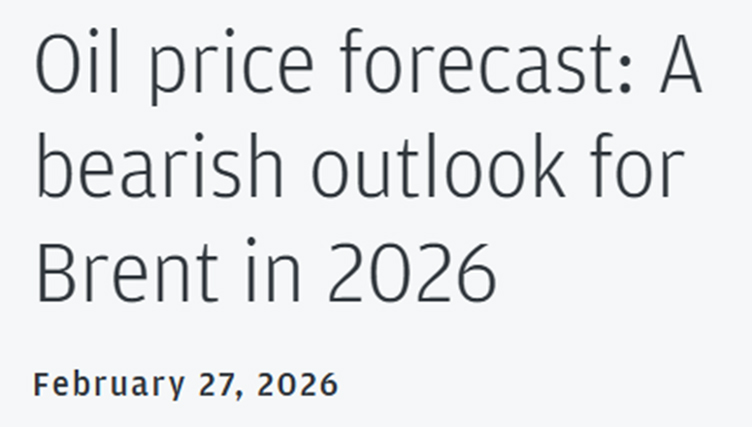
This is a piece the firm published last month, JUST before the war broke out:
Source: JPMorgan
[Click to open in a new window]
Note the date, JP Morgan was bearish on oil, even in the last hours just before oil made some of its most rapid advances ever.
And to be fair, who really could have predicted the volatility that’s happened since?
But if you’ve been a reader of Mining Memo, you’ll know I’ve been bullish about oil and gas for several months.
In fact, here’s an update I made in February, around the time JPMorgan put out its bearish predictions on Brent: “Oil: Only One Trade Matters.”
While that piece didn’t specifically note the Middle East as the catalyst for higher prices, it did point to the geopolitical vulnerabilities underlying the world’s most important resource.
So, how did we know higher
prices were coming?
Back in February, I put together a report for my paid readership group at Diggers & Drillers. Again, just before the war broke out in Iran.
The core theme underlying this report was the relative strength in energy stocks.
Here’s a snippet from our February report:
Narratives, outlooks and supply forecasts often paint a very different picture to ‘price action.’
That’s why I believe the world’s ‘experts’ will be proven wrong on the trajectory of energy prices this year, especially within the oil and gas market.
In fact, this sector is already demonstrating some clear signs of strength.
How so?
Whether you’re looking at a company or a sector, one of the most useful guides for identifying future leaders is to focus on something called relative strength.
What do I mean?
Let’s put it simply: emerging bull sectors tend to decline LESS during market-wide sell-offs.
That’s why corrections can be incredibly useful in pinpointing where future strength sits in the market.
There are always opportunities; it’s just a matter of having strategies to identify them, and ‘relative strength’ is one such strategy.
So, with that in mind, how did the traditional energy market fare in the last market-wide sell-off?
I’m referring to the sell-down that started in late January.
Let’s find out…
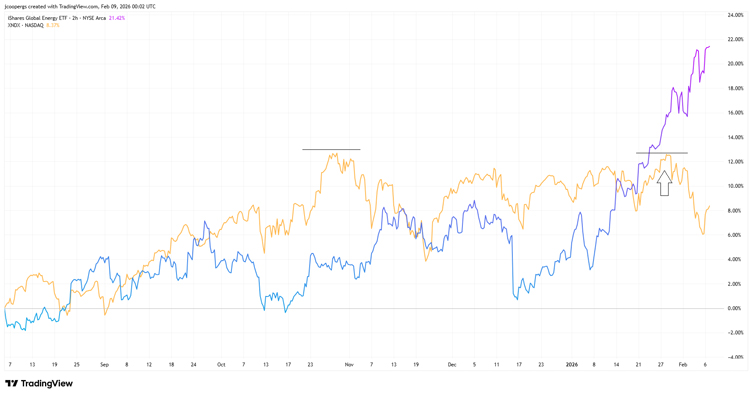
Here’s a chart comparing the Nasdaq 100 Total Return Index (orange) versus the iShares Global Energy ETF [NYSE: IXC], shown as purple:
Source: Trading View
[Click to open in a new window]
The Nasdaq 100 is made up of the world’s largest tech firms, like Google, Apple, Nvidia, and Amazon.
Meanwhile, the Global Energy ETF comprises oil giants such as Exxon, Chevron, BP, and Shell.
Two completely different sectors, which could be on very different long-term trajectories.
Tech has been the market leader for the past several years.
That’s why I’ve used it as the bellwether on this chart, a gauge to measure the relative strength in other sectors, in this case, the energy market.
So, what does it show?
Referring back to the chart above, you’ll note that the iShares Global Energy ETF hasn’t just held firm; it has surged against investor uncertainty.
The energy ETF is up almost 16.8% this year, while tech remains flat.
This could be our first important clue that the energy market is starting to show compelling ‘relative strength’.
As I detailed in your December recommendation, energy should be your focus as we head into 2026.
And that forecast has only strengthened on the back of this latest market action.
It’s why I firmly believe the tide is finally turning in the traditional energy market.
Now’s the time to deploy our strategy and build exposure.
That’s what the price action is telling us.
JPMorgan didn’t pick it.
The world’s leading authority on oil and gas markets, the International Energy Agency (IEA), didn’t pick it.
Very few market ‘expert’ insiders were bullish on oil for 2026.
Most were downright bearish.
And throughout that time, I was recommending a bunch of traditional energy plays to my paid readership group.
This was the ultimate contrarian play; it was timely, and it has served as an excellent hedge for our portfolio against major market volatility.
Some of those positions have already hit triple-digit gains in a matter of weeks.
So, while the biggest moves in the oil trade might be behind us now, other opportunities are emerging…
If you want a front-row seat to where I think the next major moves will be, I suggest you check out my work here.
This is where you can put all this knowledge into action by following my model portfolio.
Until next time.
Source link