Don’t Watch The Strait, Read This – Fat Tail Daily

Two weeks of breathing room.
Oil sold off aggressively.
Guess we’ll be driving our petrol cars in a month, right?
None of this really matters.
What does matter is this.
Y’all paying attention?
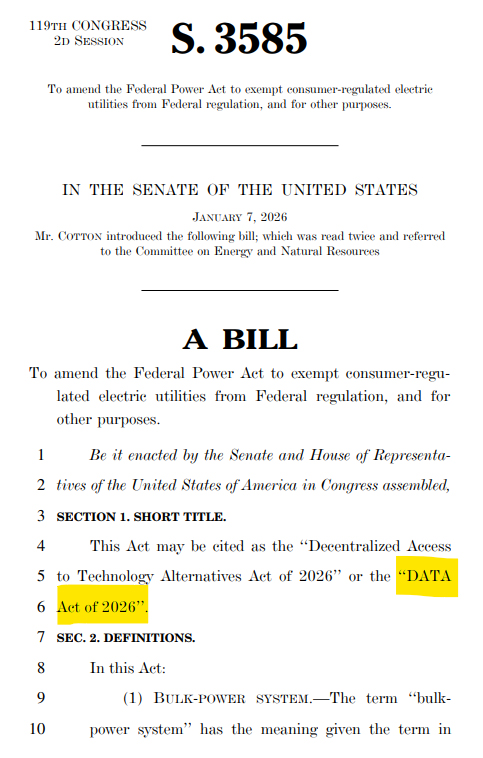
This is the first page of the text of the Data Act of 2026, introduced in the US Senate:
Source: US Congress
Congress runs the play
In January this year, Senator Tom Cotton introduced the DATA Act of 2026 — the Decentralized Access to Technology Alternatives Act.
The bill and subsequent iterations will be essential reading from K Street (where the lobbyists live) to Wall Street (where the money lives).
What it does, in plain language, is create a pathway for tech companies to build their own private, “islanded” electricity generation systems — completely outside federal regulation.
Consumer-regulated electric utilities would be exempt from FERC oversight, rate regulation, interconnection requirements, and reliability standards.
As long as they stay physically “islanded” from the main grid.
The signal is hard to miss.
Washington understands the grid cannot handle the AI buildout.
So rather than wait for regulators to catch up, the Cotton bill effectively says: build your own power.
That is a direct invitation for large-scale private energy investment.
Nuclear included.
In fact, nuclear, especially.
Robots need it
Here is where things get interesting.
Before the Iran conflict dominated every front page, the big energy story was AI.
The RAND Corporation published research earlier this year with numbers that should have stopped investors in their tracks.
Their analysis found that global AI data centres could need 68 gigawatts of total power capacity by 2027.
That is nearly double the entire global data centre power footprint from 2022.
By 2030, AI power requirements could reach 327 gigawatts.
By the late 2020s, training the biggest AI models could draw around a gigawatt of power for a single run under aggressive scenarios — roughly the output of a large power station.
By 2030, specialist researchers estimate the largest frontier AI training runs could demand 4–16 gigawatts, equivalent to the output of several nuclear reactors, although these are still speculative, worst‑case scenarios.
The International Energy Agency, meanwhile, expects global data centres to use about 945 terawatt‑hours of electricity per year by 2030.
That’s more than the country of Japan consumes today — with data centres driving close to half of all growth in US electricity demand this decade.
The grid, quite simply, is not built for this.
If oil liquidity dam is broken, where
does that money flood into?
Here is the thread that ties all of this together.
The Iran war has forced the oil market to soak up enormous amounts of capital to keep prices from blowing out even further.
That kind of inflationary pressure historically compresses the speculative froth in financial markets.
But that capital has to go somewhere now.
And the most obvious place for it to go right now is the intersection of two enormous demands: energy security and AI infrastructure.
Both require long-term, patient capital.
Both require physical assets in the ground.
The Iran conflict has made it viscerally clear what happens when you depend on hostile chokepoints for your energy supply.
The constraint is power.
And the only source of power that is clean, baseload, and scalable enough to meet AI’s exponential demands is nuclear.
Here’s what I did.
In the last two weeks, I’ve recommended two uranium companies to readers of Australian Small Cap Investigator and Fat Tail Micro-Caps.
I expect both to be important players as nuclear demand ramps up to meet the challenges posed by AI’s strain on electricity grids around the world.
The DATA Act signals that tech companies will be building their own generation capacity.
And a world that has just watched the Strait of Hormuz close is not going to be shy about investing in domestic, fuel-secure energy sources.
Uranium is the fuel that powers that outcome.
The Iran war may dominate the headlines for a while yet.
But underneath it, the capital is already starting to move.
Warm regards,
Lachlann Tierney,
Australian Small-Cap Investigator and Fat Tail Micro-Caps
The post Don’t Watch The Strait, Read This appeared first on Fat Tail Daily.
Source link