Wal-Mart de México Stock: Strength In The Face Of Persistent Headwinds (OTCMKTS:WMMVY)
bgwalker
My initial coverage of Walmex – officially, Wal-Mart de México, S.A.B. de C.V. (OTCQX:WMMVY)(OTCPK:WMMVF) – turned out to be well-justified. Against a then-current price of about $42 on Jan 2, the current as-of-writing price of $35 or so represents a +15% YTD dip. My rating was a Hold, and I mentioned that near-term headwinds could mean it was the wrong time to get in. On further analysis, the fundamentals seem to be intact after Q124 earnings were reported at the end of April. If you see my initial article, you’ll notice that I mentioned a $32 to $42 price range that the stock seems to be stuck in. That phenomenon of the past two years seems to still be in play. The stock bounced off a support level just above $32 after the Q323 report, and since that time it has been twice rejected at just above $42, further validating that assumption.
Now that Q124 results has been out for a while and the second quarter is well underway, let’s look at how the fundamentals have shaped up, and whether or not this is still worth a Hold.
Spoiler: I’m upgrading my rating from Hold to Buy, and the reason is that I’m seeing a lot of strength in the business as we continue to navigate persistent headwinds of a largely macro nature.
Quarterly Performance – Q423 and Q124
Walmex seems to have blasted out of the gate with some impressive numbers in the first quarter of FY24. It did have muted revenue growth of 6.7% exiting Q4 (7% adjusted), but Q1 painted a very different story. To keep things relevant, I’ll only focus on Q124 results and how I see things moving forward over the course of the current fiscal year.
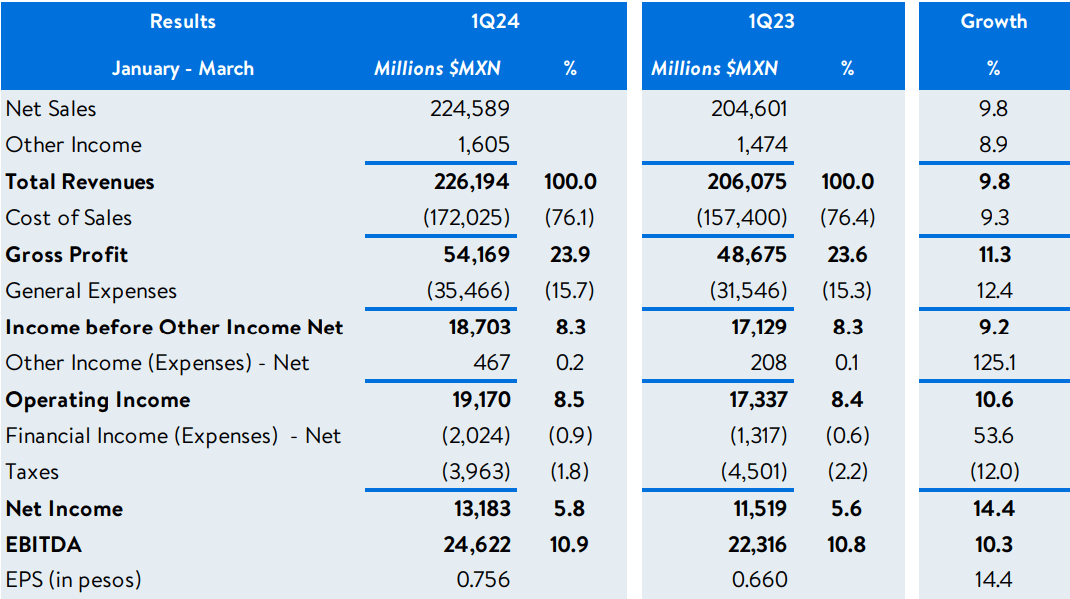
Q1 revenue growth was a strong 9.8% YoY, which is higher than any individual quarter through FY23. To me, that immediately signifies some favorable tailwinds developing; or, at the very least, it tells me that the near-term headwinds aren’t as forceful as they were two quarters ago when I last covered Walmex.
But let’s not get too excited at this point, because it’s still too early to say whether this kind of near-double-digit growth at the top is sustainable through the year, particularly when the entire market is so volatile and consumer sentiment is so-so. According to a Mastercard Data & Services report from earlier this year, “Latin America will benefit from stabilizing inflation, leading to a smooth slowdown in GDP growth.” However, the same report also shows that “Consumers are benefiting from strong labor markets, but consumer spending growth will moderate in 2024 compared to 2023.” That’s a mixed bag, unfortunately.
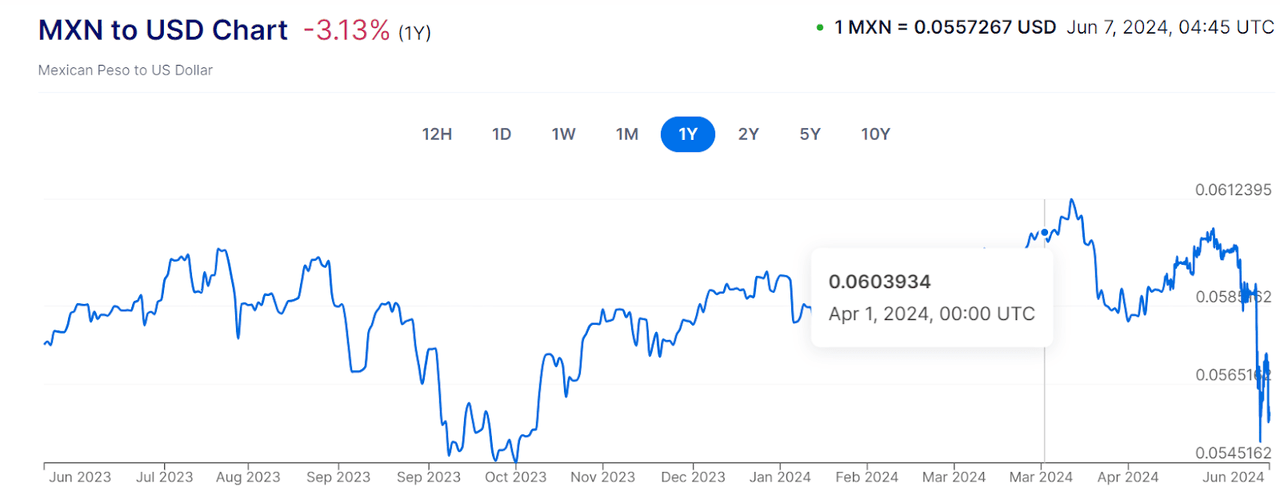
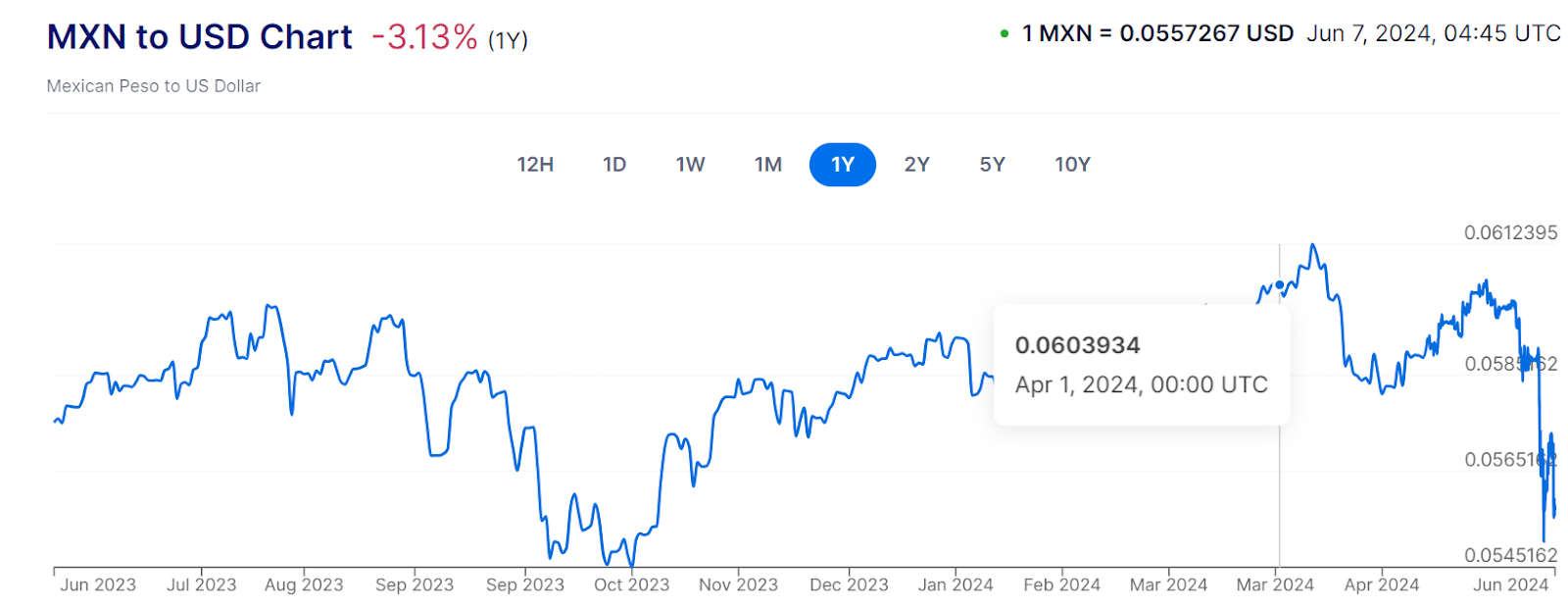
What’s good is that Walmex seems to be bucking trends with its performance – for now, at least. One major factor was the Mexican Peso appreciating against the dollar until the start of April. The problem now is that this trend took a sharp reversal, and is currently quite volatile. More on that later.
XE
Nevertheless, the October 2023 to early April 2024 rally helped Walmex as a tailwind through two quarters. That’s alongside a 2.5% bump from the calendar effect that helped Q1 revenue growth come in strong at 9.8%. You won’t see much in the way of operating leverage, though, and this is typical of the retail industry where variable costs such as SG&A tend to rise alongside revenues. Moreover, with the strong store opening cadence in the fourth quarter, operating expenses were bound to increase. Still, I liked the fact that cost of sales or COGS only grew 9.3% on the back of that 9.8% revenue bump, which signifies some amount of pricing power at the gross margin level.
Walmex Press Release – Q124
Further supporting bottom-line EPS growth of 14.4% were a half-million peso reduction in taxes and a 125% boost in the ‘other income’ line item on the P&L statement. Overall, a pretty strong quarter underpinned by favorable currency, pricing power, the calendar effect, lower taxes, and increased other operating income.
Going deeper into the segment disaggregation for revenue and profitability, we see that the bulk of the growth at the top and bottom came from the core Mexican market, which contributed $MXN190 billion versus Central America’s $MXN36 billion, and exhibiting much stronger growth rates in the former, at 11.2% versus 9.7%, respectively. The EBITDA spread is even starker, with Mexico reporting 12.2% growth against Central America’s 6.9%. Moreover, the pricing advantage is much clearer in Mexico, with gross profit growing 13.1% on the back of that 11.2% revenue growth figure, a 190bps core operating leverage spread, while Central America only showed a 30bps spread on top of the 8.7% revenue growth rate.
It’s always good news when the larger segment is showing healthier growth figures, and a lot of investors tend to miss the fact that the quality of revenue growth is as important, if not more so, than the revenue growth itself. The EBITDA growth of these respective segments further strengthens that assumption.
In toto, Walmex is showing clear uptrends at the top and bottom; unfortunately, the stock price hasn’t followed that same pattern, as we saw above. Nevertheless, it does give me a little more confidence in my rating change to a Buy, which melds nicely with the fact that it is trading at the lower end of that range it established over the past couple of years.
That said, the second quarter might not come in as strong, and we’re already seeing weakness in the $MXN-USD currency pair. This indicates that the tailwinds of the past two quarters might not persist through Q2, so I’d be wary of expecting similar growth when the report comes out next month. Let’s also look at what’s new as of Q2 so we have a better view of what to expect.
New Developments and their Implications
The obvious new development is the announcement of the new CEO, Ignacio Carde. The reason it’s a positive is that his predecessor is taking on a larger role as EVP and Regional CEO for Walmart Inc’s (WMT), Canada, Chile, and Mexico/Central America divisions and will eventually be expected to take the reins as Walmex’s Chairman of the Board sometime in H224. I usually look at this sort of smooth succession as a developmental positive because the company has adequate time to consider the pros and cons of the new appointee. In this case, the new CEO is being brought in “to continue to strengthen Walmex’s successful omnichannel strategy and provide continuity to our business.”
One apparently negative development in Q124 was the sudden slowdown in store growth. In Q323, Walmex opened 24 new units; in Q4 that jumped more than threefold to 101 new units; in Q124, however, that dropped down to single digits for an increase of just 11 stores. This extremely volatile cadence is not something a lot of investors will be comfortable with, and I can sympathize with that. On the one hand, it could be a sign that management is projecting a growth slowdown through the rest of FY24; on the other, it could be seen as a prudent move to preserve cash.
My view is that it’s the latter. We need to move to the balance sheet and cash flow statements to get a better perspective on that. Between September 30, 2023 and December 31, 2023, Walmex’s C&CE (cash and cash equivalents) dropped from nearly $MXN 50 billion down to a little over $MXN 40 billion. While that would have helped fund some of the capital needs for new stores, as indicated by the jump in cash used to invest in long-lived assets from $MXN 17 billion to more than $MXN 46 billion between Q323 and Q423, it would have also triggered the need to be cash-conservative for a period. Put another way, with its strong cash position at the end of Q3, the company had ample funds to fuel that expansion in the following quarter, but by the end of Q4, however, we saw the cash position down near the $MXN 40 billion mark, so it makes sense that cash preservation was once again prioritized. As of Q1, C&CE is back up to around $44 billion, so this was a pretty prudent move by management to first capitalize its cash holding aggressively by funding store growth, and then choking off that aggressive growth until cash flows once again replenish that cash holding.
I’m predicting a continued slowdown in store growth for Q2, but perhaps not as muted as in Q1. It’s very likely that these new stores will further boost revenues as well as operating cash flows, so once that phase is complete, we should see more aggressive numbers again on the store count front, probably as soon as Q324.
The third positive development is that the nearly four-year investigation by COFECE, or the Federal Economic Competition Commission, is getting ever closer to being resolved. Walmex submitted the necessary supporting documents and defense evidence at the end of 2023, so we should be able to see some sort of closure for this stage of the battle later this year. Walmex itself expects this to happen in H224, but these investigations are largely unpredictable from a timeline perspective.
Conclusion: Is There Value Here?
Value should always be preceded by growth, in my opinion. Without growth, value is usually restricted to squeezing out more and more profits from a stagnant revenue base or resorting to financial engineering. Neither of those are sustainable, in my opinion, so it’s encouraging to see Walmex’s consistently strong high-single-digit and low-double-digit growth at the top and bottom. I think the company is growing in a sustainable way, although there are wild swings in their operating activities that make it almost cyclical. Over the longer time horizon, however, the uptrends in growth and the potential for ongoing growth are abundantly clear.
The headwinds I mentioned in my last article still persist, but I do see them dissipating over the year ahead. One example of this is the weaker $MXN-USD exchange rate that’s likely to have taken a chunk out of Q2 revenues that will be announced next month, but forecasters are predicting a bounceback to $MXN 17 per USD, with the sudden decline being attributed to a surprise landslide win in the Mexican elections. There are also other factors that could help the peso strengthen against the dollar even further, such as the carry trade or FX carry trade advantage that Mexico still has over the U.S. with its 5% higher interest rates, at about the 11% benchmarked by the Bank of Mexico in May 2024. Inflation is still high in Mexico, so we could see a prolonged period of higher interest rates and a strong spread with U.S. benchmark interest rates.
In the final analysis, it seems that there’s some amount of stability on the horizon for Walmex, which means continued growth, but perhaps at a slightly muted level compared to the first quarter. In terms of valuation, the current price implies a price to forward earnings of under 18x, based on an EPS estimate of USD 1.98 for FY24. That’s not necessarily expensive, but it’s not cheap, either. Go a year out and we see a forward PE of about 16x based on analyst projections for FY25, so I’d feel quite comfortable upgrading Walmex to a Buy against my earlier Hold rating. My reasons? Primarily, despite the ongoing headwinds like very high interest rates and inflation, consumer sentiment seems resilient. This evidence comes from the stellar growth posted at the top and bottom for the first quarter, so even if the rest of the year sees more moderate growth rates, there’s still some long-term value in this stock. The second reason is the aggressive store growth cadence from Q4, which should potentially help offset any quarter-over-quarter sequential growth rate declines we might see.
To be clear, the risks that my last article mentions are very much present even now, but those risks were somewhat mitigated by the company’s on the ground performance coming out of the FY24 gate. Moreover, with a new CEO who’s specifically mandated to grow eCommerce and omnichannel offerings, we could see a more stable revenue growth story in the quarters ahead.
As always, these are my opinions, and investors are advised to do their own due diligence before investing in any security. For me, there’s enough evidence to upgrade WMMVY to a Buy.
Editor’s Note: This article discusses one or more securities that do not trade on a major U.S. exchange. Please be aware of the risks associated with these stocks.
Source link