GDP Reports and Interest Rate Decisions – Currency Thoughts
GDP Reports and Interest Rate Decisions
July 30, 2025
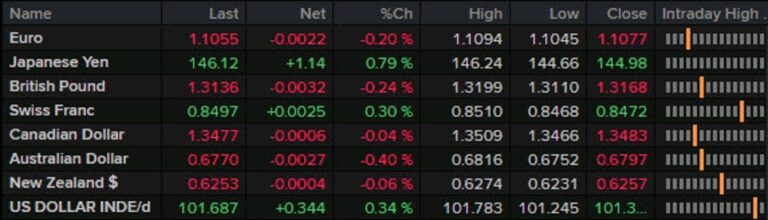
The dollar strengthened from Tuesday closing levels ahead of the Federal Reserve’s interest rate announcement due within the hour and amid preliminary second-quarter GDP releases that showed faster growth in the United States but slower expansion in Europe. Dollar gains have amounted so far to 0.8% against the Australian dollar and South Korean won, 0.7% relative to the euro, 0.6% versus the Swiss franc, 0.5% vis-a-vis sterling and 0.4% against the Japanese yen. The price of gold has dropped 1.0%, while that of oil is up 1.0%. Bitcoin is steady.
Ten-year sovereign debt yields today are up four basis points in the United States but down three basis points in the U.K. and a basis point each in France and Japan. Share prices rose 1.1% in Taiwan but fell 1.4% in Hong Kong. U.S. and European equities are flashing green but not by much.
Central Banks in Canada and Georgia have already announced decisions to leave their policy interest rates unchanged, which had been as analysts were expecting.
The Bank of Canada’s interest rate target has been 2.75% since two 25-basis points earlier this year done in January and then March. That’s down from a cyclical peak of 5.0% from September 2023 until an initial reduction in May 2024. The Bank of Canada’s message was a nuanced one, reflecting the lack of a trade deal between Canada and the United States.
With still high uncertainty, the Canadian economy showing some resilience, and ongoing pressures on underlying inflation, Governing Council decided to hold the policy interest rate unchanged. We will continue to assess the timing and strength of both the downward pressures on inflation from a weaker economy and the upward pressures on inflation from higher costs related to tariffs and the reconfiguration of trade. If a weakening economy puts further downward pressure on inflation and the upward price pressures from the trade disruptions are contained, there may be a need for a reduction in the policy interest rate.
From a cyclical peak of 11.0% maintained from April 2023 until a first cut in May 2023, officials at the National Bank of Georgia had lopped a total of three percentage points from its interest rate target by May 2024 but has kept the rate steady at 8.0% at all subsequent policy reviews. Officials have prioritized the need for caution. Inflation is currently a percentage point above the 3.0% target, and economic activity remains robust. Ever-present geopolitical tensions and trade-related uncertainties create two-sided economic risks.
A slowdown in Euroland quarterly GDP growth (not annualized as is the reporting custom) to 0.1% last quarter from 0.6% in 1Q 2025 was not surprising and in fact was marginally less pronounced than consensus expectations. Year-on-year inflation of 1.4% was only 0.1 percentage point less than the first quarter reading and above calendar year growth of 0.9% in 2024 and 0.4% in 2023.
Reported quarterly growth among European countries today was highest in Spain (0.7%). Portugal (0.6%) but negative 0.1% in both Germany and Italy. A 1.0% drop in Ireland followed a GDP leap of 7.4% in the prior quarter and still left Irish GDP 16.2% higher than a year earlier.
Mexican GDP rose 0.7% in the second quarter after 0.4% in 0.4% in 1Q, but year-on-year growth there of just 0.1% was at a 17-quarter low.
U.S. GDP rebounded from a 0.5% contraction in 1Q to show a 3.0% annualized quarter-on-quarter advance in 2Q, but 3.0% masked some a disturbing composition of growth. The principal driver was a 30.6% plunge in imports. Business non-residential investment growth slowed appreciably to 1.9% from 10.3% in the previous quarter. Personal consumption, which had increased nearly 3% in 2024, experienced a second straight tepid quarter, rising 1.4% annualized after just 0.5% in 1Q. Residential investment and exports fell by 4.6% and 1.8%, while government expenditures increased just 0.6%.
Inflation measured by the core PCE price deflators last quarter exceeded expectations.
ADP’s estimate of U.S. private employment growth last month was better than feared at 104k but still low from an historical perspective.
Another notable data report today involved Euroland economic sentiment in July rising to a 5-month high of 95.8 but remaining still well shy of its long-term average centered on 100. The industrial and service sector sentiment indices were at 2- and 5-month highs, while construction printed at a 2-month low. Labor market sentiment reached a 5-month high.
Copyright 2025, Larry Greenberg. All rights reserved. No secondary distribution without express permission.
Tags: Bank of Canada, Euroland GDP growth in 2Q 2025, National Bank of Georgia, U.S. 2Q 2025 GDP


 ShareThis
You can leave a response, or trackback from your own site.