What Does The Grossman Stiglitz Paradox Tell Us About The Efficiency Of The Markets?
The Grossman-Stiglitz paradox refers to the paper On the Impossibility of Informationally Efficient Markets written by Sanford J. Grossman and Joseph E. Stiglitz.
Published in the American Economic Review in June 1980, the paper presents an argument and a mathematical justification that the market cannot be 100% efficient.
Because if the market were perfectly efficient, there would be no participants in the market.
It would result in a paradox – a self-contradictory conclusion that results in the fact that it cannot be.
Let’s think about this.
Contents
An informationally efficient market means that the prices of all assets in the market are perfectly priced and reflect all known information.
Suppose I go to Target to buy a Lego set priced at $58.99.
Then I go to Walmart and see it selling the same model for $45.75.
The price of this asset is not perfectly priced.
The market for this item is not efficient – at least not yet.
Shoppers will go from store to store looking for the best deal.
Since Walmart sees more shoppers (higher demand) for this item, it will raise the price.
Since Target is not attracting many buyers (low demand), it will lower prices to increase sales.
The effect of many shoppers seeking the best price will drive the item’s price to its fair price of perhaps $50.00.
Traders buying and selling a stock will cause the stock price to move toward its fair value.
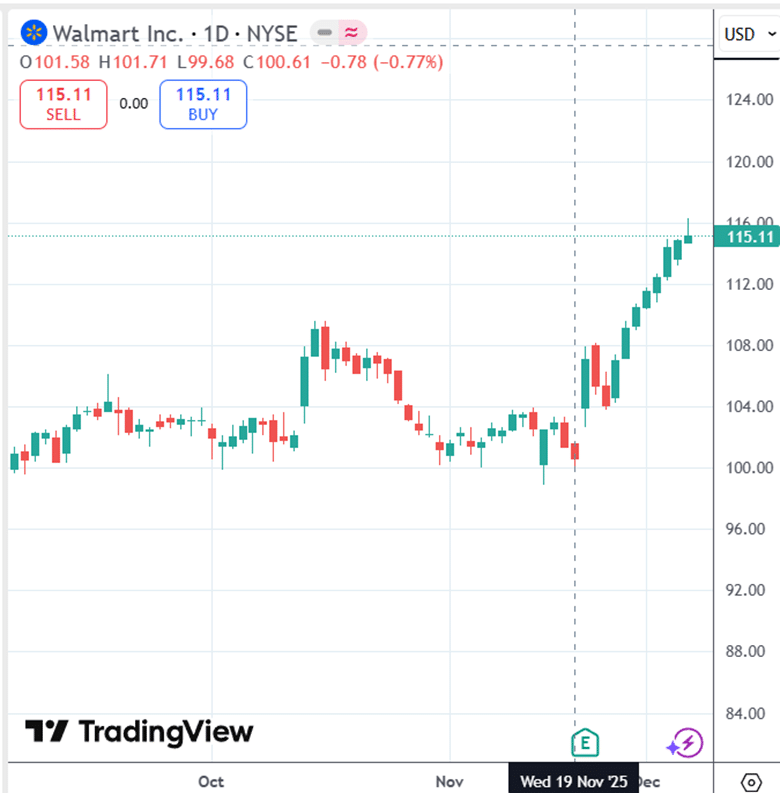
On November 19, 2025, the price of Walmart stock (WMT) was trading at the close for $100.61 per share.
The next morning, Walmart had an earnings announcement, introducing new information into the marketplace.
The price of stock jumped to $103.94 on open.
The price of the stock reflects any new information available.
The market is very efficient in pricing new information into the stock price very quickly.
However, it is not perfectly 100% efficient.
In the following days, the price went up and down, and then eight green candles showed price trending upwards…
Source: TradingView
The picture sure looks like the stock price is trying to go somewhere.
This may be because new information has been discovered or because it is still being propagated in the marketplace.
The traders, investors, quants, and analysts who spent time and effort performing analysis or research to discover new information know something others do not.
In this case, they likely discovered something positive that they believe would make Walmart more valuable than its current price.
Hence, they buy the stock.
This increases demand for the stock, driving the stock price up.
The above example demonstrates that not all participants have the same information at the same time – some know something that others do not.
The price is the mechanism that transmits information from those who know to those who do not.
The people who don’t know – who did not spend the research effort – could now come to know simply because they see the price going up.
They know that someone already did the work to find something positive about the stock.
In a fair market, things have to be fair.
Those who spent the time and effort to get to know must be rewarded for knowing more than those who simply sit on the couch and watch the price go up.
And they are rewarded because those in the know bought the stock first and reaped greater rewards.
This is only possible if the market is slightly inefficient.
If what they found out was immediately and instantaneously reflected in the price, and all participants knew about it, they could not reap the greater rewards and hence would not have benefited from their time and effort.
If they could not reap any rewards, then next time they would never take the effort to perform the research.
They would not trade.
No one would buy or sell.
The market would collapse, and there would be no market – no participant.
I’m making a bit of a hyperbole here.
But that is the crux of the Grossman Stiglitz paradox.
The market can not be perfectly efficient.
Because if it were, then no one could profit.
If no one can profit, then no one will trade.
If no one trades, then there is no market.
Since the market exists, it can not be perfectly efficient.
This explains why price inefficiencies exist and why some active traders can make money.
Prices must deviate a little from fair value so that informed traders can profit – their reward for their extraction of information.
Uninformed traders create market noise, which causes prices to deviate from fair value.
Informed traders exploit this deviation and drive prices back to fair value.
The Grossman Stiglitz paper writes…
“…there is an equilibrium degree of disequilibrium: prices reflect the information of informed individuals (arbitrageurs) but only partially, so that those who expend resources to obtain information do receive compensation.”
What about the person sitting on the couch, seeing the price of the stock go up, and then buying the stock?
When a person does this, it helps bring the stock price to its fair value.
This person is rewarded for doing so.
Not as much as the original information gatherer, who buys the stock first, but enough to make this person try to do it the next time.
Market makers provide liquidity in the market that makes the market work.
They contribute to making the market efficient.
What is their reward for doing so?
They get compensated by taking some profit from the bid/ask spread.
The paper writes…
“How informative the price system is depends on the number of individuals who are informed; but the number of individuals who are informed is itself an endogenous variable in the model.”
Anyways…
I think the general consensus is that the market is “slightly” inefficient.
Just inefficient enough to attract enough traders into the marketplace to make the markets work.
If there are not enough participants, the market becomes illiquid and inefficient.
It is possible for those participating to make good money.
This draws more participants into the market to try to do the same.
When there are too many participants, the market becomes very efficient.
So efficient that the edge is gone or arbitraged away – it’s more difficult to make money.
Some participants give up and drop away.
The strong form of the Efficient Market Hypothesis states that prices reflect all information – public and private.
The Grossman-Stiglitz argument contradicts this hypothesis and says that the strong form of the Efficient Market Hypothesis can not be true.
The semi-strong and the weak form of the Efficient Market Hypothesis are consistent with the Grossman-Stiglitz hypothesis.
Options have another level of complexity besides price.
It has implied volatility.
As with price, the implied volatility of options must also be “slightly” wrong.
If IV were perfect, there would not be any volatility traders.
Based on the Volatility Risk Premium model, implied volatility is generally overstated compared to the realized volatility.
Markets cannot be perfectly efficient because the process of making them efficient requires informed individuals who must earn profits, which can only exist in an inefficient market.
If you have ever grappled with the question of whether the market is efficient or not, I hope this has provided some clarity.
We hope you enjoyed this article on the Grossman Stiglitz Paradox and market efficiency.
If you have any questions, please send an email or leave a comment below.
Trade safe!
Disclaimer: The information above is for educational purposes only and should not be treated as investment advice. The strategy presented would not be suitable for investors who are not familiar with exchange traded options. Any readers interested in this strategy should do their own research and seek advice from a licensed financial adviser.
Source link