Zweig Breadth Thrust: Rare Market Signal That Predicts Bull Runs

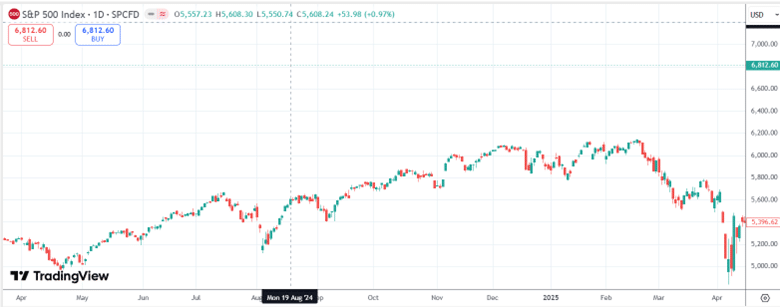
What if there was a market signal so rare it only triggers a few times per decade – but when it does, major bull runs tend to follow?
The Zweig Breadth Thrust (ZBT) is exactly that signal.
Since its development in the 1970s by legendary investor Marty Zweig, it’s flashed fewer than 30 times.
But its track record is remarkable: when this signal triggers, the S&P 500 has historically rallied an average of 20%+ over the following 6-12 months.
Most recently, it triggered on April 24, 2025, and the market surged 15% in just three months.
Unlike typical indicators that focus on price, the Zweig Breadth Thrust measures something more powerful: explosive expansion in market participation.
When the majority of stocks suddenly shift from declining to advancing, it signals a fundamental change in sentiment that often marks the beginning of significant uptrends.
Here’s everything you need to know about this signal and how to trade it.
Contents
The Zweig Breadth Thrust Signal can be abbreviated as ZBT.
All four words contribute to what it means.
Zweig: It was developed by Marty Zweig
Breadth: It is based on market breadth readings
Thrust: It indicates bullish upside momentum
Signal: based on the criteria that trigger the signal
Market breadth measures how many stocks are advancing (we will call A) relative to declining (we will call D).
Market breadth is the ratio of the advancing stocks to the total stocks:
Market breadth = A / (A+D)
Marty Zweig uses NYSE (New York Stock Exchange) stocks to determine the number of advancers and the number of decliners.
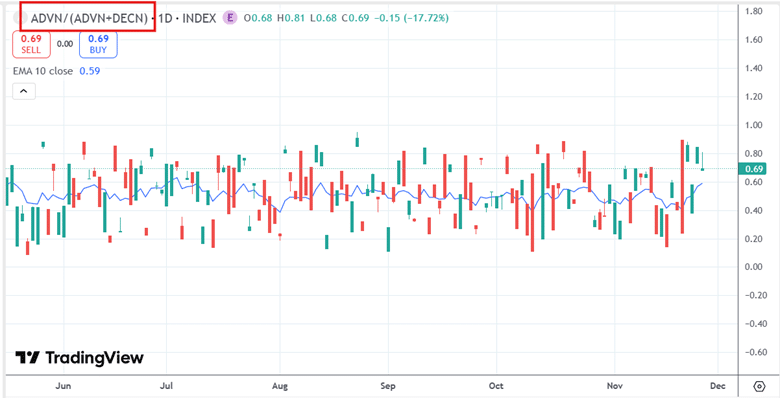
On TradingView, the symbols are “ADVN” and “DECN” respectively.
So, you can enter the formula into the symbols field like this…
Next, add a 10-day exponential moving average (the blue line).
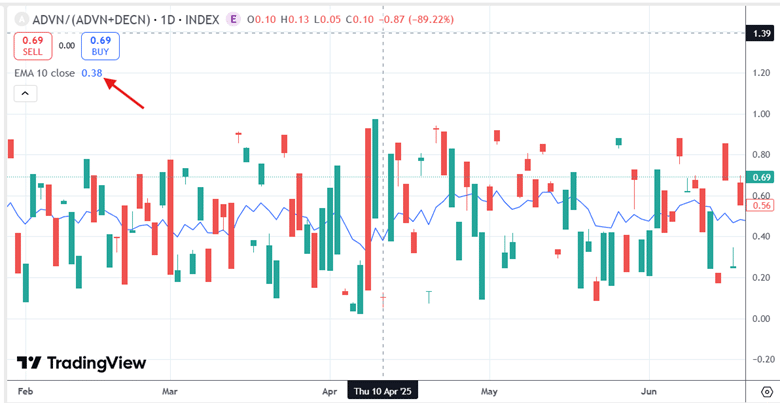
The ZBT signal is triggered when this exponential moving average (EMA) crosses from below 0.4 to above 0.615 within 10 trading days.
For example, on April 10, 2025, the EMA was 0.38:
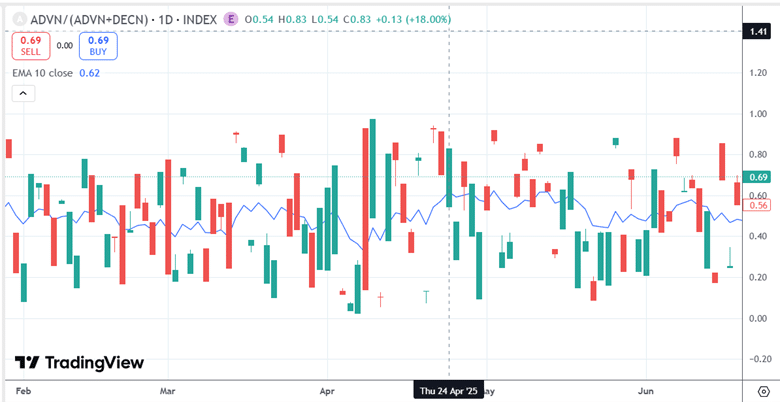
And nine candles later on April 24th, the value rose to 0.62:
Which meant that it did it in nine trading days.
The signal is based on trading days and not calendar days.
This is a valid signal.
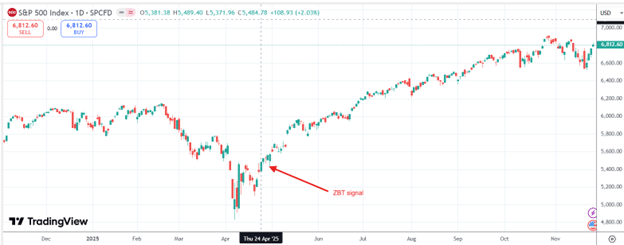
Let’s see how the S&P 500 (SPX) responded to this signal:
The market went on a bullish run after that signal.
How often does the Zweig Breadth Thrust Signal occur?
The signals are relatively rare.
The previous signal before the above example was eight months prior on August 19, 2024:
Q: How accurate is the ZBT signal?
Historical win rate is approximately 80-85%, with the S&P 500 averaging 20%+ gains over 6-12 months following a signal. However, reliability may have decreased in modern markets due to algorithmic trading and a changed market structure. The signal was developed in the 1970s, so some debate exists about its current effectiveness. Tom McClellan’s research provides detailed historical evidence.
Q: Can I use this signal for day trading or swing trading?
No. The ZBT signal identifies the beginning of sustained rallies lasting months, not short-term moves. Using it for day trading or even weekly swing trades misses the point entirely. Think of it as a strategic positioning signal, not a tactical entry trigger. Plan to hold positions for a minimum of 3-6 months.
Q: What other indicators should I combine with ZBT?
The ZBT works best when combined with:
(1) Volume confirmation – ensure volume is expanding,
(2) VIX behavior – ideally, VIX should be declining as ZBT triggers,
(3) Trend indicators – moving averages turning up, (4) Sentiment measures – extreme bearish sentiment reversing. No single indicator should be used alone.
Q: Does the signal work for individual stocks or just indices?
The ZBT is specifically a market-breadth signal using NYSE advance/decline data, so it applies to the broad market (indices). However, when the signal triggers, individual stocks within the market often participate in the rally. Focus on broad index exposure when trading the signal itself, but individual quality stocks can be good plays as follow-through trades.
Q: What if the signal triggers, but the market immediately drops 5%?
This would be an invalidation. If the market drops significantly (5%+) within 1-2 weeks of a ZBT signal, consider it a failed signal. Close positions and reassess. Failed signals are rare but do happen, especially during systemic crises. Always use stop losses even with high-probability setups.
Q: Is this better than other market breadth indicators?
The ZBT is more selective and less common than indicators such as the McClellan Oscillator or the advance-decline line. It’s not “better” but rather complementary. Use ZBT for major strategic shifts (when to go from defensive to aggressive), and use other breadth indicators for tactical day-to-day assessment. The rarity of ZBT signals makes them special when they occur.
This is difficult to say, given the low frequency of occurrence.
The signal was developed in the 1970s, which is quite a long time ago so that market dynamics may have changed since then.
So the signal’s reliability is up for debate.
But you can review Tom McClellan’s article, which provides additional historical evidence on when the ZBT triggered.
The Zweig Breadth Thrust Signal reflects a sudden surge of broad-based buying.
It seems to occur when buying pressure returns to the market after a period of weakness.
When this rapid momentum shift occurs, it has the potential to mark the beginning of significant market uptrends.
Of course, no single indicator or signal is reliable in every market environment, and the Zweig Breadth Thrust is no exception.
It’s best used as one piece of a broader analysis rather than a stand-alone decision tool.
Pairing it with other sentiment measures, trend indicators, or market factors can help confirm whether the broader market truly supports the signal and provide a more balanced perspective.
Understanding market signals like the Zweig Breadth Thrust helps you time your options strategies more effectively.
If you want systematic approaches to combining technical analysis with options income strategies:
Options Income Mastery: Learn how to use market indicators to improve timing on credit spreads, put selling, and income strategies ($397)
The Accelerator Program>: Advanced training covering market analysis, timing strategies, and portfolio-level management ($997)
We hope you enjoyed this article on the Zweig breadth thrust signal.
If you have any questions, please send an email or leave a comment below.
Trade safe!
Disclaimer: The information above is for educational purposes only and should not be treated as investment advice. The strategy presented would not be suitable for investors who are not familiar with exchange traded options. Any readers interested in this strategy should do their own research and seek advice from a licensed financial adviser.

Source link