Comparison Of Single Versus Double Diagonals
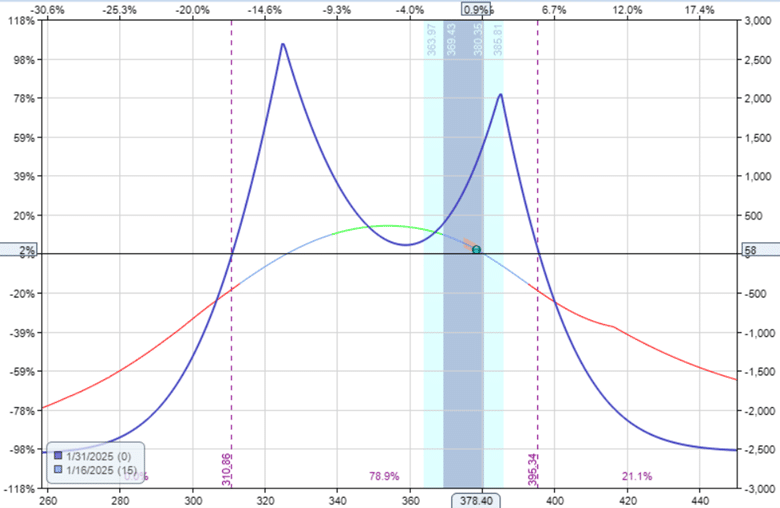
Pre-earnings diagonal spreads offer a unique opportunity: profit from rising implied volatility and time decay while avoiding the actual earnings announcement.
But should you trade single diagonals or double diagonals?
The answer isn’t straightforward.
Single diagonals give you directional exposure with limited risk on one side.
Double diagonals maximize theta decay but expose you to risk in both directions.
The wrong choice can mean the difference between a 9% gain and a 42% loss – as you’ll see in the real examples below.
In this guide, I’ll show you exactly when to use each strategy, with actual trades in AMZN, CVS, and CAT that show both winners and losers.
Contents
Single Diagonal Spread: A single diagonal consists of two options (either both calls or both puts) at different strike prices and different expiration dates. You sell a near-term option and buy a longer-term option at a different strike.
Double Diagonal Spread: A double diagonal combines two single diagonals – one using calls and one using puts. Think of it as an iron condor, with the long options pushed out to a later expiration date.
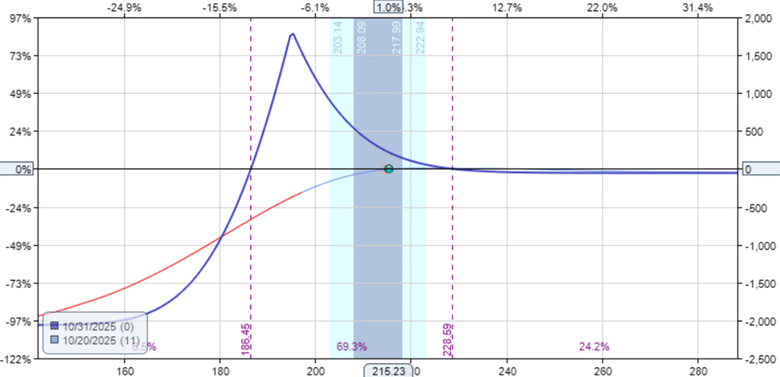
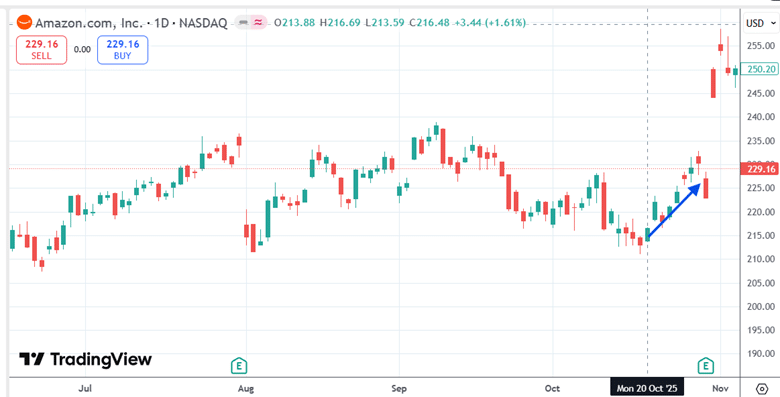
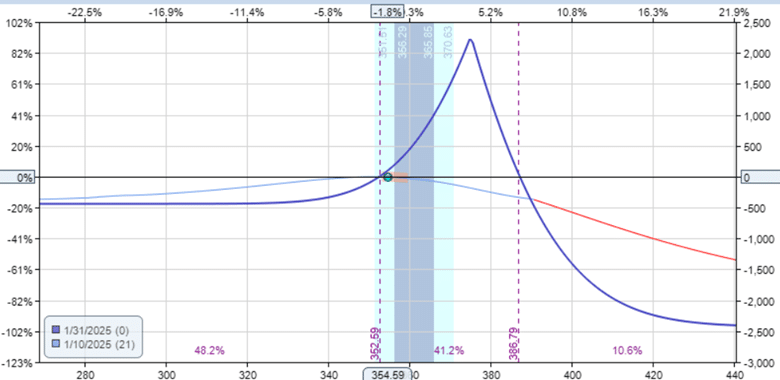
Amazon reports earnings after the close of the session on Oct 30.
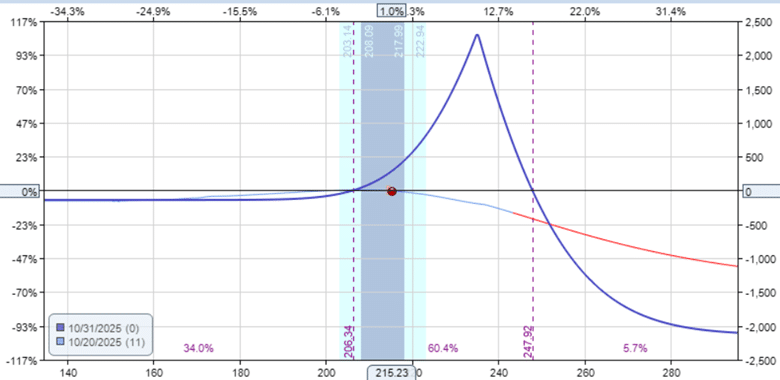
We sell some put options expiring right after earnings.
And we buy some put options expiring two weeks after the short options’ expiration.
Date: Oct 20, 2025
Price AMZN @ $215.23
Buy four contracts Nov 14 AMZN 190 put
Sell four contracts, Oct 31 AMZN 195 put.
Net Debit: -$54
Max risk: $2054
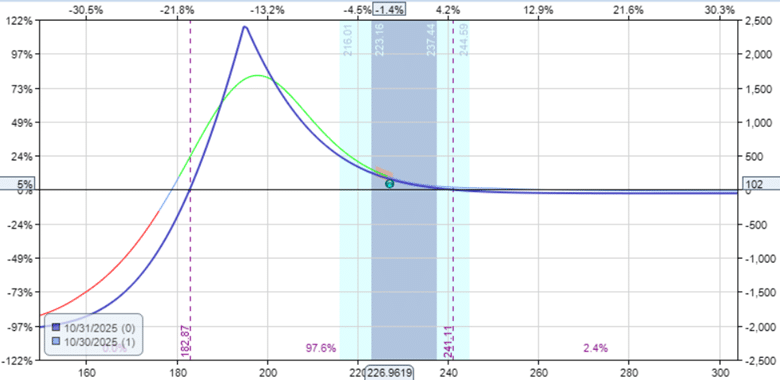
Because this is a pre-earnings trade, we exit on October 30, before the earnings release, to avoid the unpredictable move.
Pretty good.
A profit of $102, or 5% return on capital at risk.
The capital at risk in this trade is $2054, as calculated by the model and can be seen on the graph.
And best of all, the trader experienced no drawdowns during the trade.
Why not make a good thing better by adding call diagonals on the other side to double our theta?
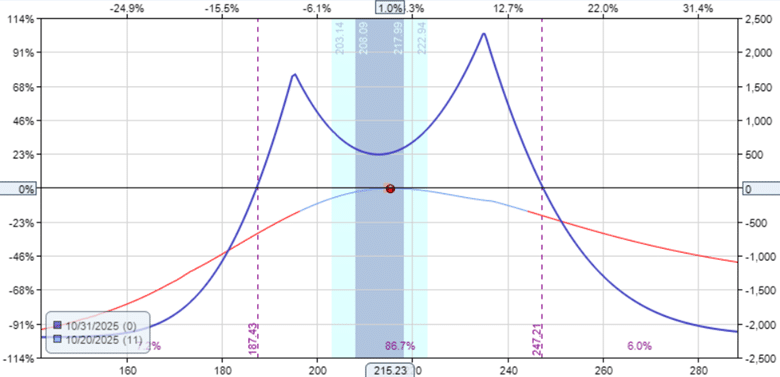
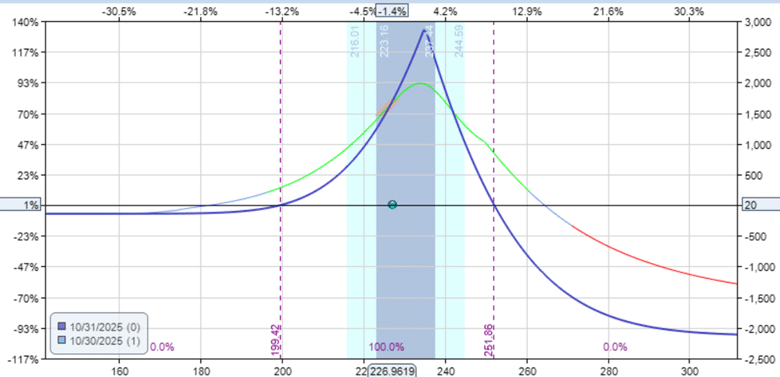
This is the double diagonal.
Date: Oct 20, 2025
Price AMZN @ $215.23
Buy four contracts Nov 14 AMZN 190 put
Sell four contracts, Oct 31 AMZN 195 put
Sell four contracts Oct 31 AMZN 235 call
Buy four contract Nov 14 AMZN 240 call.
Net Debit: -$194
Max risk: $2194
Note that adding diagonals on the other side hardly increases the maximum risk.
The maximum risk is just slightly over $2000, as shown in the graph.
This is because if you are going to take the maximum risk, it will be the maximum risk on one side.
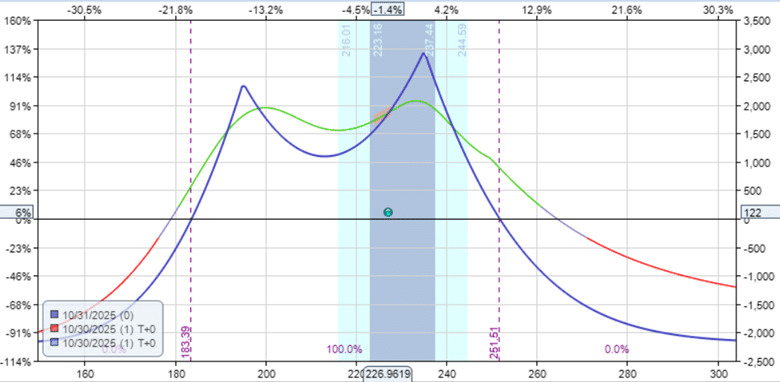
Exiting at the same time as before on October 30, we get a similar profit of $122, a 5.5% return on risk.
Adding the diagonals on the other side does not necessarily double our profits.
This is because if the price of the underlying asset trends a lot, one of the diagonals will start taking losses.
One could argue that the single diagonal performed so well only because the price moved in its favored direction…
So let’s try the single diagonal on the call side…
Exiting on October 30, with one day left until expiration, results in a break-even trade that makes no money.
So picking the correct side for the single diagonal does matter.
Also, popular sought-after stocks tend to run up into earnings.
So be careful of using call diagonals unless some technicals make it really compelling.
One myth is that if the price moves into the tent right underneath the short strike, the trade will make a lot of money.
We are one day before expiration, and the price is near the short strike, but the profit is still sitting near zero.
It’s not a bad tick.
It sat at zero profit at the beginning of the day (above picture), all the way to the end of the day (below picture).
Profit is not at the top of the tent.
That’s only in theory and only when perhaps in the last hours before expiration.
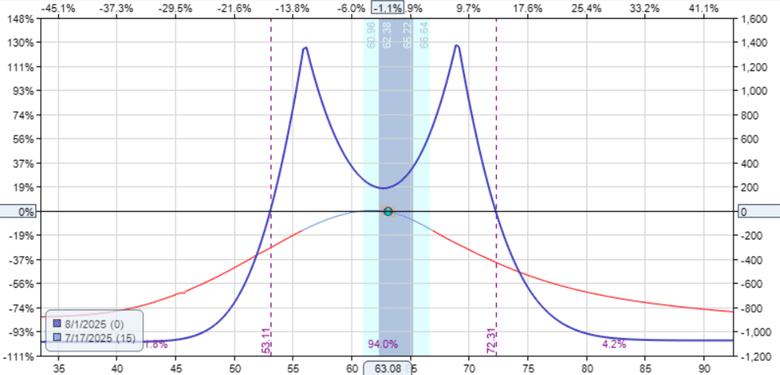
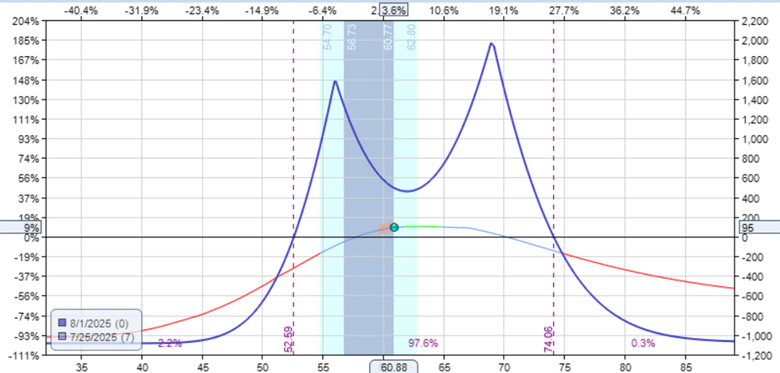
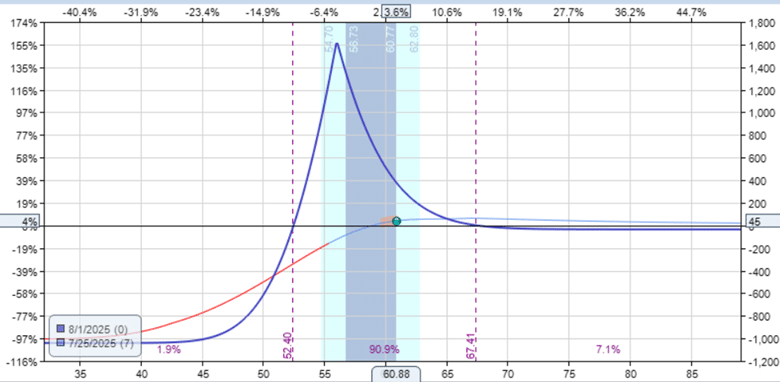
This example is of CVS on Jul 17, 2025, starting with a double diagonal…
Resulted in $95 of profit (or 9%) on July 25th…
The single diagonal would have made only half as much…
When the price of the underlying is well-behaved, the double diagonal can give double the profits with the same amount of risk.
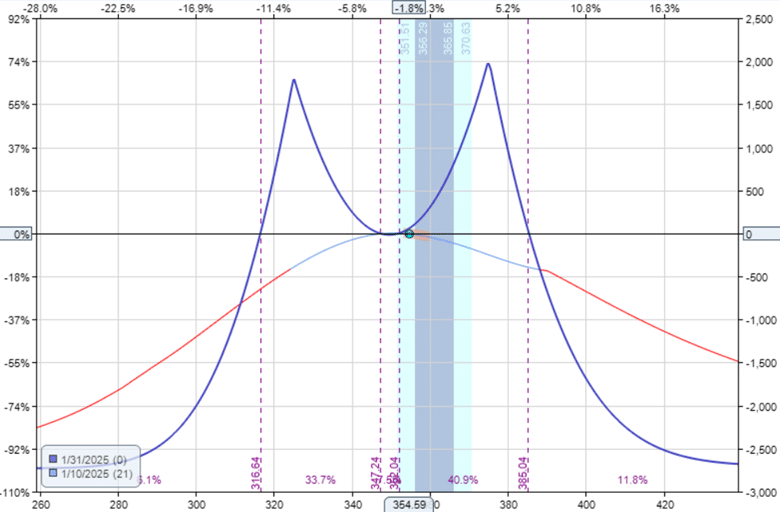
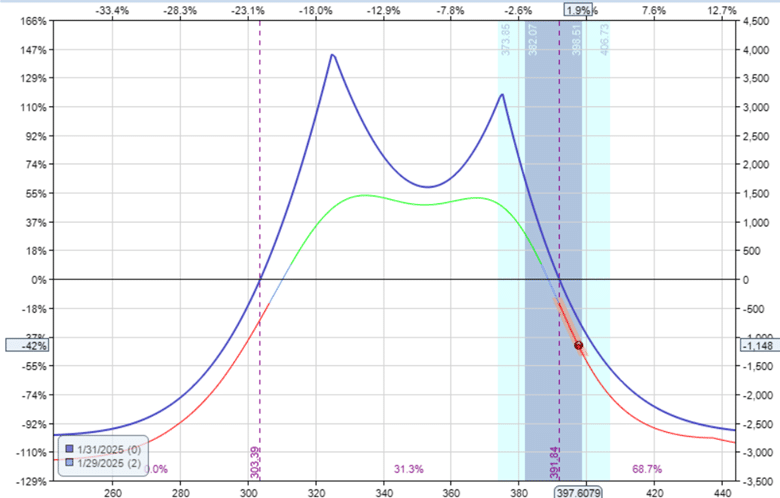
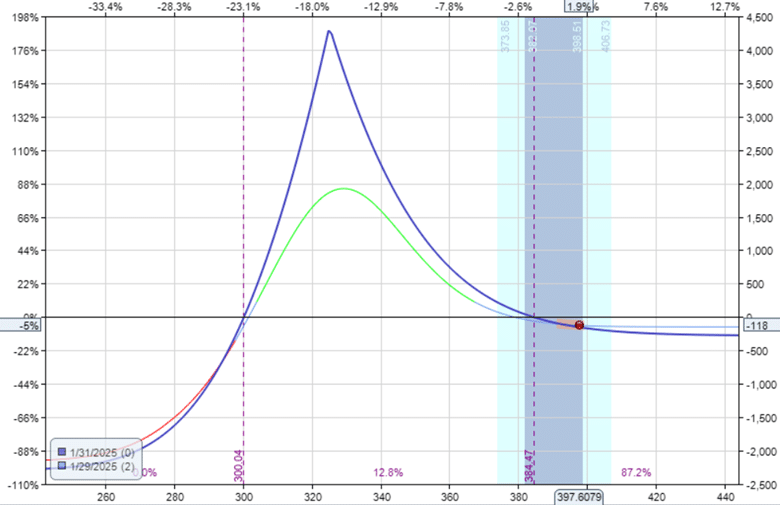
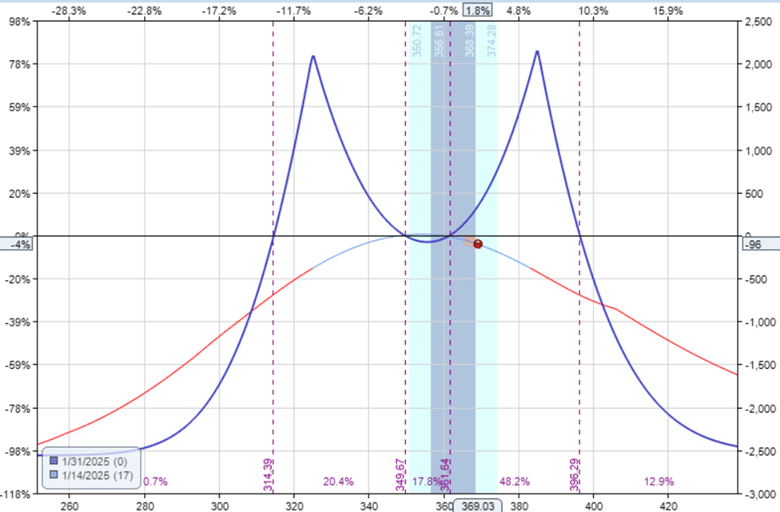
The below is a double diagonal on Caterpillar (CAT) starting Jan 10, 2025…
And exited on Jan 29, 2025, without doing anything…
Resulting in a loss of -$1148, or 42% loss on capital.
If the trader had selected a single call side diagonal…
It would have resulted in a similar fate with a loss of -$1030…
If, however, the trader had selected the single put side diagonal, the loss would have been limited to -$118.
The single diagonal limits the risk on one of its sides.
The double diagonal has risks on both sides.
When doing the single diagonal, picking the right side matters.
These are not set-and-forget trades.
Traders need to monitor the trade and do something before it’s too late.
Doing something can mean exiting the trade, or it can mean adjusting the trade.
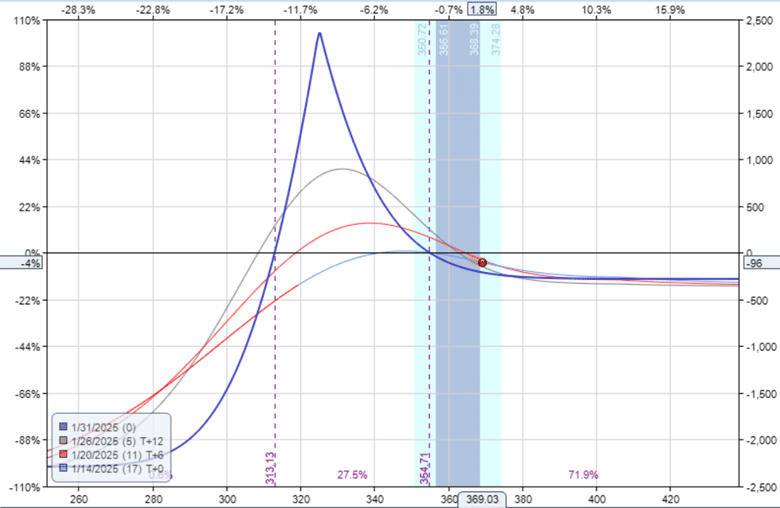
If the put diagonal trader had seen that the price of CAT is overshooting to the upside…
The trader can adjust the trade by adding an opposing diagonal on the other side, as here…
This boosts theta enough so that, two days later, the trade is back into profits and the trader can exit the trade profitably…
There’s no universally “better” strategy – it depends on your trading style and market outlook.
Choose Single Diagonals if you:
- Want simplicity and easier management
- Have a mild directional opinion
- Are working with limited capital
- Prefer focused positions over spreading risk
- Like positive vega exposure
Choose Double Diagonals if you:
- Expect range-bound movement
- Want to maximize income from time decay
- Can handle more complexity
- Need flexibility in adjusting Greeks
- Like neutral income strategies
In the examples, we saw that when working with the single-sided diagonal, picking the correct side does make a difference.
So, for the trader who can more consistently pick the right direction, they may prefer the single diagonal because it reduces the risk on one side.
Others may also prefer it because it has more adjustment options.
However, when the price stays within a narrow, non-trending range, the double diagonal can give double the profits with the same amount of risk.
Test out both ways and see which suits you.
Frequently Asked Questions
Q: How far in advance should I enter pre-earnings diagonals?
Enter 1-3 weeks before earnings for optimal IV expansion.
Entering too early (4+ weeks) means less IV benefit. Entering too late (less than 1 week) gives insufficient time for theta decay and IV to work in your favor.
Q: What’s the typical return on these trades?
Target 5-10% return on capital at risk.
Some trades will hit 15%+ when everything aligns. Others will lose 20-40% if the stock trends hard against you.
The key is consistent execution across many trades, not trying to hit home runs on individual positions.
Q: Can I hold through earnings for bigger gains?
Don’t do it.
The risk-reward doesn’t justify it. You’re effectively gambling on a binary outcome.
The entire strategy is designed around capturing IV expansion and theta decay while avoiding the actual earnings move.
Exit 1-2 days before earnings, always.
Q: Should I use weekly options or monthly options for the short leg?
Use the nearest expiration that’s right after the earnings date.
This is often a weekly option, but sometimes it’s a monthly option.
The key is having the short leg expire shortly after earnings, so you’re not holding overnight risk.
Q: How do I know which side to pick for single diagonals?
Use technical analysis: check whether the stock is at support or resistance, assess momentum, and review recent price action.
Generally, put diagonals are safer because stocks tend to run up into earnings.
Only use call diagonals if you have a strong conviction that the stock will drop or consolidate.
Q: What if IV doesn’t expand before earnings?
Sometimes IV stays flat or even contracts. If you’re 5-7 days from earnings and IV hasn’t budged, consider exiting early for a small loss rather than hoping it changes.
Not every earnings setup works – that’s why position sizing matters.
Pre-earnings diagonals are just one tool in a complete options trading arsenal. If you’re ready to learn systematic approaches to income generation:
Options Income Mastery: Learn proven strategies for consistent monthly income, including diagonals, credit spreads, and iron condors ($397)
The Accelerator Program: Advanced training covering earnings strategies, portfolio management, and systematic trading approaches ($997)
Related Articles
We hope you enjoyed this article comparing single- and double-diagonals before earnings.
If you have any questions, please send an email or leave a comment below.
Trade safe!
Disclaimer: The information above is for educational purposes only and should not be treated as investment advice. The strategy presented would not be suitable for investors who are not familiar with exchange traded options. Any readers interested in this strategy should do their own research and seek advice from a licensed financial adviser.

Source link