Shifting Expectations about What Central Banks Might Need to Do – Currency Thoughts
Shifting Expectations about What Central Banks Might Need to Do
March 3, 2026
All things considered, the reaction of financial markets yesterday to the quickly unfolding war in the Middle East was more muted than many had reason to expect. The media are having a hard time keeping up with the rapidly changing events, and a crisis-watcher is apt to be misled by anything but real-time breaking news. By design, this fast pace is an intentional logistical element of President Trump’s approach. Stepping back, here are some emerging takeaways:
Number one especially for financial market participants, the likeliest scenarios for what central banks will be doing with interest rates has become less clear. Governor Kocher of the Austrian National Bank, who is a member of the ECB Governing Council, put things succinctly overnight by asserting that ECB policymakers need to be prepared to move quickly in either direction to this new shock. Ever earlier, Governor Bullock of the Reserve Bank of Australia warned that an interest rate hike could be in play as soon as the upcoming scheduled RBA Board meeting on March 17. Bank of Japan Board member Himino yesterday expressed the view that geopolitical uncertainties mustn’t deter the gradual increases in that central bank’s interest rates that are being guided by price and wage trends as well as inflation expectations. Meanwhile, Fed officials have not commented publicly on the Middle Eastern developments. For some time Fed officials have been balancing the opposing signals of its twin policy mandates, and this latest crisis only magnifies that gap. War is apt to weaken growth but lift inflation. Money markets nevertheless have prioritized the inflation goal and are now discounting an unchanged fed funds target until end-summer, which would be later than before.
Number two, stock market participants in Asia and Europe did not find comfort in yesterday’s recovery of share prices after an initial drop at the open. Equities today fell 7.2% in South Korea, 3.1% in Japan, 2.2% in Taiwan, 1.4% in China, 1.3% in India and Malaysia, 1.1% in Hong Kong and 1.0% in Indonesia. Major markets in Europe are down already by 2.5% or more, and so is the Russell 2000 in futures trading. While he may change his message any moment as he is wont to do, President Trump has dissuaded the public and officials in other countries from thinking this new conflict with Iran will be short like the 12-day war last summer.
Number three and related to the first point, long-term interest rates have stayed on an upward course. The 10-year U.S. Treasury yield has jumped to 4.09% from 4.03% yesterday and 3.95% at Friday’s close. Other 10-year sovereign debt yields just today show double-digit basis point increases in the U.K. (+15), Italy (+13), France and Spain (each +10). Increases in Germany, Switzerland and Spain range from four to six basis points.
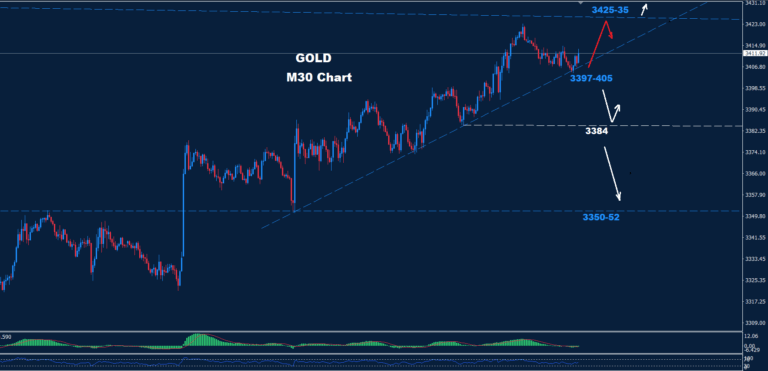
Number four, precious metal prices remain huge movers, but their path has been more two-sided than is the case with fixed income securities. Silver back-tracked over 7.0% so far today, and gold is 2.3% lower. Oil has also been very volatile. With the Strait of Hormuz closed, West Texas Intermediate has jumped over 6% to the mid-$70’s range. The price of Bitcoin is 2.5% lower today and, at around $67k almost half of its record value touched five months ago.
Number five, the United States economy is considered comparatively sheltered from the potential supply-chain disruption if the Middle East war persists more than a few weeks. That advantage, plus the dollar’s magnetic pull on funds seeking a safe haven, is enabling the dollar to recover some of the ground lost over the past year. The weighted dollar index is 0.9% higher today. The Swiss franc (-1.2%) has dropped even more steeply but paradoxically enhancing the likelihood of Swiss intervention to drive it even lower. The Swiss franc has been objectively one of the most overvalued currencies, and intervention can be especially effective when used at a time just after underlying market momentum has shifted in the direction that supports where officials want the exchange rate to go. One currency against which the dollar has ticked just 0.1% higher today is the Turkish lira, as Turkish central bank officials have sold quite a bit of U.S. currency this week.
Number six, there is reason beyond the latest developments in the Middle East to be more concerned about inflation around the world, and it comes from recent data that do not yet embody the fallout from the war. Most startling, the price sub-index in the U.S. manufacturing purchasing managers index compiled at the Institute of Supply Management shot up to 70.5, most since mid-2022 just a couple of months before the peak readings during the Biden era. President Trump has mischaracterized the state of U.S. inflation at the time of the power transfer to him from Biden some 14 months ago. His contrast of inflation under Biden and himself is looking less and less well-grounded after this ISM report.
Among price data reported today in other economies,
- Euroland consumer prices jumped 0.7% on month in February, the most in 25 months, and that raised year-on-year inflation to a 2-month high of 1.9% despite a 3.2% on-year drop in the energy component that is now outdated. In February, other CPI components posted month-on-month rises of 0.8% in the case of services and 0.7% in non-energy industrial goods.
- Year-on-year inflation rose to 1.1% in February from 0.4% in January in France, to 1.6% from 1.0% in Italy, 2.5% from 2.4% in Spain and 2.3% from 2.2% in the Netherlands. Only in Germany among Euroland’s largest economies did inflation ease.
- Turkish consumer price inflation in February of 31.53% was at a 4-month high, producer price inflation of 27.56% rose to a 2-month high.
- Romanian producer price inflation accelerated 1.8 percentage points to a 3-month high of 7.8% in January.
- Croatian consumer price inflation of 3.8% last month after 3.4% in January exceeded expectations, too.
- Austrian CPI inflation bounced off January’s 13-month low of 2.0% to 2.2% last month.
- Dutch CPI inflation in February matched January’s 2.4% reading but exceeded earlier lows of 1.6% at end-2023 and -0.4% two months before that.
Japan’s jobless rate unexpectedly rose to an 18-month high of 2.7% in January.
Australian building permits sank 7.2% on month and 15.7% on year in January.
Czech GDP growth last quarter has been revised a bit higher to 0.6% compared to the 3Q level and 2.6% year-on-year. Average growth in 2025 was 2.5%, almost double the rise in 2024.
In Hungary real GDP went up 0.2% last quarter and posted its biggest on-year increase (0.8%) in six quarters. Hungary has been another autocratically governed country that lately has struggled to achieve economic growth, which avearged just 0.4% in 2025 and 0.5% in the year before that.
Brazilian GDP effectively flat-lined in the second half of 2025, averaging a 1.8% rise compared to the second half of 2024.
British shop prices were just 1.1% above the year-earlier level in February.
Australia’s current account deficit in 2025 equaled $74 billion, or roughly 2.4% of GDP.
Turkey’s trade deficit in January-February combined totaled $17.6 billion, 15% wider than in the first two months of 2025.
Purchasing manager surveys for February reported today include South Korea’s manufacturing index (a 2-month low of 51.1) and non-oil PMI scores for Egypt (an 5-month low of 48.9) and Saudi Arabia (a 9-month low of 56.1).
An improvement last month in how consumer perceive the U.S. 6-month-ahead economic outlook was relinquished almost entirely in the early March reading of 47.5 in the RCM/TIPP optimism index. This was the seventh consecutive sub-50 reading.
Copyright 2026, Larry Greenberg. All rights reserved.
Tags: Euroland CPI, middle east war and financial markets response


 ShareThis
You can leave a response, or trackback from your own site.