From Rust to Renaissance: Can Victoria Reclaim Its Industrial Crown? – Fat Tail Daily
I’m putting on my futurist’s cap today, proposing a very left-field idea that’s not being discussed at all…
Right now, the global focus is on commodities: copper, energy, and critical minerals. The basic building blocks that sustain modern industry.
And that capex cycle is still in its infancy; capital is only just starting to shift back into the mining and energy sector after years of neglect.
But all trends come to an end, and that means one day, commodities too, will reach a point where supply easily meets demand.
And with commodity price deflation.
This cycle constantly shifts between scarcity to abundance, driven by investment in new production.
As I said, this is not imminent; we’re still in the early stages of the mining sector’s capex cycle.
But what happens when it matures?
I’ve highlighted in the past that major events (like the war in Iran) can start, or at least fast-track, new trends in the global economy.
One of those could be major re-industrialisation efforts across the West.
That may sound like a very Trumpish idea, but there are already tangible signs that manufacturing is returning to the West.
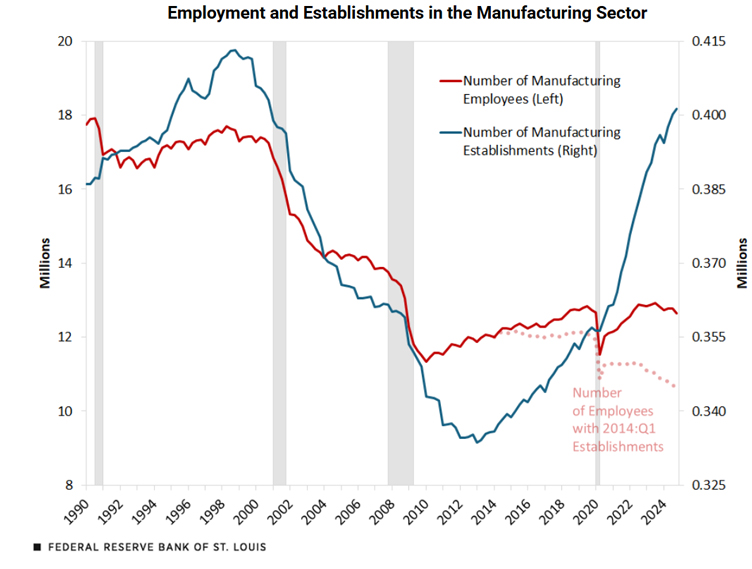
Here’s an interesting graphic highlighting the recent surge in the number of ‘manufacturing establishments’ being built across the US (blue line):
Source: Federal Reserve Bank of St Louis
[Click to open in a new window]
Manufacturing establishments refer to the number of physical hubs being built; think factories and mills, but also their modern counterparts, data centres.
As you can see, the build-out of these hubs has surged to levels not seen since the late 1990s, or pre-China industrialisation.
As global supply chains fragment, the trend towards self-sufficiency could become the most important factor for investors to watch.
As I said, the main focus right now is centred around commodities, the raw materials that enable these sites to get built.
But over time, with adequate investment and abundant supply, building new hubs across the West becomes even more feasible and the products they produce become more economically viable.
As raw materials become more accessible and cheaper, manufacturers’ margins will improve.
So, what does that mean for Australia?
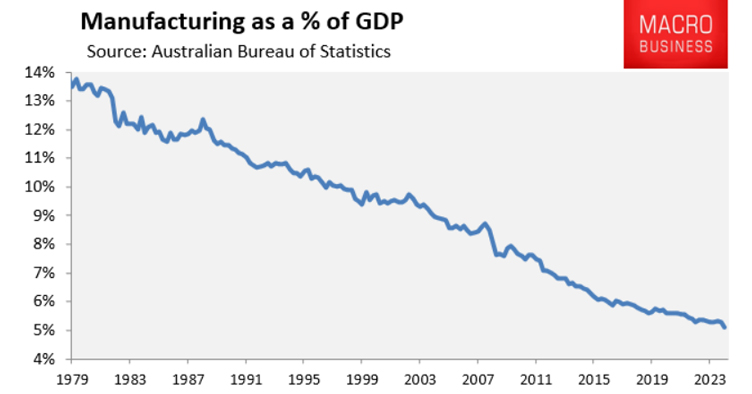
As you can see, Australia’s manufacturing industry has been in a dismal decline, falling to just 5% of the economy in 2024.
That’s down from around 14% in the late 1970s:
Source: ABS/Macro Business
[Click to open in a new window]
Australia has forgotten how to build stuff.
But as bad as this trend looks, it is reversible.
The dramatic geopolitical events taking place today could become the catalyst for a rebirth of industrialisation in Australia.
And the regions that could benefit the most might be those that have performed the worst.
Victoria: A return from the Ashes
Victoria hasn’t been a star performer in recent Australian history.
Pandemic spending, lavish infrastructure projects, and a state government that’s been on a drunken spending bender for the better part of half a decade.
As a consequence, its racked up the highest debt in Australia… This is projected to rise above $194 billion by 2025/26.
But despite the state’s economy being run into the ground in recent years, the Greater Southeast Melbourne region has emerged as Australia’s largest and most important manufacturing hub.
It generates the highest output, with 3,800-plus businesses employing over 75,000 people, representing a massive slice of the national manufacturing sector.
If we are going to see re-industrialisation in this country, then Victoria could emerge as one of the key winners.
Where the boom shifts from resource-driven states like Western Australia, Queensland and South Australia to the manufacturing heartland of the country.
Re-industrialisation could be the trigger that turns the tide on Victoria’s lacklustre economy.
It’s a long-term theme that I’ve had in the back of my mind for quite some time, and it might be worth watching in the years ahead.
We’re not there yet, but events like we’re seeing in Iran and the breakdown of global supply chains could spark this important shift.
The re-industrialisation of the West.
I’ll have more to say about that over the coming months.
Until next time.
Source link