VYM vs DGRO: Which High Dividend ETF Is Better?

Contents
At the time of this writing, high dividend yield stocks are in favor.
To see if that’s still the case when you read this, we can take a look at two dividend-based ETFs – the VYM and DGRO.
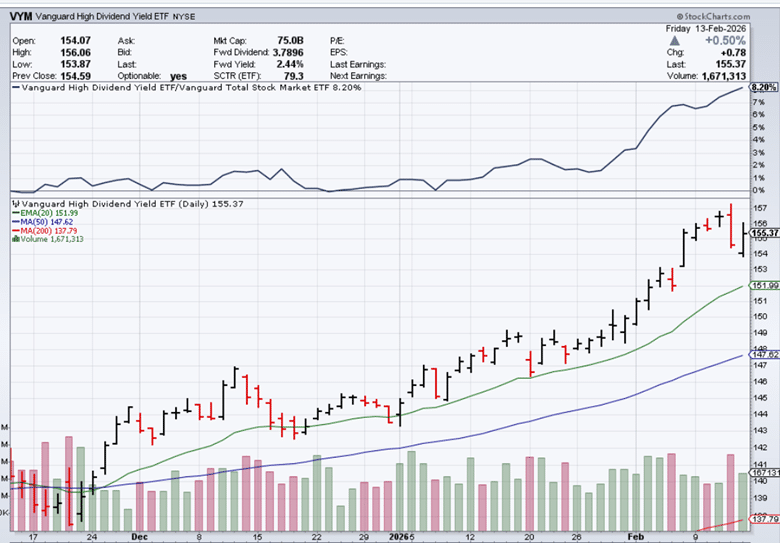
We see that VYM is outperforming the Vanguard Total Stock Market ETF, as its relative strength line is above zero and rising (see the top panel of the screenshot below).
In the bar chart, we also see a bullish characteristic: the price bars are stacked above the 20- and 50-day moving averages.
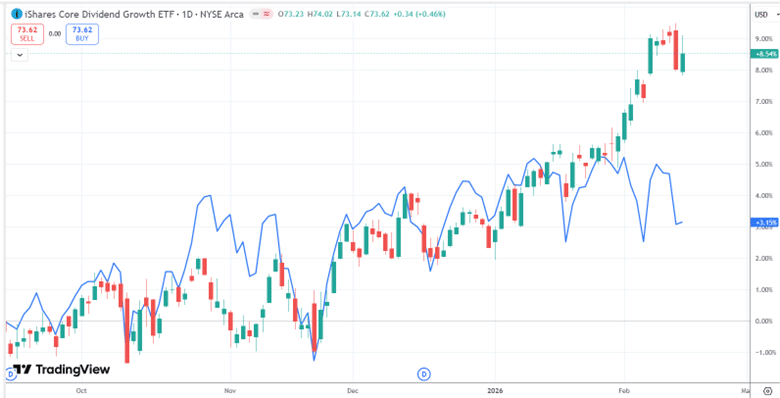
Using a different method, we can overlay the DGRO graph on the SPY (S&P 500 ETF) and see that it outperforms the S&P 500.
The candlesticks, which have returned 8.5% over the past 5 months, represent DGRO’s price appreciation.
The blue line graph represents the S&P 500.
Now let’s talk about what these two VYM and DGRO ETFs are all about.
The symbol VYM is the Vanguard High Dividend Yield Index Fund ETF.
You buy and sell it like a stock, even though it is an Exchange Traded Fund (ETF).
While it does offer options, the liquidity in those options is not as good as we would generally like.
The VYM is designed to track the FTSE High Dividend Yield Index, which measures the performance of a group of large and mid-cap U.S. companies that pay higher-than-average dividends.
As is typical of these indices, they exclude REITs because of their different tax and accounting structures, which may distort yields.
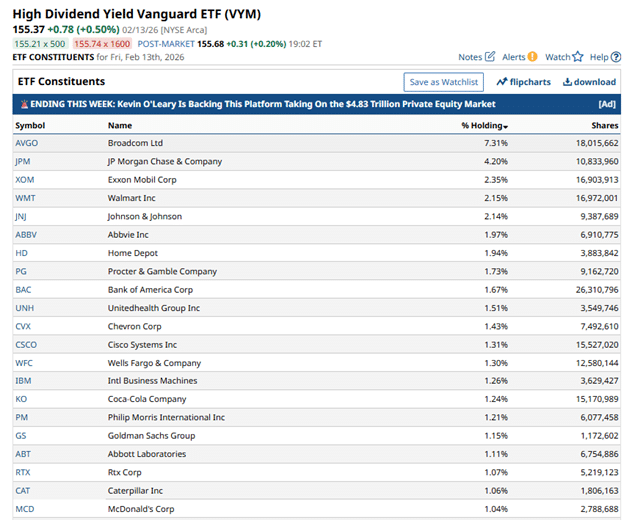
Inside the VYM fund are about 569 stocks, which we can see under the “constituents” in barchart.com.
Sorted by % holding, the fund currently holds Broadcom (AVGO) as its largest holding at 7%.
Broadcom currently has an annual dividend yield of 0.8%.
While this holding does not have an impressive dividend yield, many Dividend Aristocrat companies are on the list.
These are companies that have increased their dividends for at least 25 consecutive years.
Below are just some of these aristocrats that are held in the VYM fund, along with their dividend annual yield:
Exxon (XOM): 2.75%
Johnson & Johnson (JNJ): 2.13%
Procter & Gamble Co. (PG): 2.62%
PepsiCo, Inc. (PEP): 3.4%
Coca-Cola Co. (KO): 2.58%
McDonald’s (MCD): 2.24%
Chevron Corp. (CVX): 3.75%
NextEra Energy (NEE): 2.46%
Smith AO Corp (AOS): 1.81%
Colgate-Palmolive (CL): 2.16%
The Clorox (CLX): 3.98%
Sysco (SYY): 2.4%
These individual names have more options liquidity than the VYM ETF.
So, for investors who want to sell call options or buy put options in addition to buying the stock, they may want to look at these.
These also may be good candidates for the Wheel strategy.
Keep in mind that buying the options does not entitle you to the dividend.
You need to buy the actual stock before the ex-dividend date.
That is because you need to buy the stock and wait two days for the transaction to settle so that the stock ownership is recorded on the record date.
The record date is typically one day after the ex-dividend date for most U.S. equities.
DGRO is the iShares Core Dividend Growth ETF.
It invests in U.S. companies with a consistent history of dividend growth.
In particular, companies with 5+ years of consecutive dividend increases.
It focuses more on dividend growth rather than just high yields.
Hence, the companies it holds may have lower current yields than those in VYM.
But the companies it holds are more growth-oriented, such as in the technology and healthcare sectors.
Currently, DGRO has an annual dividend yield of 2%, which you can find on barchart.com.
Or you can roughly calculate it yourself as follows.
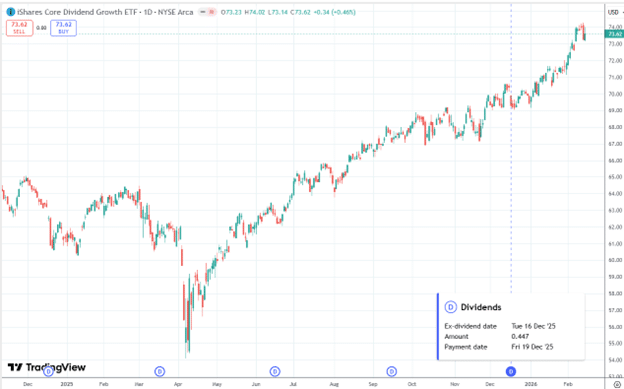
We see that DGRO pays four times a year, with about $0.447 per share each time.
With the DGRO asset price at $73.62 per share, that’s about…
($0.447 x 4) / $73.62 = 2.4% yield per year
This is a close enough approximation because the asset’s price changes from day to day, and the dividend can change quarter to quarter.
For comparison, VYM has an annual dividend yield of 2.25%, which is roughly similar.
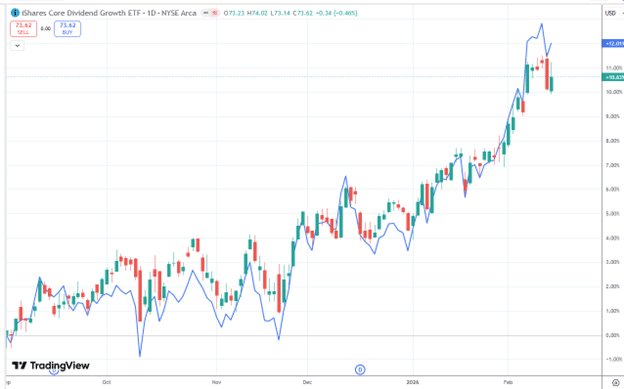
In terms of ETF price appreciation, they are also about the same…
With the candlesticks representing DGRO and the blue line representing VYM, one could argue that VYM has slightly better price appreciation than DGRO, but not by any significant amount.
In short, DGRO prioritizes growing income and long-term compounding, while VYM prioritizes higher current income.
Short-term investors may be more interested in VYM, while DGRO is for longer-term holding.
We hope you enjoyed this article on two high-dividend ETFs.
If you have any questions, please send an email or leave a comment below.
Trade safe!
Disclaimer: The information above is for educational purposes only and should not be treated as investment advice. The strategy presented would not be suitable for investors who are not familiar with exchange traded options. Any readers interested in this strategy should do their own research and seek advice from a licensed financial adviser.

Source link