Why Trading Software Needs More Transparent Testing in 2026
Trading software has become one of the most aggressively marketed categories in finance. Every platform claims to be faster, smarter, deeper, more automated, or more professional than the rest. Some push AI. Others emphasize speed, backtesting, or broker connectivity. Many highlight huge feature lists. But for traders trying to choose the right platform, that creates a serious problem: the market is full of claims, yet genuinely transparent, repeatable testing is still rare.
That is the gap Liberated Stock Trader’s 2026 Trading Tool Benchmarks methodology is designed to address.
Instead of treating trading software like a lifestyle product, the benchmarks treat it like a system that should be tested. The framework applies 58 tests across 17 categories and interprets the results against a broader benchmark dataset of 35+ audited tools. The goal is not just to rank software, but to help traders see where a platform is genuinely strong, where it is average, and where it falls short.
The real problem with trading software reviews
Most software reviews still rely too heavily on impressions.
A reviewer opens the platform, comments on the design, lists the features, praises the interface, and maybe compares pricing. That can be useful at a basic level, but it often misses what matters most in real-world use. How fast is the workflow? How deep is the charting engine? How flexible is the scanner? Is the backtesting actually usable? Do alerts arrive quickly? Is the platform operationally reliable? Does the broker ecosystem create real execution flexibility, or just look good in marketing copy?
These are not small details. For an active trader or serious investor, they are often the difference between a tool that improves performance and one that creates friction.
That is why a benchmark framework matters. It shifts the conversation away from vague opinion and toward measurable performance.
Why feature lists are no longer enough
Modern trading platforms are no longer simple charting tools. Many now try to be all-in-one ecosystems. They combine charting, screening, backtesting, alerts, portfolio analysis, automation, community features, broker execution, and AI-driven tools in a single subscription.
That makes the buying decision more difficult, not easier.
A platform may look impressive because it offers many features, but that does not tell you whether those features are fast, reliable, well-integrated, or genuinely useful. Some tools are deep but slow. Some are fast but narrow. Some are excellent for chart traders but weak for portfolio investors. Others look innovative but lack operational maturity.
In other words, more features do not automatically mean better software.
The benchmark framework is built around that reality. It is designed to separate software quality from software marketing.
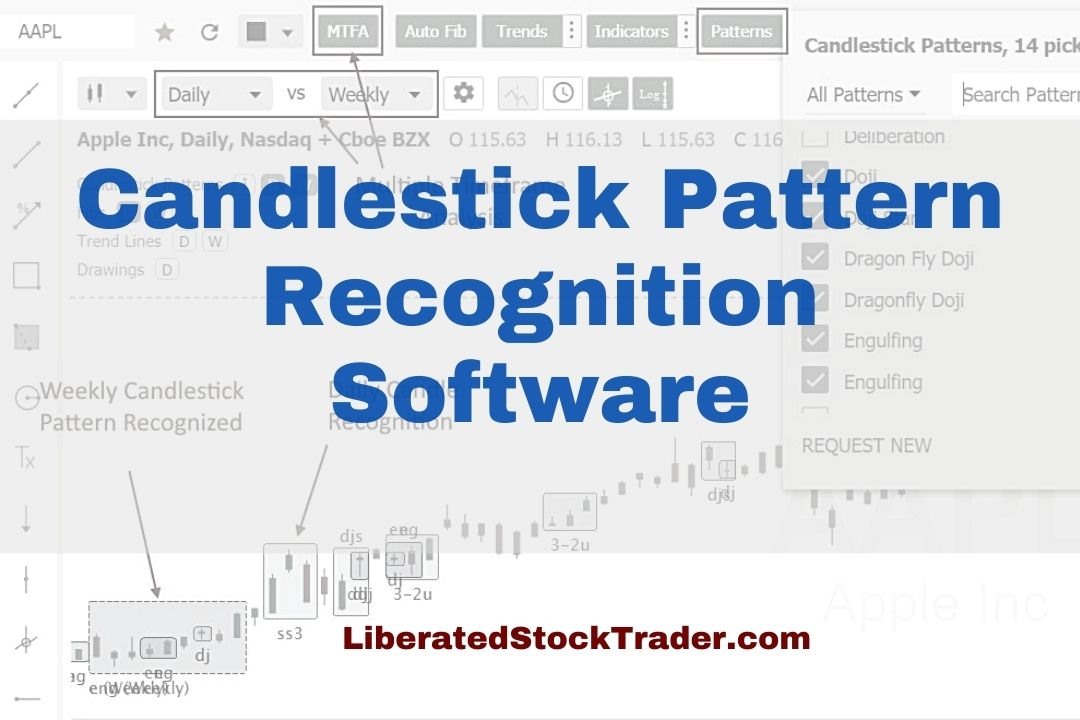
Test Result Examples
What the benchmark framework actually measures
Liberated Stock Trader’s methodology evaluates trading platforms across 17 categories, covering far more than surface-level usability. The framework includes:
- Pricing and value
- Workflow speed and ease of use
- Chart analysis depth
- Pattern recognition
- Scanning performance
- Backtesting capability
- Trading bot and auto-trading reliability
- AI and algorithmic capability
- Alerts
- Trade signal quality
- Broker connectivity
- Portfolio tools
- Financial news
- Community utility
- Support infrastructure
This category-based structure is important because it reflects how traders actually work. No single score can fully explain a platform. A trader who depends on real-time alerts has different needs than someone focused on long-term portfolio analysis. A systematic trader will prioritize scanning, automation, and backtesting differently than a discretionary chart trader.
By breaking performance into audited categories, the methodology makes those differences easier to see.
Why benchmarking matters more than isolated scoring
A score on its own does not mean much.
A platform could receive a 4.2 out of 5.0 and sound strong, but unless readers know how that compares with the rest of the market, the number lacks context. Is 4.2 close to elite performance? Is it only slightly above average? Is it strong in one category but mediocre in another?
That is where the broader benchmark set becomes useful.
Liberated Stock Trader interprets results against the observed high, median, and low performance levels across its audited dataset. This turns a score into something more meaningful. Readers can see whether a platform is near the top of the market, around the middle, or closer to the floor.
That context is one of the strongest parts of the framework. It does not just assign numbers. It creates perspective.
| Score | Tier | Tool Verdict | Feature Verdict |
|---|---|---|---|
| 4.7-5.0 | AAA | Institutional; elite superpowers. | Flawless; industry-leading. |
| 4.3-4.6 | AA | Advanced Pro; high-performance. | Robust; professional grade. |
| 4.0-4.2 | A | Reliable; professional standard. | Functional; core utility. |
| 3.0-3.9 | B | Retail Grade; notable gaps. | Basic; limited depth. |
| 0.0-2.9 | C | Sub-Standard; poor value. | Deficient; critical flaws. |
The value of the AAA-to-C grading model
To make results easier to interpret, the methodology maps its 0.00 to 5.00 scoring system into technical grades from AAA to C.
This is a smart editorial decision because it translates a technical framework into something readers can understand quickly. A platform in the AAA range signals elite, top-tier performance. A lower grade signals more visible limitations or trade-offs. The approach is familiar, but still grounded in measurable testing.
More importantly, it prevents the common review mistake of treating all “good” tools as basically equal. They are not equal. Some are clearly better built, faster, deeper, or more robust than others. A grading model helps show that at a glance.
Hardware transparency is a major strength.
One of the more credible parts of the methodology is its hardware disclosure.
Liberated Stock Trader publishes the system used for benchmarking, including an AMD Ryzen 9 7900X3D, 32GB DDR5 RAM, NVIDIA RTX 4080 Super, Windows 11 Pro, and dual 34-inch ultrawide displays. That matters more than many casual reviews admit.
Software speed testing is only useful when readers understand the environment in which the tests were performed. If a platform appears slow, is that because the tool itself is poorly optimized, or because the reviewer ran it on weak hardware? If a multi-chart workflow feels smooth, is that due to the platform architecture or the display setup?
By disclosing the test rig, the benchmark improves transparency and gives readers a cleaner way to interpret the results. It is not a perfect laboratory environment in the scientific sense, but it is far more rigorous than the usual “I tried this platform and here’s what I thought.”
Why this matters now
This story is especially relevant in 2026 because the trading software market is becoming more crowded and more competitive.
Platforms are increasingly fighting on the same fronts: AI-driven tools, automation, deeper charting, faster scanning, cross-device support, richer alerts, broker integrations, and broader all-in-one functionality. As that competition intensifies, marketing claims naturally become louder.
But that also makes independent verification more important.
Traders do not just need to know what a company says its platform can do. They need to know how it performs under consistent testing, how it compares with the wider market, and what trade-offs come with each product. In that sense, the benchmark is not just a review method. It is a response to a market environment where software promotion has outpaced software accountability.
A better question than “Which platform is best?”
One of the most useful ideas behind this framework is that it pushes readers toward a better question.
Instead of asking, “Which platform is the best?” the benchmark encourages a more practical question: Which platform is best for a specific workflow, based on measurable evidence?
That is a much stronger way to evaluate software.
No platform is perfect for every trader. Some are built for chart-focused traders. Others are stronger in research, portfolio analysis, or automation. Some offer excellent value. Others justify a higher cost through deeper capability. A proper benchmark does not erase those differences. It makes them visible.
That is what this methodology does well.
The bigger takeaway
The most important contribution of the 2026 Trading Tool Benchmarks framework is not simply that it tests a lot of software. It argues for a different standard for evaluating trading software.
The market already has plenty of platforms. It already has plenty of claims. What it needs more of is disciplined comparison built on repeatable testing, transparent scoring, and meaningful context.
For traders, that is valuable because choosing the wrong platform is not just an inconvenience. It can cost time, create workflow friction, weaken execution, and limit strategy development. In a category this important, hype should not be enough.
A benchmark framework cannot eliminate every judgment call, but it can make the decision process more rational.
And in a market crowded with promises, that may be exactly what traders need most.