Interactive Graham Number Calculator for Value Investors
The Graham Number is one of the best-known conservative valuation formulas in value investing.
It was designed to help investors estimate a reasonable upper limit on a stock’s price based on two core fundamentals: earnings and book value. Instead of relying on hype, momentum, or market opinion, the Graham Number focuses on whether a company’s price is supported by profitability and balance-sheet value.
This makes it especially useful for investors who want a quick way to screen for potentially undervalued stocks. It is not a complete valuation model, and it does not replace deeper research, but it can be a very practical first filter.
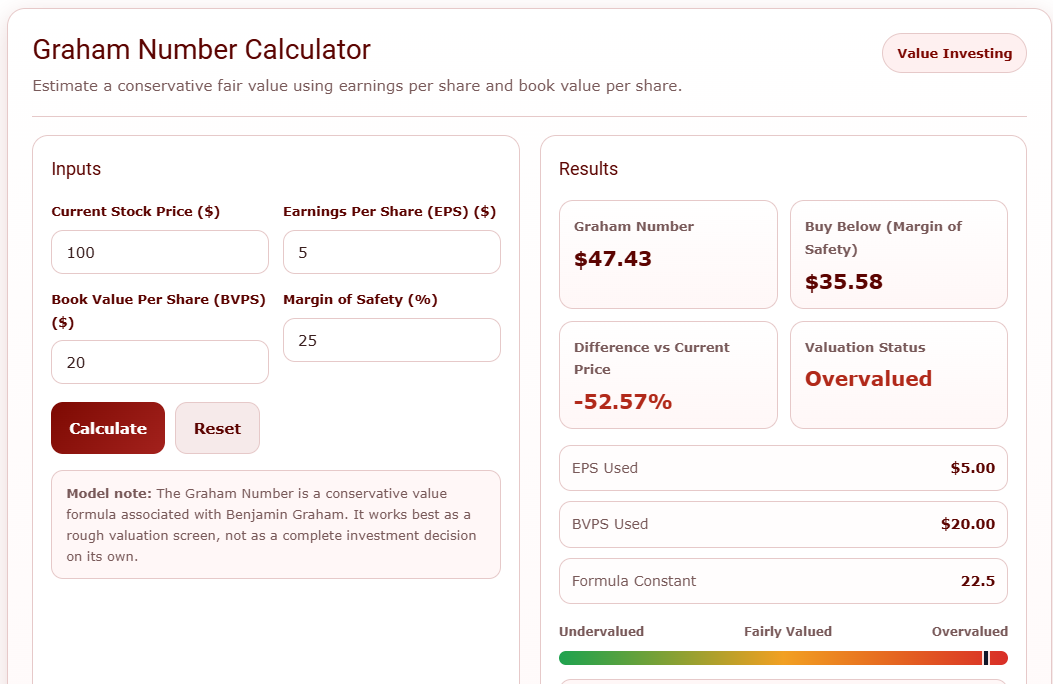
Our calculator helps you estimate the Graham Number, compare it to the current stock price, and apply a margin of safety to judge whether a stock is undervalued, fairly valued, or overvalued under a conservative framework.
Inputs
Model note: The Graham Number is a conservative value formula associated with Benjamin Graham. It works best as a rough valuation screen, not as a complete investment decision on its own.
Results
Graham Number
$0.00
Buy Below (Margin of Safety)
$0.00
Difference vs Current Price
0.00%
Valuation Status
—
EPS Used$0.00
BVPS Used$0.00
Formula Constant22.5
Undervalued
Fairly Valued
Overvalued
Formula Used
Graham Number = √(22.5 × EPS × Book Value Per Share)
Buy Below Price = Graham Number × (1 – Margin of Safety)
This calculator is for educational purposes only. The Graham Number is a simplified valuation screen and should be used alongside business quality, debt, growth stability, and profitability analysis.
How to Use the Calculator
Start by entering the current stock price. This allows the calculator to compare the market price with the Graham Number estimate.
Next, enter the company’s earnings per share, or EPS. This should usually be the most recent trailing twelve-month EPS to get a current valuation estimate.
Then enter the book value per share, or BVPS. This represents the accounting value of the company’s net assets on a per-share basis.
Finally, enter your desired margin-of-safety percentage. This gives you a more conservative buy-below price in case your assumptions are imperfect or the business faces unexpected pressure.
Once those values are entered, the calculator will show:
- The Graham Number
- the margin-of-safety buy price
- The difference between the Graham Number and the current stock price
- a simple valuation status
The best way to use the calculator is as an initial value screen. If a stock looks attractive here, the next step is to review debt, profitability, growth stability, and business quality before making an investment decision.
Formula Explanation
The Graham Number uses a simple formula:
Graham Number = √(22.5 × EPS × Book Value Per Share)
The constant 22.5 comes from Benjamin Graham’s traditional guidelines of:
- a price-to-earnings ratio of no more than 15
- a price-to-book ratio of no more than 1.5
Multiplying 15 by 1.5 gives 22.5.
The formula combines profitability, measured by EPS, with asset backing, measured by book value per share. It is designed to estimate a conservative fair value level for a stock rather than an aggressive growth-based target.
The calculator also applies a margin of safety:
Buy Below Price = Graham Number × (1 – Margin of Safety)
For example, if the Graham Number is $50 and you want a 25% margin of safety, your buy-below price would be $37.50.
This means the Graham Number gives you a fair-value estimate, while the margin of safety helps you set a more disciplined entry price.
Worked Example
Assume a stock has:
- current price: $40
- EPS: $3.00
- book value per share: $20.00
- margin of safety: 25%
The formula becomes:
Graham Number = √(22.5 × 3 × 20)
Graham Number = √1350
Graham Number ≈ $36.74
Next, apply the margin of safety:
Buy Below Price = 36.74 × (1 – 0.25)
Buy Below Price ≈ $27.56
So in this example:
- The Graham Number is about $36.74
- The margin-of-safety buy price is about $27.56
- The current stock price of $40 is above the Graham Number
That would suggest the stock is overvalued under the Graham framework, even if it may still be a strong company in other respects.
Interpretation Guidance
The Graham Number is best interpreted as a conservative value benchmark, not as a guaranteed true fair value.
If the current stock price is below the Graham Number, the stock may be undervalued based on this formula. If it is also below your margin-of-safety buy price, it may deserve closer attention as a possible value opportunity.
If the current stock price is close to the Graham Number, the stock may be roughly fairly valued under a conservative balance-sheet-and-earnings approach.
If the current stock price is above the Graham Number, the stock may be overvalued by Graham’s standards. That does not automatically make it a bad stock. Growth companies, asset-light businesses, and firms with strong intangible advantages often trade above what the Graham Number would justify.
That is the key limitation to remember. The Graham Number works best for more traditional, profitable businesses where book value still matters. It is less useful for companies with weak current earnings, minimal asset backing, or business models driven more by future growth than present fundamentals.
In practice, the Graham Number is most useful as a screening tool. It can help you identify stocks worth deeper investigation, but it should always be paired with a broader review of profitability, debt levels, competitive strength, and long-term earnings quality.