Day 19: 7 Common ICT & SMC Trading Mistakes Beginners Make (And How To Fix Them) | Trading Strategy Guides
This One Will Save You Months.
Welcome back. You have spent nineteen days building a comprehensive understanding of ICT and SMC. The concepts are inside your head. The framework is mapped. The trade plan structure is clear.
And yet — if you are like most traders at this stage — you are still losing money on live charts. Or you are demo trading profitably but falling apart when real capital is involved. Or you understand every concept individually but cannot seem to string them together into consistent, profitable execution.
The reason is almost never the concepts themselves. It is the same seven execution mistakes, made in the same order, by virtually every beginner in this space. Today we name them, diagnose them, and fix them — one by one.
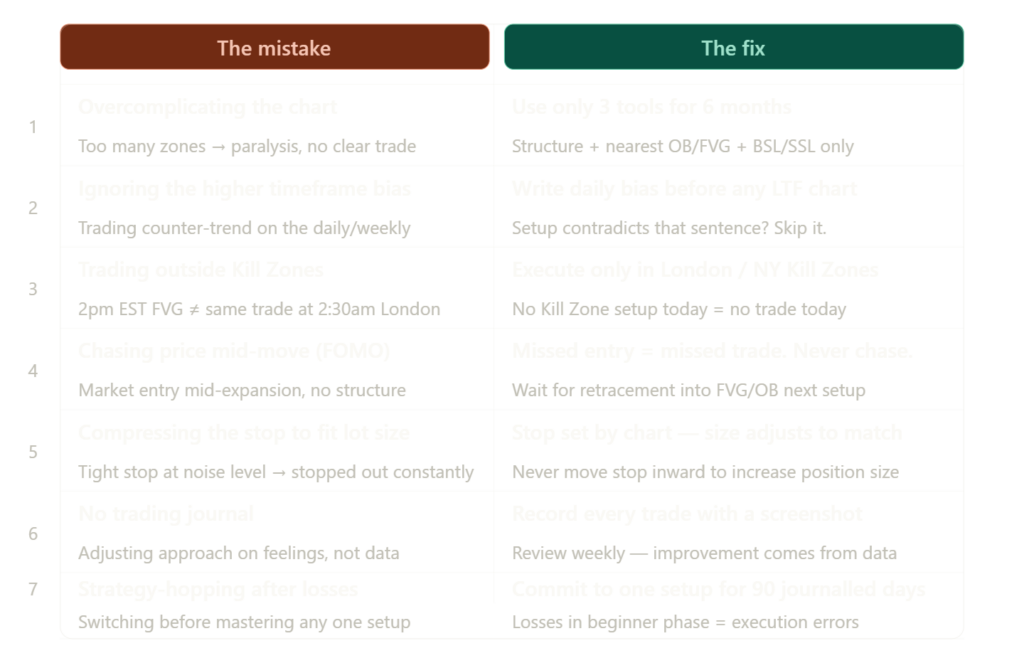
Mistake 1 — Overcomplicating the Chart
What it looks like: The trader marks every swing high and low on the chart. Every potential order block is highlighted. Every FVG is annotated. Every liquidity pool is boxed. The chart looks like a wall of coloured rectangles and arrows, and the trader genuinely cannot identify a clear trade from within it.
This is one of the most common ICT and SMC mistakes at every skill level. The methodology contains dozens of tools — and beginners try to use all of them simultaneously. The result is analysis paralysis: too many confluences, too many conflicts, and an inability to act with conviction even when a genuinely high-quality setup appears.
The fix: Pick three tools and use only those for the first six months. Market structure (BOS/CHoCH), the nearest unmitigated order block or FVG, and liquidity (BSL/SSL). That is all you need to build a competent trade plan. Add tools only after you have demonstrated consistency with the basics. A clean chart with two zones marked is more tradeable than a chart covered in fifty annotations.
Mistake 2 — Ignoring the Higher Timeframe Bias
What it looks like: The trader finds a beautiful bullish order block on the 15-minute chart, enters long with a tight stop, and immediately gets stopped out. They then check the daily chart and see that it has been in a clear downtrend for three weeks with a series of bearish BOSes.
The 15-minute setup was technically correct. The daily bias made it the wrong trade.
This mistake is responsible for more losses in the SMC and ICT community than almost any other single error. Traders fall in love with lower-timeframe patterns and forget that the higher timeframe always has authority. A perfect order block in the wrong direction relative to the daily bias is not a high-probability trade — it is a counter-trend gamble.
The fix: Write the daily bias down in plain language before you open a single lower-timeframe chart. Stick it at the top of your trading journal entry. If your 15-minute setup contradicts that one sentence, it does not exist. You are not allowed to trade it.
Mistake 3 — Trading Outside Kill Zones (ICT) or Outside High-Volume Sessions (SMC)
What it looks like: The trader spots a clean FVG on EUR/USD at 2:00pm EST. They enter. Price does nothing for two hours, grinds sideways, eventually taps the stop, then moves in the original direction at the 7:00am open the next morning.
The setup was right. The time was wrong.
Both ICT and SMC concepts produce their most reliable signals when institutional volume is highest — during the London Kill Zone (2–5am EST), the New York Kill Zone (7–10am EST for forex, 8:30–11am for indices), and around key session transitions. Outside these windows, spreads are wider, volume is thin, and price movement is dominated by smaller players and algorithmic noise rather than genuine institutional order flow.
The fix: Only execute during high-volume windows. An FVG that forms at 2:00pm EST is not the same trade as the identical FVG forming at 2:30am during the London open. The pattern is the same. The probability is not. If there is no setup during the Kill Zone today — there is no trade today. Full stop.
Mistake 4 — Chasing Price After the Move Has Already Started
What it looks like: Price sweeps a liquidity level, shifts structure, and begins a strong expansion move. The trader sees it happening in real time, feels FOMO, and enters mid-move at market price — no order block, no FVG, no defined entry — because they are afraid to miss it.
The entry has no clear invalidation level. The stop has to be placed far away. The risk-reward is poor. Price makes a brief retracement, stops them out, then continues in the original direction.
Chasing price is the market’s most efficient way of extracting money from impatient traders. Smart money runs precisely because there is a crowd of retail traders who will enter late, provide the liquidity for professionals to distribute into, and then absorb the retracement.
The fix: Accept this as a law: if you missed the entry, you missed that trade. The next setup will come. Never enter mid-move at market price without a defined structural basis. Wait for a retracement into an FVG or order block formed during the expansion. If price does not retrace and hits the target directly — that is a missed trade, not a failed discipline. Missed trades cost nothing. Chased trades cost real money.
Mistake 5 — Placing the Stop Loss at a Round Number or “Comfortable” Distance
What it looks like: The trader calculates their ideal position size, finds that the structurally correct stop is 40 pips away, but decides that feels too far — so they tighten the stop to 20 pips to increase position size and improve the R:R ratio on paper.
The stop at 20 pips sits at a level that has no structural meaning. It is inside the normal noise of price action at that timeframe. The trade gets stopped out within minutes. Price then moves 120 pips in the correct direction.
The fix: Stop loss placement is determined by the chart — specifically by the structural level at which the trade idea is invalidated. In SMC, that is below the liquidity sweep low. In ICT, that is below the Judas Swing low. That distance is what it is. If it makes the position size uncomfortably small — good. That means you are sizing correctly for your account. Never compress the stop to fit a desired position size. Always adjust the position size to fit the required stop.
Mistake 6 — No Trading Journal
What it looks like: The trader takes twenty trades over two weeks. Some win, some lose. At the end of the fortnight they have a vague sense of whether they are profitable — but they cannot identify which setups worked, which failed, at what times, on which pairs, or why any of it happened the way it did. They adjust their approach based on feelings rather than data.
Without a journal, trading improvement is essentially random. You cannot identify patterns in your mistakes because you have not recorded the data needed to find them. You cannot build confidence in your winning setups because you have no evidence base to point to.
The fix: Record every trade — entry, stop, target, timeframe, pair, session, the setup type, the reasoning, and the outcome — with a screenshot of the chart before and after. Review the journal weekly. Look for patterns: Are you losing consistently during one session? Are certain setup types underperforming? Are you winning on one pair and losing on another? The answers to those questions are worth more than any additional concept you could learn.
Mistake 7 — Strategy-Hopping
What it looks like: The trader spends three weeks learning ICT order blocks. They take five live trades and lose three of them. Immediately they conclude that order blocks “don’t work” and switch to learning FVG-only strategies. After another two weeks and another losing streak, they abandon that for breaker blocks. Then OTE. Then PD arrays. After six months they have surface-level familiarity with ten concepts and genuine mastery of none.
This is perhaps the single most career-limiting mistake in trading education. The beginner phase produces losing streaks regardless of the strategy — because the losses come from execution errors, not concept errors. Switching strategies does not fix execution errors. It just resets the learning curve at zero.
The fix: Choose one complete setup — for example, the six-step SMC trade plan from Day 15, or the ICT Kill Zone entry model from Day 16 — and commit to it for a minimum of ninety trading days with a journal. Do not evaluate the strategy after five trades or even twenty. After ninety journalled trades you will have the data to make an informed assessment. Until then, the problem is almost certainly execution, not methodology.
The Pattern Underneath All Seven Mistakes
Read back through that list and notice what every mistake has in common. None of them are conceptual failures. Nobody is struggling because they misunderstood what a breaker block is. Nobody is losing because they calculated the OTE zone incorrectly.
Every single mistake is an execution or patience failure:
Marking too much instead of waiting for clarity. Trading at the wrong time instead of waiting for the Kill Zone. Chasing instead of waiting for the retracement. Tightening the stop instead of accepting the correct position size. Switching strategy instead of waiting for the ninety-day data set to build.
The solution to all seven mistakes is the same underlying discipline: slow down, do less, wait longer. The market rewards patience more consistently than it rewards knowledge. You can know every concept in this series and still lose money if you cannot sit on your hands when conditions are not perfect.
That patience is harder to learn than any PD array or Fibonacci level. But it is the actual edge. And it is available to everyone who commits to building it.
Up Next — Day 20
Tomorrow we tackle the question that everyone in this community has asked at some point: can you combine ICT and SMC? Or does using one invalidate the other?
Day 20 gives you a direct, practical answer — and a specific framework for how the two methodologies actually complement each other rather than conflict.
→ See you on Day 20.