Are Third-Party Bridge Providers Being Priced Out By MetaQuotes?
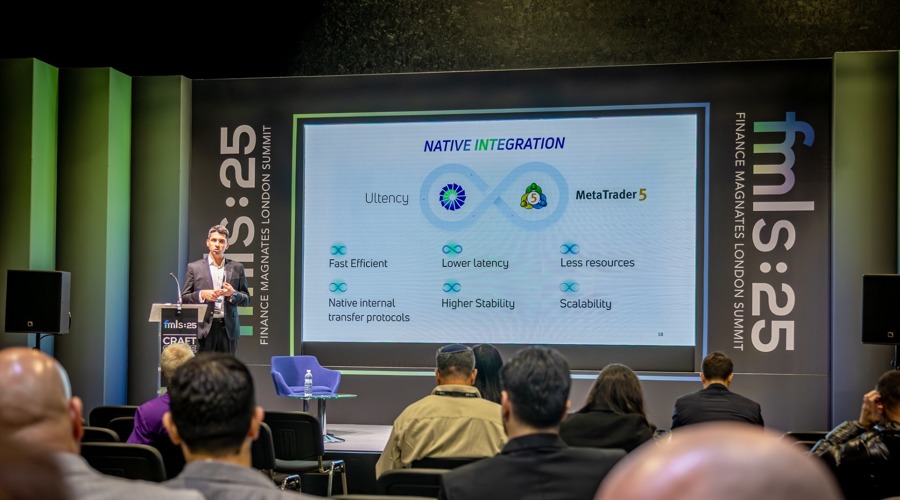
“Ultency is not designed as a primary revenue driver, but rather as a strategic layer,” says Constantinos Theodolou, MetaQuotes’ Chief Business Officer.
Singapore Summit: Meet the largest APAC brokers you know (and those you still don’t!).
When MetaQuotes introduced Ultency in 2025, it inserted itself into a part of the trading technology stack that, since the early days of MT4, had been the preserve of third-party providers: the liquidity bridge.
This is the infrastructure that connects brokers’ internal platforms to external liquidity pools. For decades, MetaQuotes was content to let others mind that gap.
No longer.
The platform provider has reportedly invested millions in a global server network to underpin the new offering. Ultency’s hosting footprint spans Equinix data centres in London, New York, Hong Kong, Singapore and Tokyo – hardly a modest undertaking.
Yet the pricing model is what truly turns heads. Ultency charges a flat US$1 per US$1m traded, a rate that is seemingly a lot cheaper than the industry standard. Traditionally, third-party providers bill brokers per volume: the more a broker trades, the higher its infrastructure costs climbs.
Which raises an obvious question. If not to recoup investment or generate profits, what exactly is MetaQuotes up to?
Christoforos Theodolou, Chief Business Officer, MetaQuotes
“By lowering the cost of connectivity and simplifying infrastructure, our goal is to drive higher adoption, increase trading volumes for both brokers and liquidity providers and further strengthen the ecosystem,” Theodolou replies.
MetaQuotes Puts Pressure on Independent Providers
MetaQuotes is not alone in muscling into the liquidity bridge business, nor in challenging its pricing orthodoxy. Match-Trade Technologies has long offered its bridge free of charge (with caveats), while in March, Spotware launched cBridge, opting for a fixed fee based on servers and connections rather than trading volume.
The motivations are broadly similar, though not identical.
For MetaQuotes, the move is framed as a natural evolution. In the industry’s earlier phase, brokers relied on separate bridge software to connect with liquidity providers. That arrangement worked well enough when the market was expanding rapidly and different layers of the technology stack were being built by different tech providers.
“Today, however, the landscape has reached a new stage in its evolution,” says Theodolou.
At the centre of that evolution sits MT5. Data from the latest Finance Magnates Intelligence Report shows MT5 accounted for 62% of retail CFD trading volumes on MetaQuotes platforms in Q3 2025, while MT4 slipped to 38% – Ultency is strictly native to the MT5 ecosystem.
“With direct interaction in broker technology, shaping trader behaviour, liquidity and pricing dynamics, as well as infrastructure performance, we are now in a position to rethink how connectivity can be better delivered,” Theodolou says.
The benefit of MetaQuote’s bundled bridge, he adds, is operational simplicity. By eliminating the need for third-party integrations, brokers can manage execution, routing, aggregation and risk from a single interface. “This removes the need for platform administrators, dealers, and risk managers having to learn and operate across multiple systems, significantly reducing operational overhead and the complexity associated with working across multiple vendors,” Theodolou says.
For Michał Karczewski, the CEO of Match Trade Technologies, the bundled bridge – MetaQuotes in particular – also enjoys a structural advantage. New brokers entering the market often begin within its ecosystem, using MT4 or MT5 by default. If a credible bridge is available within that environment, the path of least resistance is clear.
Marcel Karczewski, CEO, Match-Trade Technologies
“That creates real pressure on independent bridge providers who have historically relied on that early-stage relationship to build long-term revenue,” Karczewski adds.
Match-Trade initially built its bridge for its own liquidity clients before deciding to externalise it in 2015. “It made sense to offer it more broadly rather than keeping it purely proprietary,” Karczewski notes.
At first, the bridge was bundled tightly with Match-Trade’s liquidity offering, FX-EDGE, giving the impression that the two were inseparable. That was never the intention, Karczewski insists; brokers are free to connect to multiple liquidity providers. The bridge, though, is free only if clients use Match-Trade’s own liquidity. As a standalone product, it comes with a price tag.
Nonetheless, there was another reason for externalising the bridge: the volume-based pricing system.
“It is one of the consistent pain points we observe, especially among startup and smaller brokers. Those fees can be significant when margins are already thin, and they can effectively price smaller operations out of accessing institutional-grade connectivity,” Karczewski notes.
Karczewski is blunt about the underlying logic: the value capture isn’t really about monetising the bridge directly, but about winning and retaining liquidity relationships.
“If a broker is getting reliable execution technology for free as part of the package, that becomes a real differentiator when they’re evaluating which liquidity provider to route their flow through.” he says.
The bundled bridge, then, is less than a product and more a retention tool. The strategy also brings to mind the wall gardens erected by the big boys of Silicon Valley: lower the barrier to entry, smooth the user experience, and quietly raise the cost of exit.
“There Will Always Be Someone Offering a Cheaper Product”
Not everyone is convinced that cheaper is better.
Tom Higgins, founder and CEO of Gold-i, a long-established player in the bridge market, views the new pricing claims with measured scepticism. When Spotware launched cBridge and touting potential cost reductions of up to 80%, he notes, the comparison was largely with the most expensive incumbents.
“And that’s probably fair,” he concedes.
Gold-i, which has evolved into a major player in crypto connectivity, takes a more segmented approach to pricing. It offers specialised pricing for segments such as prop trading firms, while for crypto-focused clients, the standard is a monthly fee with a generous transaction allowance. This, Higgins argues, allows the company to support both the agile startup and the institutional heavyweight without compromising on service.
“There will always be someone offering a cheaper product,” he observes. “But that almost comes at the expense of reliability and support. When you buy a car, you don’t buy the cheapest one available; you buy the one that fits your needs and budget.”
Elena Petersen, CEO of Your Bourse, offers a different defence of the traditional model. Volume-based pricing, she argues, can actually favour smaller brokers by aligning costs with growth.
Elina Pedersen, CEO, Your Bourse
“It allows startup brokers to benefit from the full technology stack without having to commit to large monthly fees from day one,” she says.
Flat fees, by contrast, may raise barriers for brokers that lack sufficient trading volume to justify even modest fixed costs. And, Petersen cautions, such pricing is rarely as simple as it appears.
“They often look simple on paper but include limitations, such as trades per second, connection limits, or infrastructure tiers, which means the pricing is not always as flat as it appears,” she notes.
Your Bourse, tellingly, does offer flat-fee pricing for another product in its stack, Trade Server.
Who Wins in a Race to Zero?
Being a pure-play bridge is increasingly precarious, particularly in a world drifting towards low or zero pricing. As Karczewski puts it, flat fees can quickly become “a race to zero”.
“And in a race to zero, the parties who can afford to subsidise the technology with revenue from elsewhere – whether that is liquidity, platform licensing or data services – will almost always win.”
The logical response is diversification.
For Your Bourse, a pivotal moment came with the launch of its matching engine. Petersen describes it as a response to a gap in the market: while many providers aggregated liquidity, few enabled brokers to internalise client flow effectively.
From there, the tech provider expanded into a broader platform-as-a-service offering, driven largely by client demand. Brokers wanted to add new asset classes, support margin accounts for B2B clients, and manage multi-currency accounts, all without building their own technology from scratch.
These capabilities are now embedded in Your Bourse’s Trade Server. The roadmap extends further still, into areas such as physical conversion and advanced settlement, territory far removed from simple connectivity.
As third-party providers evolved alongside their clients, they have created deepening relationships that may prove harder to dislodge than platform providers expect.
The DeFI Complication
Not all bridges are built the same, and that is especially true in the crypto space. Decentralised exchanges operate in a world that often lacks the basic trappings of conventional finance: corporate structures, customer support lines, and even email addresses.
Integrating with them is no trivial task.
Tom Higgins recalls Gold-i’s early foray into the space. “Initially, crypto was simply an exciting new technology, and nobody really knew where it was headed. At that time, the traditional MT4/MT5 FX broker world had little interest in crypto, so we created a separate brand – Crypto Switch – to target early crypto-native firms.”
Tom Higgins, Founder & CEO, Gold-i
Since then, the boundaries have blurred. Traditional brokers are launching crypto exchanges, while crypto firms are acquiring MiFID-licensed brokers to offer derivatives.
Gold-i eventually unified its offering, but the technical challenges remain formidable. Beyond their unconventional structures, connecting to decentralised exchanges requires translating alien APIs into formats compatible with traditional systems. “It was one of the most interesting technical challenges we’ve worked on,” Higgins says.
Latency can be higher in decentralised environments, but Higgins argues that the model is viable. “Importantly,” he says, “settlement and wallet custody remain the broker’s responsibility, but we provide detailed guidance and proven architectures to ensure this can be implemented safely. This really is new market access, not just another exchange connection.”
Some Just like It Simple
Michał Karczewski believes that a significant portion of the market is being overlooked in the rush to add features, particularly small- to mid-size brokers. They are simply looking for a reliable and cost-effective way to route trades to the outside world for their A book needs.
“They do not need a system layered with features they will never use,” he says.
Match-Trade has developed advanced tools, including intelligent order routing and VWAP-based execution, but these are optional by design. The core product remains deliberately simple.
“The key principle is that these features are there when you need them – they don’t impose complexity on those who simply want clean, efficient execution,” Karczewski explains.
So, What’s Next for the Bridge Space?
Where, then, does all this leave the independent bridge providers?
For Higgins, the answer lies partly in market segmentation. MetaQuotes’ bridge, at least for now, operates within a relatively closed loop, supporting MT5-to-MT5 connectivity. Providers like Gold-i, by contrast, position themselves as cross-platform specialists.
“We serve the entire liquidity and platform ecosystem and we partner with the best providers in each category rather than limiting ourselves to a single platform,” he says.
Specialisation , whether in crypto integration, institutional-grade infrastructure or bespoke solutions, offers an avenue for differentiation. And having a trusted client base, which extends to institutional players – Gold-i and Your Bourse serve both retail and institutional clients – can give the incumbent third-party providers breathing room.
Petersen, for her part, welcomes the increased competition. “And we are not afraid of it. A more competitive environment pushes technology providers to build better products,” she says. “I salute MetaQuotes for continuing to develop new product suites and improving their ecosystem, as this ultimately contributes to the overall development and maturity of the industry.”
Even Theodolou acknowledges that third-party vendors will retain a role, especially when it comes to specialisation. “But,” he argues, “the baseline expectation is shifting and connectivity is becoming an embedded capability rather than a separate product.”
Karczewski goes further, warning that the industry has yet to fully digest the implications of the bundled bridge.
“The bundling trend is real, and it’s accelerating,” he says. And when core infrastructure is folded into broader platforms, it will inevitably alter the competitive dynamics for standalone providers.
“Ultency is not designed as a primary revenue driver, but rather as a strategic layer,” says Constantinos Theodolou, MetaQuotes’ Chief Business Officer.
Singapore Summit: Meet the largest APAC brokers you know (and those you still don’t!).
When MetaQuotes introduced Ultency in 2025, it inserted itself into a part of the trading technology stack that, since the early days of MT4, had been the preserve of third-party providers: the liquidity bridge.
This is the infrastructure that connects brokers’ internal platforms to external liquidity pools. For decades, MetaQuotes was content to let others mind that gap.
No longer.
The platform provider has reportedly invested millions in a global server network to underpin the new offering. Ultency’s hosting footprint spans Equinix data centres in London, New York, Hong Kong, Singapore and Tokyo – hardly a modest undertaking.
Yet the pricing model is what truly turns heads. Ultency charges a flat US$1 per US$1m traded, a rate that is seemingly a lot cheaper than the industry standard. Traditionally, third-party providers bill brokers per volume: the more a broker trades, the higher its infrastructure costs climbs.
Which raises an obvious question. If not to recoup investment or generate profits, what exactly is MetaQuotes up to?
Christoforos Theodolou, Chief Business Officer, MetaQuotes
“By lowering the cost of connectivity and simplifying infrastructure, our goal is to drive higher adoption, increase trading volumes for both brokers and liquidity providers and further strengthen the ecosystem,” Theodolou replies.
MetaQuotes Puts Pressure on Independent Providers
MetaQuotes is not alone in muscling into the liquidity bridge business, nor in challenging its pricing orthodoxy. Match-Trade Technologies has long offered its bridge free of charge (with caveats), while in March, Spotware launched cBridge, opting for a fixed fee based on servers and connections rather than trading volume.
The motivations are broadly similar, though not identical.
For MetaQuotes, the move is framed as a natural evolution. In the industry’s earlier phase, brokers relied on separate bridge software to connect with liquidity providers. That arrangement worked well enough when the market was expanding rapidly and different layers of the technology stack were being built by different tech providers.
“Today, however, the landscape has reached a new stage in its evolution,” says Theodolou.
At the centre of that evolution sits MT5. Data from the latest Finance Magnates Intelligence Report shows MT5 accounted for 62% of retail CFD trading volumes on MetaQuotes platforms in Q3 2025, while MT4 slipped to 38% – Ultency is strictly native to the MT5 ecosystem.
“With direct interaction in broker technology, shaping trader behaviour, liquidity and pricing dynamics, as well as infrastructure performance, we are now in a position to rethink how connectivity can be better delivered,” Theodolou says.
The benefit of MetaQuote’s bundled bridge, he adds, is operational simplicity. By eliminating the need for third-party integrations, brokers can manage execution, routing, aggregation and risk from a single interface. “This removes the need for platform administrators, dealers, and risk managers having to learn and operate across multiple systems, significantly reducing operational overhead and the complexity associated with working across multiple vendors,” Theodolou says.
For Michał Karczewski, the CEO of Match Trade Technologies, the bundled bridge – MetaQuotes in particular – also enjoys a structural advantage. New brokers entering the market often begin within its ecosystem, using MT4 or MT5 by default. If a credible bridge is available within that environment, the path of least resistance is clear.
Marcel Karczewski, CEO, Match-Trade Technologies
“That creates real pressure on independent bridge providers who have historically relied on that early-stage relationship to build long-term revenue,” Karczewski adds.
Match-Trade initially built its bridge for its own liquidity clients before deciding to externalise it in 2015. “It made sense to offer it more broadly rather than keeping it purely proprietary,” Karczewski notes.
At first, the bridge was bundled tightly with Match-Trade’s liquidity offering, FX-EDGE, giving the impression that the two were inseparable. That was never the intention, Karczewski insists; brokers are free to connect to multiple liquidity providers. The bridge, though, is free only if clients use Match-Trade’s own liquidity. As a standalone product, it comes with a price tag.
Nonetheless, there was another reason for externalising the bridge: the volume-based pricing system.
“It is one of the consistent pain points we observe, especially among startup and smaller brokers. Those fees can be significant when margins are already thin, and they can effectively price smaller operations out of accessing institutional-grade connectivity,” Karczewski notes.
Karczewski is blunt about the underlying logic: the value capture isn’t really about monetising the bridge directly, but about winning and retaining liquidity relationships.
“If a broker is getting reliable execution technology for free as part of the package, that becomes a real differentiator when they’re evaluating which liquidity provider to route their flow through.” he says.
The bundled bridge, then, is less than a product and more a retention tool. The strategy also brings to mind the wall gardens erected by the big boys of Silicon Valley: lower the barrier to entry, smooth the user experience, and quietly raise the cost of exit.
“There Will Always Be Someone Offering a Cheaper Product”
Not everyone is convinced that cheaper is better.
Tom Higgins, founder and CEO of Gold-i, a long-established player in the bridge market, views the new pricing claims with measured scepticism. When Spotware launched cBridge and touting potential cost reductions of up to 80%, he notes, the comparison was largely with the most expensive incumbents.
“And that’s probably fair,” he concedes.
Gold-i, which has evolved into a major player in crypto connectivity, takes a more segmented approach to pricing. It offers specialised pricing for segments such as prop trading firms, while for crypto-focused clients, the standard is a monthly fee with a generous transaction allowance. This, Higgins argues, allows the company to support both the agile startup and the institutional heavyweight without compromising on service.
“There will always be someone offering a cheaper product,” he observes. “But that almost comes at the expense of reliability and support. When you buy a car, you don’t buy the cheapest one available; you buy the one that fits your needs and budget.”
Elena Petersen, CEO of Your Bourse, offers a different defence of the traditional model. Volume-based pricing, she argues, can actually favour smaller brokers by aligning costs with growth.
Elina Pedersen, CEO, Your Bourse
“It allows startup brokers to benefit from the full technology stack without having to commit to large monthly fees from day one,” she says.
Flat fees, by contrast, may raise barriers for brokers that lack sufficient trading volume to justify even modest fixed costs. And, Petersen cautions, such pricing is rarely as simple as it appears.
“They often look simple on paper but include limitations, such as trades per second, connection limits, or infrastructure tiers, which means the pricing is not always as flat as it appears,” she notes.
Your Bourse, tellingly, does offer flat-fee pricing for another product in its stack, Trade Server.
Who Wins in a Race to Zero?
Being a pure-play bridge is increasingly precarious, particularly in a world drifting towards low or zero pricing. As Karczewski puts it, flat fees can quickly become “a race to zero”.
“And in a race to zero, the parties who can afford to subsidise the technology with revenue from elsewhere – whether that is liquidity, platform licensing or data services – will almost always win.”
The logical response is diversification.
For Your Bourse, a pivotal moment came with the launch of its matching engine. Petersen describes it as a response to a gap in the market: while many providers aggregated liquidity, few enabled brokers to internalise client flow effectively.
From there, the tech provider expanded into a broader platform-as-a-service offering, driven largely by client demand. Brokers wanted to add new asset classes, support margin accounts for B2B clients, and manage multi-currency accounts, all without building their own technology from scratch.
These capabilities are now embedded in Your Bourse’s Trade Server. The roadmap extends further still, into areas such as physical conversion and advanced settlement, territory far removed from simple connectivity.
As third-party providers evolved alongside their clients, they have created deepening relationships that may prove harder to dislodge than platform providers expect.
The DeFI Complication
Not all bridges are built the same, and that is especially true in the crypto space. Decentralised exchanges operate in a world that often lacks the basic trappings of conventional finance: corporate structures, customer support lines, and even email addresses.
Integrating with them is no trivial task.
Tom Higgins recalls Gold-i’s early foray into the space. “Initially, crypto was simply an exciting new technology, and nobody really knew where it was headed. At that time, the traditional MT4/MT5 FX broker world had little interest in crypto, so we created a separate brand – Crypto Switch – to target early crypto-native firms.”
Tom Higgins, Founder & CEO, Gold-i
Since then, the boundaries have blurred. Traditional brokers are launching crypto exchanges, while crypto firms are acquiring MiFID-licensed brokers to offer derivatives.
Gold-i eventually unified its offering, but the technical challenges remain formidable. Beyond their unconventional structures, connecting to decentralised exchanges requires translating alien APIs into formats compatible with traditional systems. “It was one of the most interesting technical challenges we’ve worked on,” Higgins says.
Latency can be higher in decentralised environments, but Higgins argues that the model is viable. “Importantly,” he says, “settlement and wallet custody remain the broker’s responsibility, but we provide detailed guidance and proven architectures to ensure this can be implemented safely. This really is new market access, not just another exchange connection.”
Some Just like It Simple
Michał Karczewski believes that a significant portion of the market is being overlooked in the rush to add features, particularly small- to mid-size brokers. They are simply looking for a reliable and cost-effective way to route trades to the outside world for their A book needs.
“They do not need a system layered with features they will never use,” he says.
Match-Trade has developed advanced tools, including intelligent order routing and VWAP-based execution, but these are optional by design. The core product remains deliberately simple.
“The key principle is that these features are there when you need them – they don’t impose complexity on those who simply want clean, efficient execution,” Karczewski explains.
So, What’s Next for the Bridge Space?
Where, then, does all this leave the independent bridge providers?
For Higgins, the answer lies partly in market segmentation. MetaQuotes’ bridge, at least for now, operates within a relatively closed loop, supporting MT5-to-MT5 connectivity. Providers like Gold-i, by contrast, position themselves as cross-platform specialists.
“We serve the entire liquidity and platform ecosystem and we partner with the best providers in each category rather than limiting ourselves to a single platform,” he says.
Specialisation , whether in crypto integration, institutional-grade infrastructure or bespoke solutions, offers an avenue for differentiation. And having a trusted client base, which extends to institutional players – Gold-i and Your Bourse serve both retail and institutional clients – can give the incumbent third-party providers breathing room.
Petersen, for her part, welcomes the increased competition. “And we are not afraid of it. A more competitive environment pushes technology providers to build better products,” she says. “I salute MetaQuotes for continuing to develop new product suites and improving their ecosystem, as this ultimately contributes to the overall development and maturity of the industry.”
Even Theodolou acknowledges that third-party vendors will retain a role, especially when it comes to specialisation. “But,” he argues, “the baseline expectation is shifting and connectivity is becoming an embedded capability rather than a separate product.”
Karczewski goes further, warning that the industry has yet to fully digest the implications of the bundled bridge.
“The bundling trend is real, and it’s accelerating,” he says. And when core infrastructure is folded into broader platforms, it will inevitably alter the competitive dynamics for standalone providers.