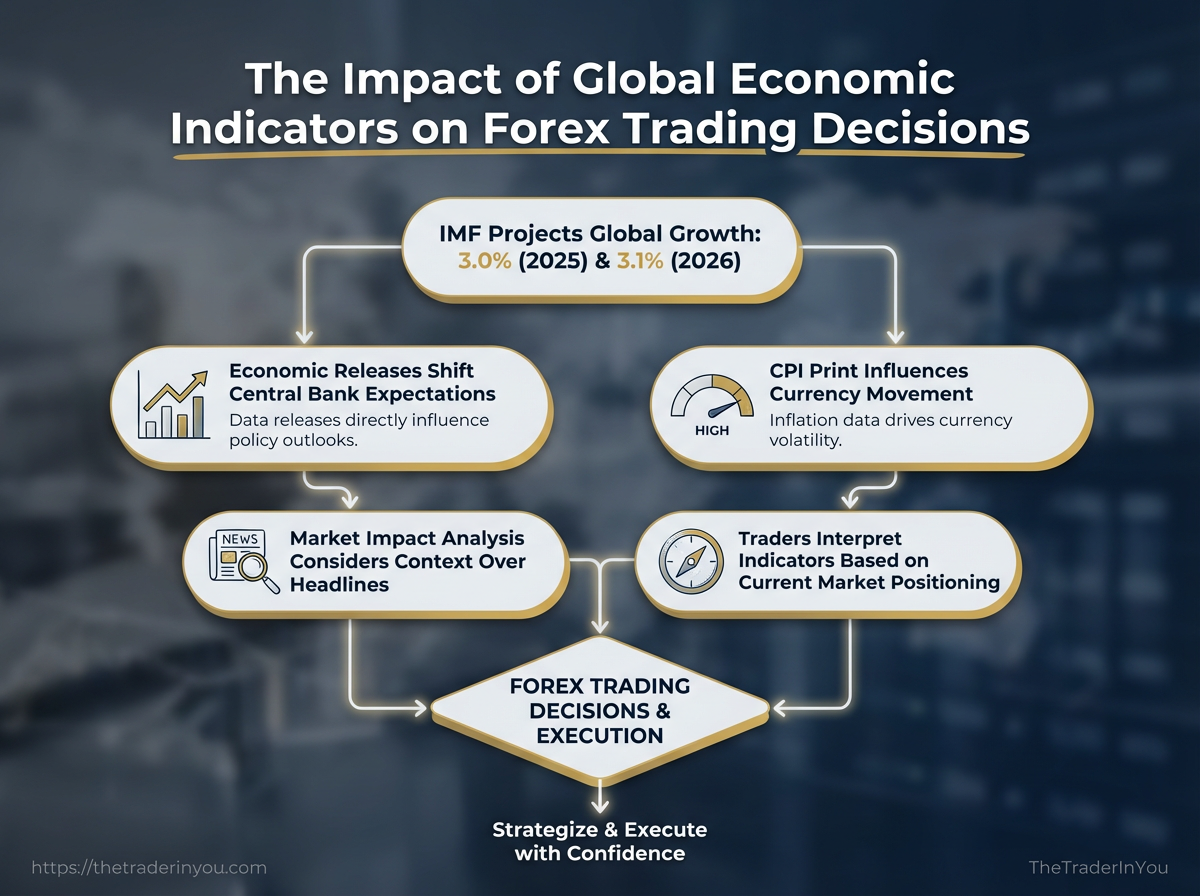
The Impact of Global Economic Indicators on Forex Trading Decisions » The Trader In you
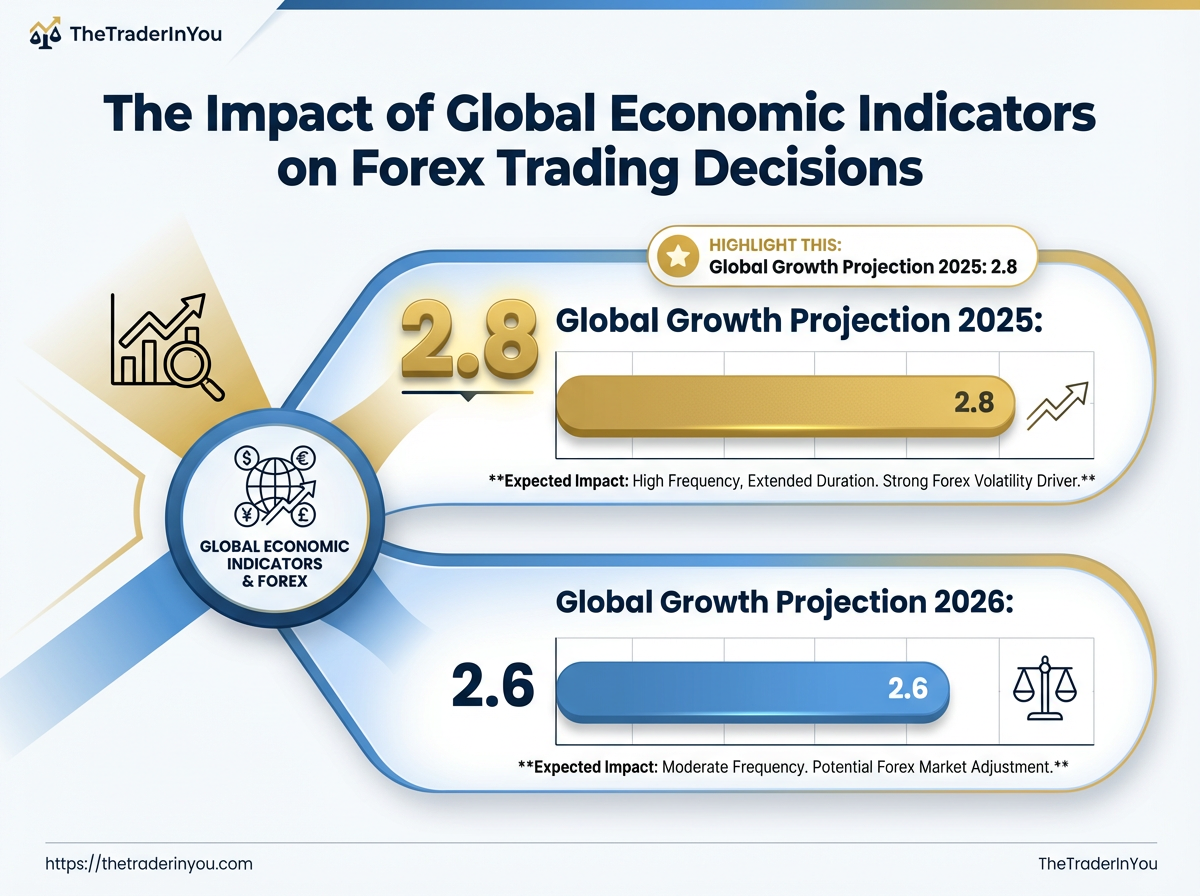

What moves a currency pair hardest is often not a chart pattern.
It is the surprise in a payroll report, an inflation print, or a central bank statement that resets expectations in seconds.
That is why economic indicators matter so much in forex.
A trader watching forex trading economics is really watching how growth, inflation, rates, and confidence reshape capital flows, and those shifts often show up in price before the headlines settle.
The tricky part is that not every release means the same thing.
A hotter-than-expected inflation number can lift rate expectations, while weak growth can do the opposite, and the market may care more about the gap between the forecast and the result than the result itself.
Good market impact analysis comes down to reading context, not memorizing calendars.
When traders understand which data leads, which confirms, and which merely adds noise, they stop guessing at candles and start reading the forces behind them.
Why macro indicators matter for forex
What happens when a central bank keeps rates unchanged, yet a currency still jumps hard? That happens because forex trading economics is never just about the policy headline.
Traders are reacting to inflation prints, jobs data, revisions, trade flows, and whether the market had already priced the move.
Interest rates and GDP matter, but they are only part of the picture.
A useful market impact analysis looks at surprise versus expectation, not just the number itself.
In Argentina, for example, Deloitte’s 2026 outlook projects inflation falling to 29.4% in 2025 and 13.7% in 2026, after a near-300% peak in 2024, while growth and reserve trends shift the currency story at the same time.
That kind of backdrop changes how traders think about policy, capital flows, and exchange-rate pressure. Deloitte Global economic outlook 2026
The mechanics are pretty direct.
A release hits the calendar, algorithms compare it with consensus, and orders start moving before most humans finish reading the headline.
Forex.com’s cheat sheet on key economic indicators is a good reminder that inflation, jobs, GDP, and central-bank decisions are all part of the same pricing machine.
TradingView’s market notes on major releases like NFP, CPI, GDP, and FOMC show why event timing matters: volatility often clusters around scheduled data drops, not just rate meetings.
TradingView note on NFP, CPI, FOMC, and GDP releases
Different participants react on different clocks.
Central banks: they care about trend, persistence, and inflation momentum over months, then shape expectations through guidance.
Macro funds: they react fast to surprises and revisions, often within minutes, because relative growth and rate paths move currencies.
Corporates and importers: they hedge payment risk, so they care about the next quarter more than the next candle.
Retail traders: they usually feel the first volatility spike and the spread widening, which is why release timing matters so much.
That mix is why a clean read on economic indicators forex trading cannot stop at GDP and rates.
The market is always asking a second question: who has to reprice next, and how quickly? That second question is usually where the money moves.
Core economic indicators every forex trader must track
Why do some releases move EUR/USD for seconds, while others keep steering the trend for days?
Because economic indicators forex traders care about do different jobs.
Some reprice the path of interest rates.
Others confirm whether growth is actually holding up or just looking busy on paper.
Central bank statements and rate decisions sit at the top of the list.
They shape forex trading economics through expectations, not just the headline number, and scheduled events are best handled through a calendar with impact filters, like the ones described by Forex.com’s key economic indicators guide and MavenTrading’s economic calendar walkthrough.
Inflation and jobs come next. CPI tells you what consumers feel now, while PCE often matters more for U.S. policy watchers because it tracks inflation in a slightly different way.
On the labor side, nonfarm payrolls grab the spotlight, but the unemployment rate and labor force participation can tell a cleaner story when payroll growth looks noisy.
The TradingView release guide notes that NFP lands at
8:30 AM ETon the first Friday, while FOMC decisions usually arrive at2:00 PM ETwith a press conference at2:30 PM ET.Those timestamps matter because the first reaction is often pure order flow, not sober analysis.
See TradingView’s guide to major economic releases.
Release timing and FX impact
| Indicator | Release Frequency | Typical Market Reaction Timeframe | Primary FX Pairs Affected | Common Interpretation |
|—|—|—|—|—|
| Interest rate decision | 6–8 times per year, depending on the central bank | Immediate; minutes to hours, sometimes into the next session | Currency pairs tied to that central bank, especially EUR/USD, GBP/USD, USD/JPY, AUD/USD | A hawkish surprise or higher-for-longer signal usually supports the currency |
| CPI | Monthly | Immediate to the first trading session | Broad USD pairs, plus the local currency’s major crosses | Hotter-than-expected inflation can push rate expectations higher |
| PCE | Monthly | Immediate to hours; often watched into the next U.S. session | USD majors, especially EUR/USD and USD/JPY | Core PCE matters most for Fed expectations because it filters some volatile items |
| Nonfarm payrolls (NFP) | Monthly, usually the first Friday | Seconds to hours | USD majors, especially EUR/USD, USD/JPY, GBP/USD, AUD/USD | Strong job growth and firm wages often support the dollar |
| GDP | Quarterly for advance, second, and final prints | Hours to days | USD majors and other liquid developed-market pairs | Stronger growth supports a currency if inflation and policy expectations also firm |
| PMI (Manufacturing & Services) | Monthly | Minutes to the first hour, then the session trend | The currency of the reporting economy, especially during growth scares | Readings above 50 signal expansion; the surprise versus forecast matters more than the raw level |
The practical part is simple. Rate decisions and inflation data usually drive the trend, while NFP and PMI releases often create the cleanest volatility window.
GDP sits in the middle, because it can confirm a macro turn, but it rarely beats the market’s forward expectations on its own.
One small detail saves a lot of bad trades. Unemployment can fall for the wrong reason if people leave the labor force, so participation rate deserves a glance before anyone cheers a “strong” jobs report.
That mix of timing, context, and surprise is where market impact analysis gets useful.
Once these releases are on your radar, the chart stops feeling random and starts looking a lot more like a series of scheduled repricings.
How to interpret indicator releases in context
Why does a “good” number sometimes push a currency lower? Because the market rarely trades the headline alone.
In economic indicators forex trading, the real question is whether the release beats or misses expectations by enough to force a change in rate pricing, growth views, or risk appetite.
A tiny surprise often gets faded.
A large one can reset the entire market impact analysis for the next few sessions.
The cleanest habit is to compare three things at once: the forecast, the actual print, and what neighboring markets did in the first few minutes.
Calendars such as the Forex Factory Calendar guide and MavenTrading’s guide to reading an economic calendar for forex help because they separate high-impact releases from background noise.
Read the surprise, then read the reaction
A release is only useful if the surprise has teeth.
If CPI prints a touch above forecast but bond yields barely move, the market is probably saying, “Nice try, not enough to matter.”
That reaction matters more than the headline.
Goldman Sachs’ 2026 Global FX Outlook points to relative growth, returns, and risk sentiment as major drivers of USD performance in 2026, so the same data point can mean very different things depending on whether it changes those variables.
Use other markets as confirmation, not decoration
Bond yields, equities, and commodities often reveal whether the release was actually believed.
If yields rise after a hot inflation print and the dollar firmed too, the move has support.
If equities rally, yields fall, and gold spikes after the same release, the market is probably reading slower growth or easier policy ahead.
That context is especially useful around scheduled events.
TradingView’s release guide shows how major data points like NFP, CPI, GDP, and FOMC can arrive at predictable times but still produce very different reactions.
Don’t get fooled by seasonality, revisions, or one-offs
A strong January print can be less impressive than it looks if seasonal hiring is doing the heavy lifting.
Revisions can also erase the excitement from a first read, which is why one print should never be treated like a verdict.
Policy shifts and intervention risk can change the whole story too.
The U.S.
Treasury’s January 2026 FX report shows how closely authorities still watch foreign exchange policy, while Deloitte’s Global Economic Outlook 2026 highlights how inflation, borrowing costs, currency values, and trade flows can move together when policy credibility changes.
Check the gap: bigger forecast misses usually matter more.
Watch yields first: they often lead the currency move.
Confirm with risk assets: equities and gold often tell the same story from another angle.
Respect revisions: the first print is not always the final word.
A disciplined read turns noisy releases into usable signals.
That is where forex trading economics stops feeling random and starts making sense.
From data to decision: trading frameworks and strategies
A big release can light up a chart in seconds, but the real edge comes from having a plan before the number hits.
That is where economic indicators forex traders care about stop being “data points” and start becoming decisions.
The cleanest framework is simple: define the event, define the market expectation, and decide in advance whether you are trading the first move or waiting for confirmation.
That matters because forex trading economics often rewards the trader who plans around reaction windows, not the trader who reacts emotionally after the candle has already gone.
For positioning, three styles dominate. Scalping tries to catch the first burst of volatility. Breakout trading waits for price to escape a pre-set range after the release. Fade trading looks for an overdone spike that snaps back once the market digests the number.
Major calendars such as the Forex Factory Calendar overview and the economic calendar guide from MavenTrading both point to the same practical truth: high-impact releases need timing, not guesswork.
TradingView also notes that events like NFP, CPI, GDP, and FOMC can trigger sharp swings, with NFP often driving large intraday moves in forex (TradingView’s major releases guide).
Risk is where most news trades fail.
The better play is smaller size, wider but logical stops, and a hard rule for correlated pairs or cross-asset confirmation.
Treasury’s January 2026 FX report also reminds traders that policy and intervention risk can matter as much as the headline itself, especially when markets start questioning currency policy paths (U.S.
Treasury January 2026 FX report).
Major-release execution checklist
| Step | Action | Rationale | Execution Tip | |—|—|—|—| | Pre-release liquidity check | Avoid thin sessions and sudden spread widening before the release | News fills get worse when liquidity dries up | Compare spread behavior 15–30 minutes before the event | | Define surprise threshold | Set the minimum deviation from consensus that justifies a trade | Not every beat or miss deserves a position | Use the calendar consensus, then note the size of the surprise you need | | Set entry and exit rules | Decide whether you enter on the spike, after the first pullback, or on a range break | Removes hesitation when price moves fast | Write the trigger in advance and keep it mechanical | | Establish stop-loss and position cap | Limit downside before volatility expands | News can overshoot far beyond normal ranges | Risk less than on a standard setup and cap exposure per event | | Monitor correlated markets | Watch yields, equities, and the dollar index for confirmation | FX often moves with broader risk sentiment | If related markets disagree, reduce size or stay flat | | Post-release reassessment | Recheck the trade after the first reaction fades | The first move is not always the real move | Give the market one full reaction cycle before adding exposure |
The pattern is pretty consistent: the best news traders treat the release like a process, not a prediction.
That keeps the focus on market impact analysis, where the question is not just “good or bad,” but “tradeable or not.”
Two traders can stare at the same CPI release and walk away with opposite views.
One has a clean feed, a reliable consensus number, and a volatility model ready to go.
The other is still waiting for the headline to refresh.
That gap matters in market impact analysis.
A release only becomes tradable when the timing, source quality, and expectation framework all line up.
For economic indicators forex trading, the best setup usually starts with three layers: an economic calendar for timing, a wire service for context, and a direct central bank feed for the policy language itself.
The U.S.
Treasury’s January 2026 FX report is a good reminder that intervention risk and currency policy still matter as much as growth data in some regimes, especially when markets are watching how authorities manage foreign exchange moves (U.S.
Treasury January 2026 FX report).
The modeling side is where raw data turns into judgment.
A surprise index compares the actual print with the market’s expectation, while a volatility model estimates how far price can travel after the shock.
That combination is more useful than chasing the headline alone.
Real-time sources that belong on the screen
Economic calendars are the first screen most traders check because they tell you when the risk window opens.
Platforms such as the Forex Factory Calendar centralize releases like GDP, CPI, ISM Manufacturing PMI, PPI, FOMC meetings, ADP employment, and unemployment claims, with color coding that separates higher-impact events from background noise (Forex Factory Calendar guide).
Wire services do something different.
They catch the explanation behind the number, which matters when the market is reacting to guidance, revisions, or political comments rather than the headline print.
The timing detail also helps: TradingView’s release guide notes that major U.S. data such as NFP, CPI, and GDP usually lands at 8:30 AM ET, while FOMC decisions arrive at 2:00 PM ET with a later press conference (TradingView on major economic releases).
Central bank feeds are the cleanest source of policy language.
Minutes, statements, speeches, and rate decisions often move currencies before the broader market has finished digesting the release.
Analytical tools that turn releases into signals
A simple surprise score can be enough for fast decision-making.
If the market expected 3.1% inflation and the print lands at 3.6%, the gap becomes the first input.
From there, more advanced models help.
Event-study models measure how a currency pair behaves around repeated releases, and volatility models such as GARCH help estimate whether the move is likely to fade or keep expanding.
The useful part is not the math itself.
It is the discipline of separating a true macro shock from a noisy headline.
Comparing platforms and data feeds
| Provider | Latency | Coverage (countries/indicators) | Price Tier | Best for | |—|—|—|—|—| | Free economic calendar (major broker, e.g. OANDA-style calendar) | Seconds to a few minutes | Broad global calendar, mainly major economies | Free | Fast event tracking and planning | | Major newswire (Reuters/AFP) | Seconds | Global macro, policy, geopolitics, corporate headlines | Premium / enterprise | Context and breaking narrative | | Premium economic data vendor (Macrobond-style) | Minutes to near real time, depending on feed | Deep multi-country macro histories and indicators | Enterprise | Research, backtests, and scenario work | | Central bank direct feeds | Instant at source publication time | Single institution: statements, speeches, minutes, decisions | Free | First-hand policy reading | | Specialized FX analytics platform (TradingView-style) | Seconds to minutes, source-dependent | Calendar plus chart-linked event context | Free and paid tiers | Chart-based traders who want one workspace |
A free calendar is enough for awareness, but it breaks down when execution speed and source depth matter.
Premium vendors and direct feeds become worth it when the trade depends on second-by-second context, while chart-first platforms help traders connect forex trading economics with actual price behavior.
The best stack is usually mixed, not fancy.
One source for timing, one for context, and one model for expected range will beat a crowded dashboard almost every time.
Practical case studies and trade walkthroughs
Ever seen USD/JPY jump before the headline even finishes hitting the wires? That usually happens when a release changes rate expectations faster than traders can react.
In economic indicators forex trading, the first move often comes from yields, not the number itself.
A clean market impact analysis starts by knowing which release can move the market, which level matters, and which move is just noise.
According to TradingView’s major-release timing notes, CPI and GDP often land at 8:30 AM ET, while the Forex Factory Calendar guide and MavenTrading’s economic calendar walkthrough both show why traders sort events by impact before the session even starts.
USD/JPY on a hot CPI print
A strong CPI surprise can hit USD/JPY in two waves.
The first wave is the knee-jerk move as traders price a more hawkish path for the Fed, and the second is the follow-through, which depends on whether price holds above the pre-release range.
That second wave matters more than most people admit.
A spike that fades back into the old range usually says the market liked the headline less than the tape did.
Wait for the spread to normalize. The first candle is often messy, and chasing it usually means paying up for the worst fill.
Watch the first hold or failure. If price stays above the release high, the surprise has real weight.
Judge the next pullback, not the spike. A clean retest tells you the move has support; a fast rejection tells you it was just a reaction trade.
Dovish central bank guidance and EUR pairs
Dovish guidance can matter even when no policy rate changes that day.
If a central bank signals earlier cuts, EUR/USD often softens, and EUR/JPY can fall harder because both policy expectations and risk sentiment shift together.
That is where patience pays.
Goldman Sachs’ 2026 Global FX Outlook on dollar direction frames USD moves around relative growth and risk appetite, which is exactly why one dovish statement can ripple across several pairs.
The better trade is usually the confirmed one, not the guessed one.
If EUR/USD breaks support after the statement, then fails to reclaim it on the press-conference bounce, the move has much more credibility.
These case studies work because they force discipline.
A good read on forex trading economics separates the trigger from the follow-through, and that gap is where most traders either get paid or get chopped up.
Conclusion
When the Data Changes, the Trade Changes
After a major release, we don’t just judge whether the number was “good” or “bad.” We update our trade hypothesis—and we invalidate it quickly when the market’s repricing doesn’t match the idea we entered with.
We use three checkpoints, in order:
- Path-check (what actually changed): Did the release move the rate expectations you were betting on? We look for a real change in the rate path—not just a first spike in FX price.
- Regime-check (does the move have follow-through?): Is volatility expanding or mean-reverting? We assess spreads/throughput and whether the follow-through persists beyond the initial reaction window.
- Validity-check (does our setup still fit?): If the chart action breaks the level we need and cross-asset signals disagree (e.g., yields vs FX direction), we stand down or flip according to pre-defined contingency rules.
That’s how we adapt without “hoping” the candle eventually explains itself.
If you want to build this discipline fast, run one trade experiment this week: pick one pair, one scheduled release, and one session. Write down (1) your forecast and the macro path you expected to change, (2) what the market signaled in the first 15 minutes, and (3) whether yields/risk were aligned. Review it the next day and adjust your rules.
That’s how we turn economic indicators into repeatable execution.
How do interest rate decisions and inflation releases affect forex trading decisions?
They affect FX primarily by reshaping expectations—especially the relative rate path between countries—and by changing risk premia that influence capital flows. Inflation surprises can push the market toward a different policy path (even if the policy rate is unchanged that day). Similarly, a central bank statement can move currencies when its guidance alters how investors price future rates, balance-sheet actions, or intervention risk.
What is the best way to use an economic calendar to plan trades around high-impact data releases?
Use the calendar to (1) filter by the currency relevance of each event, (2) identify the timing windows when liquidity and volatility typically spike, and (3) standardize your reference expectations (so “consensus” comes from the same source you’ll use for the surprise calculation). Then predefine what would change your bias—usually the combination of the surprise and the subsequent rate-move evidence (yields/curve repricing)—and decide ahead of time whether you’ll trade the initial repricing or wait for follow-through.
After the release, log three things for your own process: your forecast, the surprise vs your reference expectation, and how quickly the move propagated into cross-asset confirmation.
Follow Joshua for daily forex tips on X: @thetraderinyou or connect with him on LinkedIn: Joshua Okapes.
Source link