Funded Account Survival Guide





Funded Account Survival Guide
Apr 22, 2026
Most traders who fail funded challenges don’t fail because they don’t know the rules.
They fail because they don’t understand what they are doing wrong and the funded environment quietly exposes every mistake in their process that a demo account allows them to ignore.
Here are the five reasons, and what to do about each one.
REASON 01
The Risk Management Trap
Why risking the same amount on every trade is quietly destroying your account.
Not all setups are equal. Some have strong continuation potential, these justify full risk and multiple attempts. You have higher chances of making money with them. Some are unstable and unclear, these deserve half size or no trade at all.
When you risk the same amount on every trade regardless of quality, you create hidden risk. Low quality entries slowly drain the account in a way that’s hard to see until it’s too late.
Funded accounts are rarely blown in one bad trade. They are mostly caused by repeated poor decisions on low quality setups.
The fix: Before every trade ask yourself, is this a full size trade or a reduced size trade? If you’re not sure, that’s your answer.
REASON 02
The Overtrading Cycle
How forcing trades during low probability conditions slowly drains your challenge
There’s a pressure in funded challenges that you need to be doing something to get funded. But market conditions are not always appropriate for trading. If the bigger investors are not there and activity is low, forcing trades can be deadly.
And the losses from overtrading aren’t dramatic. They’re small, repeated, and unremarkable. They stack up quietly until you’re in a drawdown that forces even worse decisions.
The fix: Identify the right time of day to trade (market open, around News release). And allow yourself to trade maximum three trades per session. If still no clear setup appears, the session is over. Protecting capital on bad days is as important as growing it on good ones.
REASON 03
The Model Problem
Why trading without structured rules leads to inconsistency under pressure
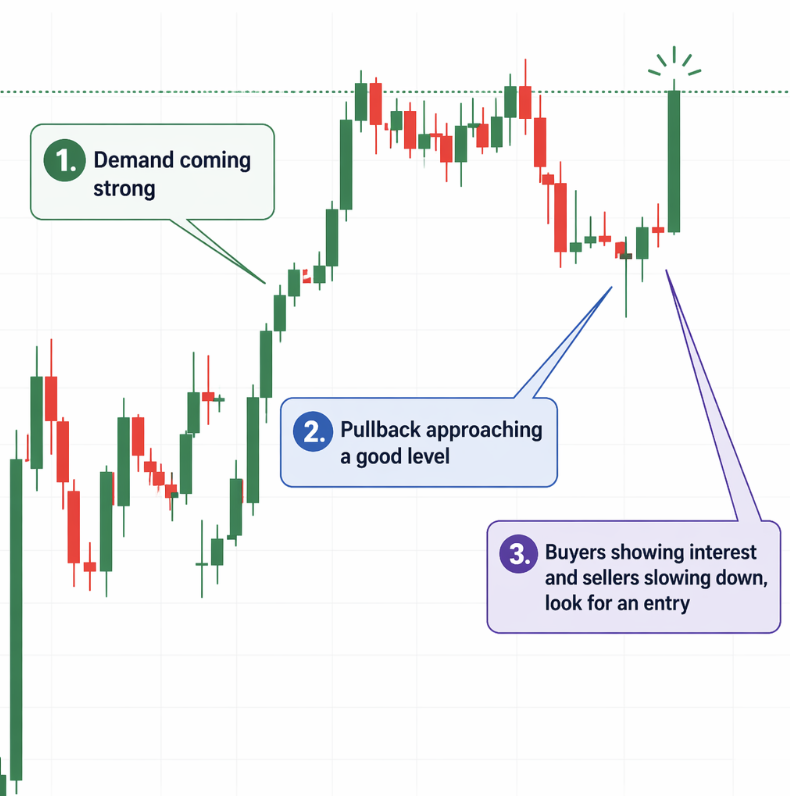
The traders who consistently pass funded challenges are not the most talented. They are the most prepared. So let me ask you, can you explain your entry in one sentence? Not a paragraph. One sentence.
“Price pulled back to a key daily level with a clean H1 rejection and I entered on the retest with clear room to my target.“
If you can say something like that before you enter, you have a model. If you can’t, you’re guessing. And guessing in a funded challenge is how you fail.
The fix: Define your setup rules before the session starts. If a trade doesn’t meet every criterion, it doesn’t get taken.
The trade walkthrough (access below) shows exactly what a one-sentence entry looks like on a real chart, and what happens when that clarity isn’t there.
REASON 04
The Expectation Gap
Why unrealistic targets lead to poor decisions and blown challenges
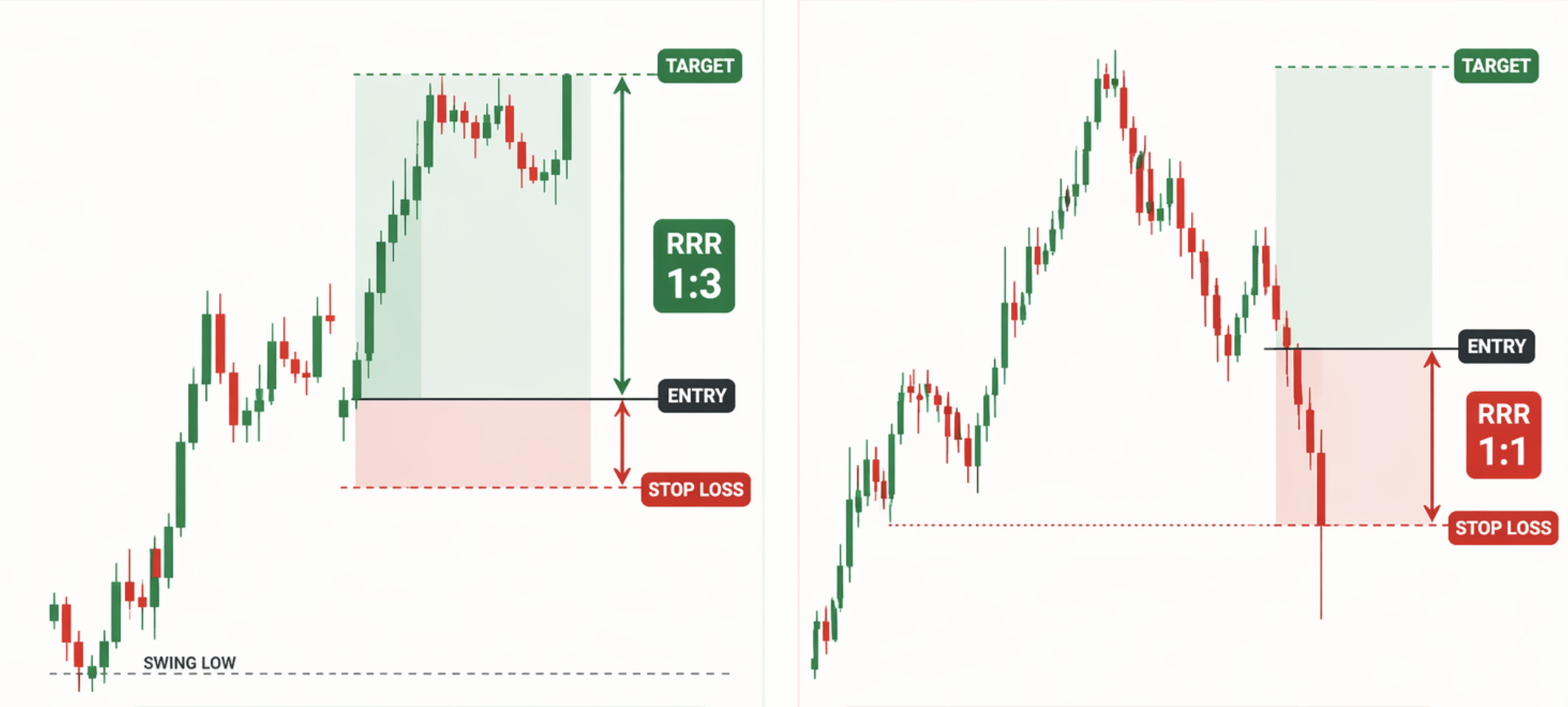
Different setups produce different outcomes. High quality setups have genuine continuation potential, hold for a larger move. Medium quality setups trade level to level, take what the market offers and exit. Low quality setups don’t get traded.
The problem happens when traders take a medium quality setup and hold it like a high quality one. The trade stalls, reverses, and turns into a loss on a setup that was never going to go further than the next level.
The fix: Before you enter, decide what kind of setup this is. Match your target to the setup quality, not to what you need to hit your profit target.
In the trade walkthrough (access below), you’ll see exactly how setup quality determines the target, and why the same level produces a completely different trade depending on how clean the setup is.
REASON 05
The Trade Selection Problem
How low quality trades quietly destroy accounts, and how to identify them before you enter
Low quality trades don’t look obviously bad when you’re about to take them. They look almost right. They have most of the criteria. But something is off.
Use these three questions as a filter before every entry:
Question 1
Do I have a clear reason to take this trade, or am I convincing myself it’s significant?
Question 2
Does this trade have enough room before the next level, or am I selling/buying from a bad price, because I’ve got FOMO?
Question 3
Am I following my plan, to entry and exit, or am I just reacting to the market?
If the answer to any of these is the second option, the trade is not worth it.
The fix: Trade the plan, not the emotion.
This is exactly what the trade walkthrough (access below) demonstrates on a real chart. You’ll see an example of a high quality setup and an example of a low quality one, and how to plan yourself accordingly.
CONCLUSION
Passing a funded challenge is not about finding more trades. It’s about making better decisions, consistently.
Most traders don’t fail because the market is too hard. They fail because small mistakes repeat over and over until the account can’t recover. Poor risk sizing, forcing trades, unclear setups, unrealistic targets, and weak trade selection, these don’t feel dangerous in the moment, but together they create steady damage.
The traders who pass are not chasing trades every day. They are protecting capital, waiting for the right conditions, and following their process without hesitation.
So before your next session, don’t ask yourself how much you need to make.
Ask yourself this instead:
Do I have a clear plan, and am I prepared to follow it without exceptions?
Because the funded challenge is not testing your intelligence.
It’s testing your discipline.
And discipline is what turns a trader into a funded trader.
Source link