Breaking Math – Fat Tail Daily
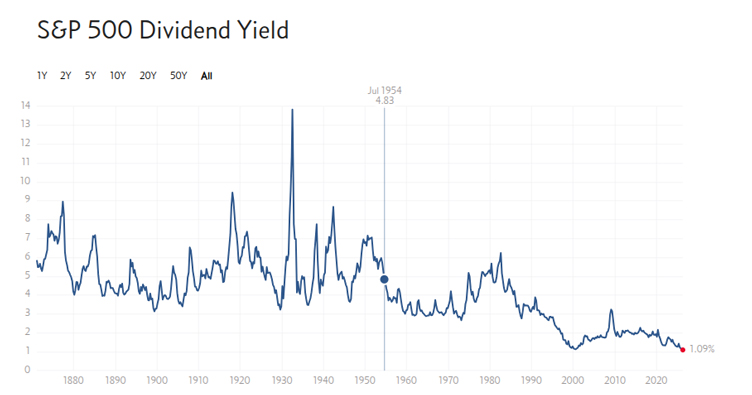
The dividend yield on the S&P 500 sets a new all-time low at 1.9%. Source: www.multpl.com
[Click to open in a new window]
The South China Morning Post reports:
Will China’s mathematicians join a global effort to boycott the United States?
America’s tech prowess — AI included — is built on a foundation of numbers.
So, the International Congress of Mathematicians is a big deal. It’s scheduled to meet in Philadelphia in July. But America’s tough visa rules and its war on Iran have inspired more than 2,300 mathematicians to sign a petition to “move the 2026 ICM out of the US.”
Does it matter? We don’t know. But it is just one of many signs that the world is moving away from us. And here’s more, The Conversation:
‘China’s rapid rise in science has hit a milestone. The country’s investment in research and development has reached parity with — and by purchasing power measures has surpassed — that of the United States, according to a March 2026 report from the Organisation for Economic Co-operation and Development. Both nations have crossed the US$1 trillion threshold on research spending.’
But so far, investors worldwide have not turned their backs on US equities…even though those stocks are at the top of bubble territory…and even though no bubble has ever failed to pop.
The question we left you with yesterday was: how come the bubble hasn’t popped? Is this something new, an eternal bubble? A smile that never turns to a frown? It seems unnatural…like mac without the cheese…a bender without a hangover…the Resurrection without the Crucifixion.
The eternal bubble idea came to us just as words. But mathematicians know why it isn’t possible. Our newest and bestest friend — an unpaid researcher, Claude — told us so. Claude is, of course, an AI app, freely available on the internet. And there is almost nothing that Claude doesn’t know.
Why can’t we have a bubble without tears, we asked him. Claude:
Bubbles pop because the conditions that inflate them are self-undermining.
The same dynamics that drive prices far above any reasonable estimate of underlying value also guarantee that the rise can’t continue indefinitely.
The arithmetic eventually breaks. A bubble requires prices to keep rising fast enough to reward new buyers. But sustaining, say, 30% annual gains compounds into absurdity within a decade — the asset would consume the entire economy. At some point the implied future earnings, rents, or cash flows become mathematically impossible, and even committed believers run out of ways to justify the next leg up.
In other words, what makes a bubble a bubble is that it is unusual. The things in it go up at an extraordinary pace. But as Claude points out, it is mathematically impossible for that to continue for very long. Nothing can grow at an extraordinary rate forever. Because it would soon fill the universe. There would be no room for anything but the extraordinary thing, which would make it very ordinary.
But why couldn’t the bubble just remain as it is? Claude might be worn out from his mental exertion already, so we’ll answer the question ourselves.
Investors don’t buy into a bubble, looking forward to the dividend checks. As they say on Wall Street, “you make your money when you buy.” And buying high means that the anticipated earnings per share will be relatively low.
Speculators buy into bubbles, not investors. In the bubble psychology, speculators believe that they can buy high…and sell even higher. They believe, often correctly, that when others see how well they are doing, they will want to join the party too.
But eventually the math doesn’t work. The bar closes and they turn off the music. Then, the speculators, who might have borrowed money to bet on the bubble, will be disappointed….and under pressure. They can ‘do the numbers’ too. If they have borrowed at 5% interest, even a 4% gain leaves them feeling blue.
Stable prices work for investors; not for speculators. When the music stops and a bubble no longer acts like a bubble, speculators go home. Not only does a stagnant bubble make them no money…it also poses substantial risk of big losses.
Speculators, after all, are betting on capital gains, not earnings. So, they are very alert to capital losses, too. And when a bubble seems to level off, they know what is likely to happen next.
First, the mathematicians edge for the exits. And then they all skedaddle.