FX Perps Explained: What Are They and How Do They Work? | BitMEX Blog
The foreign exchange market is the world’s largest and most liquid financial market. In April 2025, the daily trading volume averaged $9.6 trillion.
Yet for the past decade, it sits behind bank desks, brokerages, inefficient CFDs, and only runs 5 days a week. Crypto changes this.
FX (Forex) Perps bring FX trading onto crypto rails. No bank account, no broker approval, no expiry dates. Deposit crypto, pick a currency pair, choose your leverage, trade.
BitMEX invented the perpetual swap in 2016. It became the most traded instrument in crypto history. That same mechanism now powers forex perpetual contracts, giving crypto-native traders direct access to the world’s largest financial market.
In this article, we’ll breakdown:
What are FX Perps (Forex Perpetual Swaps)
How Did Perpetual Swaps Originate
How Does the Funding Rate Work on FX (Forex) Perps?
How Does Pricing Work on Forex Perpetual Contracts?
How Do Forex Perps Compare to CFDs, Spot, and Futures?
Who Should Trade Forex Perpetual Swaps?
What Are FX Perps (Forex Perpetual Swaps)?
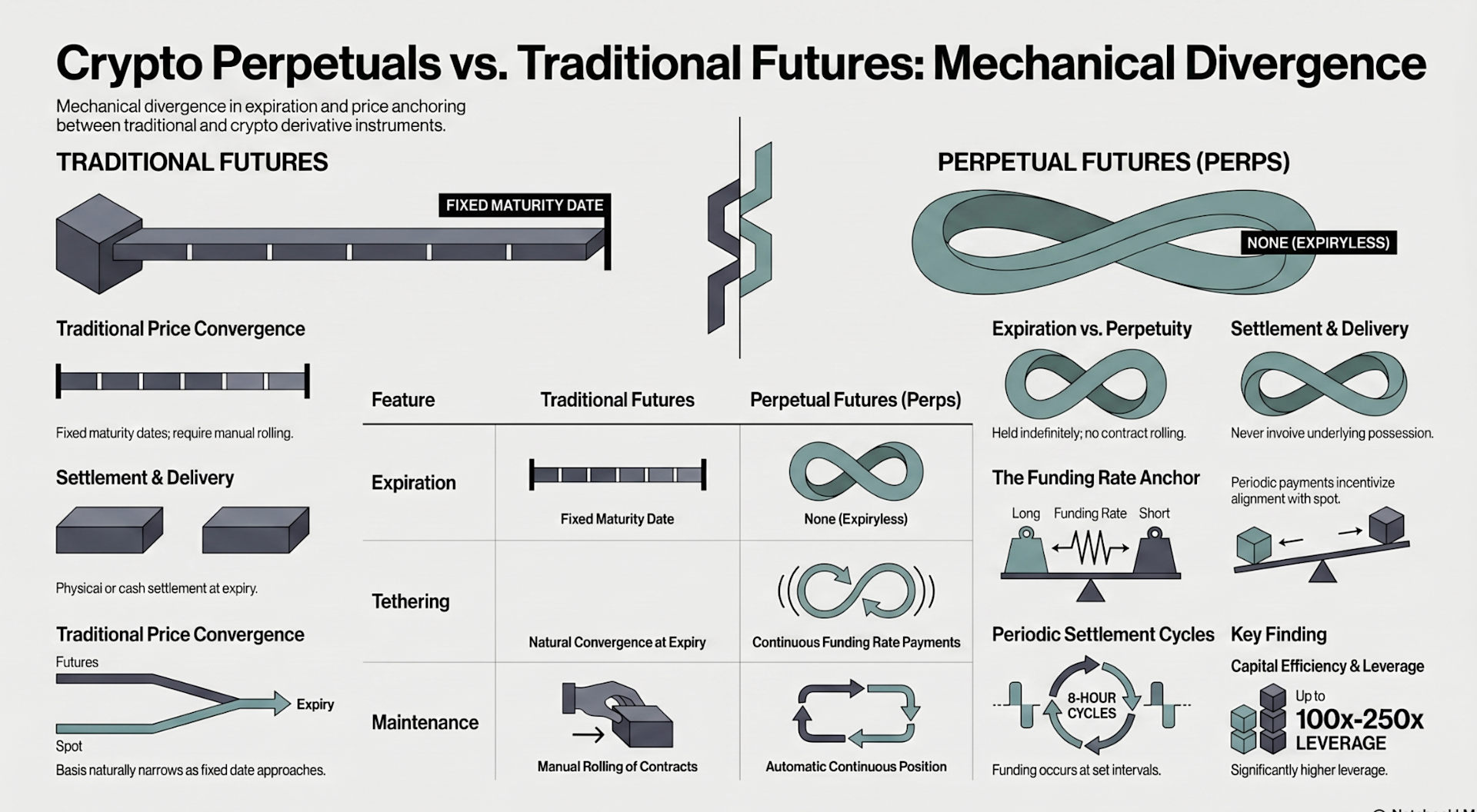
A forex perpetual swap is a derivative contract that tracks the price of a currency pair — such as EUR/USD or USD/JPY. Unlike traditional forex futures, which settle on a fixed date, forex perps have no expiry.
Three features define forex perpetual contracts:
No expiry date: No rollovers, no settlement deadlines, no forced position closures.
Crypto-settled: Deposit and withdraw in crypto (USDT on BitMEX). No bank wires, no fiat rails.
24/7/365: Trade Forex even when markets are closed. Traditional markets run five days a week.
High Leverage: Trade up to 100x leverage with FX Perps. Traditional FX Swaps support up to 50x leverage.
Funding rate mechanism: A periodic payment between longs and shorts to keep price anchored to the spot market.
Peer-to-peer: Trade against real counterparties and not a CFD dealer or exchange.
With forex perpetual swaps on BitMEX, you deposit USDT, go long any major currency with up to 100x leverage, and manage the position 24/7.
Who created the Perpetual Swaps?
BitMEX created the perpetual swap in 2016. Before this, crypto derivatives were clunky and illiquid fixed-expiry contracts where traders constantly risked liquidation due to the volatile spread between the future and the spot price, in addition to the hassle of constant rollovers.
BitMEX solved this by introducing the funding rate mechanism. This system uses a periodic payment exchange every interval between longs and shorts to keep the contract price anchored to the spot price without expiring.

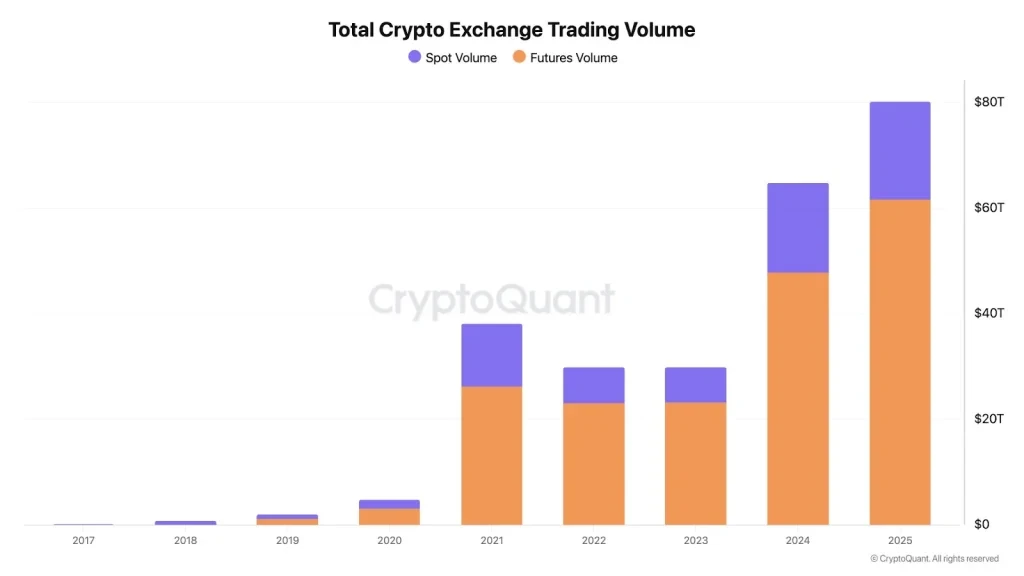
Today, the perpetual swap is the most liquid derivative instrument in crypto, accounting for over 75% of all crypto derivatives volume across every major exchange. Every competitor adopted the model BitMEX pioneered.
Forex perpetual swaps apply the same proven mechanism to currency pairs. The main difference is the underlying asset — instead of tracking BTC or ETH, the contract tracks EUR/USD or GBP/USD. On BitMEX, the funding rate has a 0% base interest rate, meaning you’re only paying for the market premium, while other exchanges charge ~11% APR.

How Does the Funding Rate Work on FX Perps?
The funding rate is the engine that keeps forex perpetual swaps priced correctly. Without it, the perpetual price would drift away from the spot FX rate.
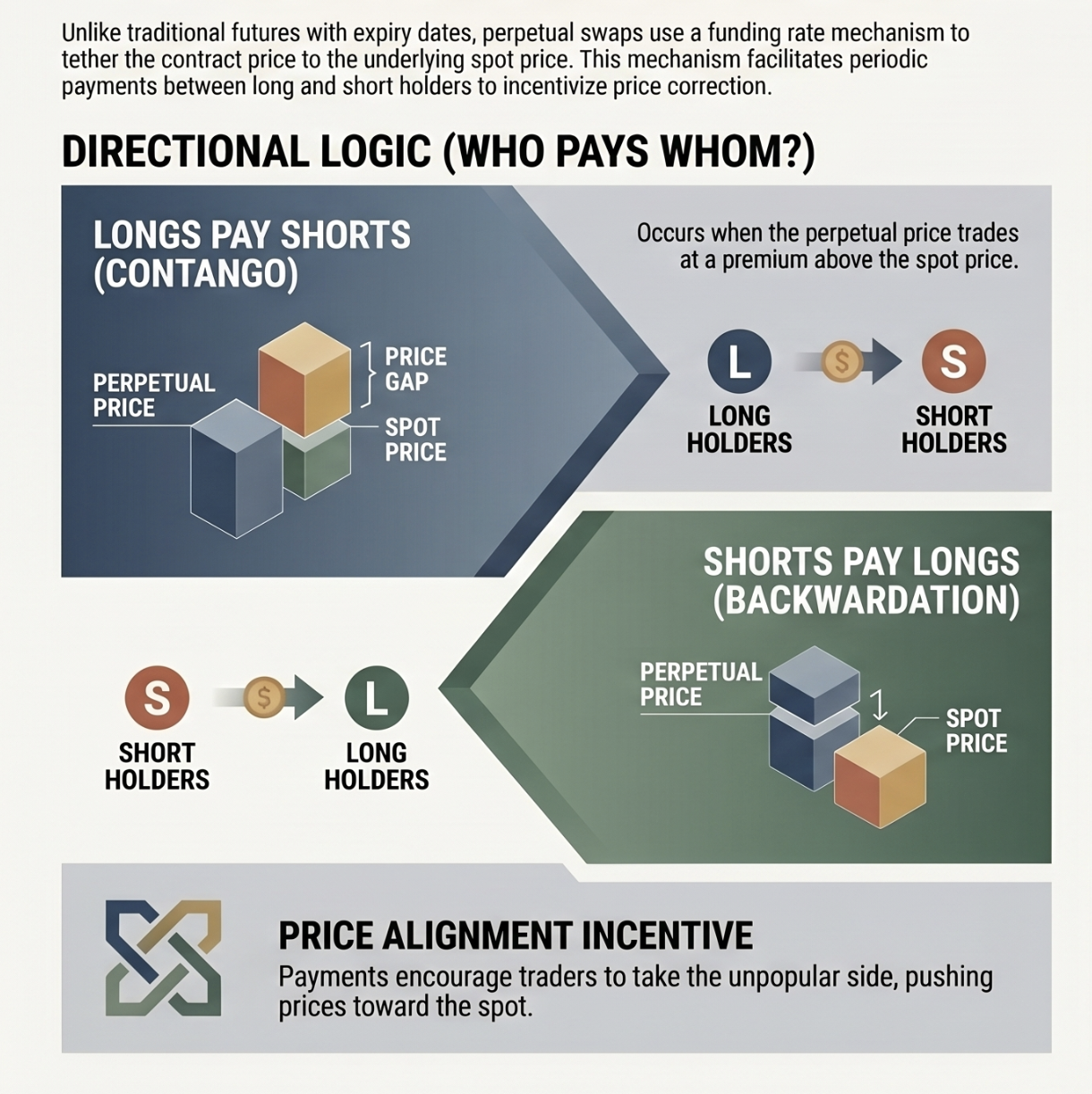
Every eight hours, the exchange calculates the difference between the perpetual contract price and the spot forex rate. If the perp trades above the spot rate, longs pay shorts. If below, shorts pay longs.

Example with EUR/USD:
EUR/USD spot rate: 1.0850
EUR/USD perpetual price: 1.0870 (perp trading at a premium)
Funding rate: +0.01%
Your long position size: $50,000
You pay: 0.01% x $50,000 = $5 every eight hours.
This small cost incentivises traders to push the perpetual price back toward spot. If longs are paying too much, some close positions or new shorts enter to collect funding. The price converges, even when traditional markets are closed.
Traditional FX brokers include overnight swap/rollover fees into every position — these can cost $5-15 per standard lot per night. BitMEX FX Perps use a 0% base interest rate when calculating funding rates. Other exchanges typically charge 11% APR for their base interest rate.
When you’re trading FX Perps, your funding rate reflects pure market premium and nothing more. The structural costs have been stripped away. Meaning if the contract is not trading at a premium or discount to the index, your cost to hold is effectively zero.
How Does Pricing Work on Forex Perpetual Contracts?
Forex perpetual contracts use three price references:
Index Price: The real-time spot FX rate, sourced from multiple major forex data providers and aggregated into a single index. This is the true market price of the currency pair. During traditional FX trading hours, BitMEX index price for FX Perps will be dominated by real-time TradFi prices. These are derived from TradFi oracles and data sources such as Chainlink. Outside of these hours (overnight, weekends, holidays), the index will be marked to the median of the Bid/Ask/Last Price on the BitMEX order book.
Mark Price: A calculated fair value used to determine unrealised profit and loss — and critically, liquidation prices. The mark price smooths out short-term wicks and manipulation attempts. Your position is liquidated based on the mark price, not the last traded price. This protects you from flash crashes caused by thin order books.
Last Traded Price: The most recent execution price on the BitMEX order book. This is the price you see moving in real time on the trading interface.
A practical illustration: you are long EUR/USD at 50x leverage. A single large market sell order temporarily pushes the last traded price down by 0.3%. Without mark price, that momentary spike could liquidate your position unfairly. Because BitMEX uses the mark price — anchored to the broader forex index — your position survives the wick.
Always check the mark price when evaluating your liquidation level. The last traded price is what you transact at. The mark price is what determines whether your position stays open.
How Do Forex Perps Compare to CFDs, Spot, and Futures?
Feature | Forex Perps | Forex CFDs | Spot Forex | Forex Futures |
|---|---|---|---|---|
Expiry | None | None | T+2 settlement | Fixed (quarterly) |
Leverage | Up to 100x | 30x-500x (varies by jurisdiction) | Up to 50x | Up to 30x |
Collateral | Crypto (USDT) | Fiat (bank transfer) | Fiat (bank transfer) | Fiat (bank transfer) |
Trading Hours | 24/7/365 | Mon-Fri (forex sessions) | Mon-Fri (forex sessions) | Mon-Fri (exchange hours) |
Counterparty | Exchange (order book) | Broker (often market maker) | Interbank/broker | Exchange (CME, ICE) |
Funding/Carry Cost | Funding rate (market demand) | Overnight swap rate (Central Banks) | Swap rate (Central Banks) | Basis/roll cost |
Account Setup | Minutes (crypto deposit) | Days (KYC + bank link) | Days (KYC + bank link) | Days (margin approval) |
Minimum Capital | $50-100 | $200-500 | $1,000+ | $5,000+ |
Regulation | Varies by exchange | FCA, ASIC, CySEC | FCA, ASIC, CySEC | CFTC, CME |
Settlement | USDT/crypto | Cash (fiat) | Deliverable or cash | Cash or delivery |
The key differences:
CFDs often mean trading against your broker: Many retail CFD brokers are the counterparty to your trade — they profit when you lose. Forex perps on BitMEX use a central order book. You trade against other traders. A true peer-to-peer system.
Spot forex requires actual currency settlement: Forex perpetual swaps are purely synthetic — no currency changes hands.
Forex futures expire: Roll positions quarterly, paying spread and slippage each time. Forex perps never expire.
Crypto settlement is the real differentiator: No bank account, no brokerage, no fiat onramps. If you hold crypto, you can trade forex.
What Margin and Leverage Are Available on Forex Perps?
BitMEX offers up to 100x leverage on forex perpetual contracts. A $1,000 deposit can control a $100,000 notional position.
Two margin modes are available:
Isolated Margin: Only the margin assigned to a specific position is at risk. If your EUR/USD trade goes wrong, only the margin allocated to that trade is lost. Your other positions and wallet balance remain untouched.
Cross Margin: Your entire available wallet balance acts as collateral for all open positions. More room before liquidation, but a losing trade can consume margin earmarked for other positions.
Learn more about margin types here.
Practical example: You deposit 5,000 USDT.
Isolated margin at 20x: Allocate 1,000 USDT to a EUR/USD long. Position size: $20,000. Maximum loss: 1,000 USDT. Your other 4,000 USDT is safe.
Cross margin at 20x: Your entire 5,000 USDT balance backs the position. More breathing room before liquidation, but the full 5,000 USDT is at risk if the trade moves far enough against you.
For forex perps, lower leverage (5x-20x) is sensible for most traders. Major currency pairs typically move 0.5%-1.0% per day. At 20x leverage, a 1% move against you equals a 20% loss on your margin. At 50x, that same 1% move equals a 50% loss.
What Forex Pairs Are Available on BitMEX?
BitMEX offers forex perpetual contracts on six major currency pairs:
These are the most liquid currency pairs in the world. EUR/USD alone accounts for roughly 23% of global FX turnover. High liquidity means tighter spreads, more predictable price action, and deeper order books.
Who trades what:
Macro traders gravitate toward EUR/USD and USD/JPY — these pairs respond directly to central bank decisions, interest rate differentials, and economic data.
News traders prefer GBP/USD — the pound is famously reactive to political events and Bank of England surprises.
Commodity-linked traders watch USD/CAD — the Canadian dollar tracks oil prices closely.
If you are new to forex perps, start with EUR/USD. Tightest spreads, most predictable behaviour, deepest liquidity.
Who Should Trade Forex Perpetual Swaps?
Forex perps are designed for a specific type of trader.
Ideal for:
Crypto-native traders who want forex exposure without leaving the crypto ecosystem. Capital stays in USDT. No fiat conversion.
Macro-focused traders who follow central bank decisions, interest rates, and economic data — and want to act on those views with leverage.
Portfolio diversifiers looking to hedge or offset crypto volatility. When BTC drops 15% in a day, EUR/USD moves 0.5%. Adding FX exposure smooths your portfolio’s risk profile.
24/7 traders who want to trade across Asian, European, and American sessions without platform restrictions.
Not ideal for:
Complete beginners who have never traded derivatives. Learn leverage, margin, and liquidation on crypto perps first.
Volatility seekers. If you trade crypto for 10%-20% daily swings, forex will feel slow. Major pairs move 0.5%-1% on a typical day.
What Are the Risks of Trading Forex Perps?
Every leveraged product carries risk. Forex perpetual swaps are no exception.
Liquidation risk: At 50x leverage, a 2% move against your position liquidates you entirely. Forex pairs can move 2% in a single day during major events — central bank surprises, geopolitical shocks, unexpected economic data.
Funding rate costs: Holding a position for weeks means funding payments accumulate. At 0.01% per eight hours, that is roughly 0.03% per day or 0.9% per month. On a $50,000 position, that equals $450 per month. Factor this into your strategy.
Liquidity risk: Forex perps on crypto exchanges have less depth than the interbank FX market. During fast-moving events, slippage can be higher — particularly on less liquid pairs.
Oracle and index risk: The index price is sourced from external forex data providers. If those feeds malfunction or experience delays, it can temporarily affect mark price calculations. Low probability, but not zero.
How to manage these risks:
Use isolated margin: Cap your maximum loss per trade.
Set stop-loss orders: Do not rely on mental stop-losses.
Start with low leverage (5x-10x): Increase only as you gain experience with how FX pairs move.
Monitor the economic calendar: Major events — NFP, FOMC, ECB decisions — create outsized moves.
Check funding rates before entering a trade: Elevated rates increase your holding cost.
Frequently Asked Questions
What is a FX Perp (forex perpetual swap)?
A forex perpetual swap is a derivative contract that tracks a currency pair — EUR/USD, GBP/USD, USD/JPY — without an expiry date. You trade it with crypto collateral (USDT on BitMEX), pick your leverage, and hold the position as long as your margin holds.
A funding rate exchanged every eight hours between longs and shorts keeps the contract price anchored to the spot FX rate. No settlement deadline, no quarterly roll, no forced close on expiry.
BitMEX invented the perpetual swap in 2016 for crypto. Forex perps apply the same mechanism to currency pairs. If you have traded a BTC perp, the mechanics are identical — only the underlying changes from a token to a fiat pair.
How do forex perps differ from traditional forex trading?
Forex perps strip away the infrastructure that gates traditional forex. Deposit USDT from any crypto wallet, pick a currency pair, and trade.
Traditional forex sits behind bank desks, brokerage accounts, and CFD dealers. It settles in fiat, runs Monday to Friday during market sessions, and requires days of broker onboarding before you can place a trade. Futures add expiry dates on top — roll every quarter, pay the spread.
Forex perps remove each of those steps:
Crypto-settled: USDT in, USDT out. No bank wire.
24/7/365: trade during London lunch, the Tokyo open, or weekend gaps.
No expiry: hold as long as your margin holds.
No broker middleman: BitMEX runs a central order book. You trade against other traders, not a dealer betting against you.
What leverage is available on BitMEX FX Perps?
BitMEX offers up to 100x leverage on forex perpetual contracts. A $1,000 deposit can control a $100,000 notional position.
You can choose between two margin modes:
Isolated margin: only the margin assigned to a specific position is at risk. If EUR/USD moves against you, only the margin on that trade is lost. The rest of your wallet stays untouched.
Cross margin: your full available wallet balance backs every open position. More room before liquidation, but a losing trade can draw down margin earmarked for other trades.
Lower leverage (5x–20x) is sensible for most forex traders. Major pairs typically move 0.5%–1% on a standard day. At 50x, a 2% move wipes out your margin — and pairs can move 2% on CPI or FOMC days.
Which forex pairs can I trade on BitMEX?
BitMEX offers forex perpetual contracts on six major currency pairs: EUR/USD, USD/JPY, GBP/USD, USD/CHF, USD/CAD, and AUD/USD.
These are among the most liquid pairs in global FX. EUR/USD alone accounts for roughly 23% of daily turnover worldwide, which means tighter spreads, deeper order books, and more predictable behaviour.
Different traders favour different pairs:
EUR/USD and USD/JPY: macro traders following central bank decisions and interest rate differentials.
GBP/USD: event traders, given the pound’s sensitivity to UK political and economic surprises.
USD/CAD: commodity-linked traders who track oil prices.
If you are new to FX Perps, start with EUR/USD. Tightest spreads, deepest liquidity, most predictable behaviour.
Do I need a bank account to trade FX Perps?
No. Forex perps on BitMEX settle in crypto, not fiat. Deposit USDT from any crypto wallet and you can open a position in minutes.
Traditional forex trading requires a bank account to fund a brokerage, plus broker KYC that can take days. Even after onboarding clears, deposits often route through international wire transfers with their own fees and cut-off times.
BitMEX replaces that flow with crypto deposit. Send USDT and other crypto from an exchange wallet or a self-custody wallet, wait for on-chain confirmation, and your BitMEX account is funded.
When you are ready to cash out, withdraw USDT to the same wallet. No bank liaison, no international wire, no explanation to your bank about why you are trading foreign currency.
What is the funding rate on FX Perps?
The funding rate is a payment exchanged every eight hours between long and short traders. It is designed to keep the perpetual price aligned with the spot FX rate.
If the perp trades above spot, longs pay shorts. If the perp trades below spot, shorts pay longs. The amount reflects the size of the premium or discount, plus the interest rate differential between the two currencies in the pair.
BitMEX forex perps use a 0% base interest rate. You pay only for the market premium — not a structural carrying cost baked in by the exchange. Other crypto venues typically apply a base rate of around 11% APR on top of the premium.
Example: on a $50,000 EUR/USD long with a +0.01% funding rate, you pay $5 every eight hours until the perp price converges with spot.
Source link