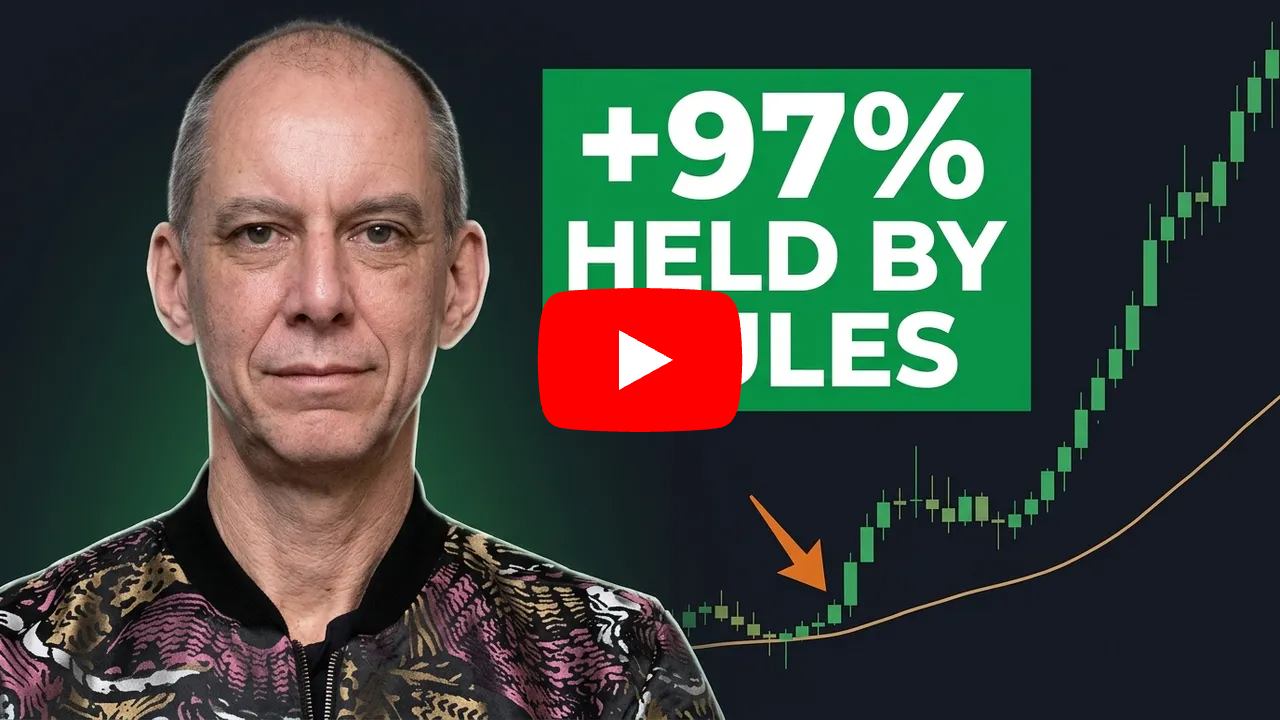
One Rule Held For An +97% Gain.
Enjoy this post? Share the love.

Most traders would have sold Micron ($MU) at +20%. Some would have panic-sold when it pulled back to the 8-day EMA. The ones who held all the way to an +80% average gain weren’t braver or luckier. They had one rule telling them exactly when to hold and when to exit.
On April 9th, we entered $MU at $405 following a confirmed market buy signal. We sold the first half on May 6th for a +63% gain. We sold the rest for +97%. The average across the full trade: 80%.
The day after the final exit, $MU dropped 11% intraday.
This is a breakdown of every rule that made this trade work, from entry to final exit.
The Buy Signal: Why April 9th Was the Entry Day
The entry wasn’t a gut call. On April 8th, the Nasdaq registered a follow-through day: a close at least 1.5% higher than the prior day, on higher volume, at least four days after the market formed a low. That’s the specific signal built into the MTG market timing model that confirmed a new uptrend.
That put April 9th as the first actionable day. The news cycle was still negative. Most traders were still scared. The rules of the rule-based methodology said the buy signal was there, and that was enough.
Micron ($MU) was already in a confirmed uptrend before the entry. That matters. The goal is never to buy off the lows. You wait for a stock that’s already showing strength, then enter when the broader market gives the green light.
Stop Placement and Position Sizing: Before the Trade Is Even On
Entry price: $405. Stop price: $393. That’s a 12-point stop, set at the time of entry, before a single share was purchased.
The position sizing formula is straightforward. Maximum risk per trade is capped at 1% of the account. On a $20,000 account, that’s $200 maximum risk. Divide $200 by the 12-point stop and you get 16 shares.
The position ends up being roughly $6,400 in capital. But the risk is $200. Not $6,400.
“Every trade becomes a $200 question, not a $6,400 question. This is how you stay in the game long enough for a trade like this to work.”
The Hold Rule: One Line on the Chart, One Decision
The rule for managing the trade was the 8-day exponential moving average (EMA). As long as $MU did not close below the 8-day EMA, the position stayed open. Full stop.
From April 9th through both exits, $MU touched the 8-day EMA several times intraday. It never closed below it once.
Every uncomfortable week, every pullback that felt like the trade was rolling over, the rule said the same thing: hold. And it was right every time.
This is the rule most traders are missing. Without it, every dip becomes a reason to second-guess. With it, the decision is already made.
The Exit: Selling Into Strength Before the Drop
The 8-day EMA never broke. By rule one, the position should still be open. But a second exit rule exists for situations where the move goes so far so fast that the trade itself becomes a risk.
Four exhaustion signals appeared at once:
- The price was more than 25% above the 8-day EMA
- Multiple gap-ups in a row, each one wider than the last
- The highest volume of the entire move (late buyers piling in)
- A gap-up day that closed below the prior day’s high
When you see those signals stacking up on a parabolic extension, you don’t wait for the breakdown. You sell into strength while buyers are still there.
The first half sold at +63%. The second half sold at +97%. The next day, $MU dropped 11% intraday.
The 5 Rules That Made This Trade
- Confirmed uptrend before entry, never buy off the lows
- Follow-through day buy signal from the MTG market timing model
- Stop price set at the time of entry, sized to 1% max account risk
- 8-day EMA as the trailing hold/exit rule for every decision
- Sell into strength when exhaustion signals appear on a parabolic extension
“This trade didn’t work because of skill or luck or a prediction about Micron’s business. It worked because these five rules were applied consistently without exception.”
What Stops Most Traders From Holding Winners
Kenneth traded for seven years without finding consistency. He could identify setups. He couldn’t hold through the discomfort. Once he had a rule precise enough to trust, that changed.
The problem for most traders is never finding good trades. The problem is having no rule for when to hold and when to exit. So emotions make that decision instead.
Join our next free live session where Deron goes deeper into the complete rule-based methodology behind trades like this:
👉 https://academy.morpheustrading.com/free-trading-masterclass
Want to go deeper? Join Deron Wagner live every week for our free masterclass — The Real Reason 90% of Traders Fail. Reserve your spot here:
👉 academy.morpheustrading.com/free-trading-masterclass
For daily professional swing trade alerts across stocks, crypto, futures, and Forex, visit The Wagner Daily PRO.
And always remember: trade what you see, not what you think.
Stay Connected:
Stay Informed:
Disclaimer: The information presented in this post is for educational and entertainment purposes only and is not financial advice. We are not financial advisors. Trading can result in loss of funds. Individuals must consider all risk factors including their own personal financial situation before trading. All individuals are responsible for their own trades and investments. Morpheus Trading and affiliates are not responsible for individual loss due to poor trading decisions or any other actions which may lead to loss of funds.
Enjoy this post? Share the love.