How Online Platforms Enhance Trading Community Engagement » The Trader In you
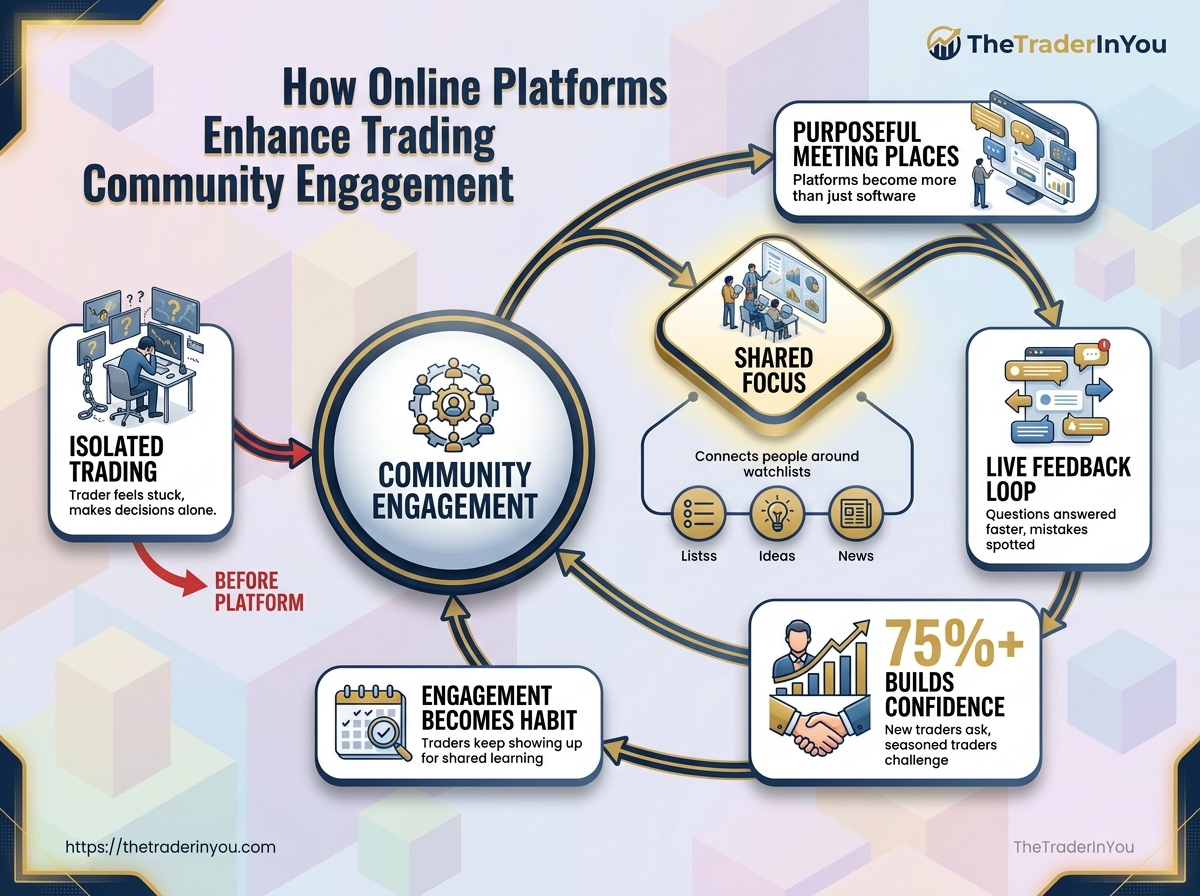

A trader can have the cleanest chart setup and still feel stuck when every decision is made alone.
That isolation is exactly where community engagement starts to matter.
Modern trading platforms do more than place orders.
They connect people around watchlists, market commentary, shared trade ideas, and fast reactions to news.
That changes how traders learn.
A strong online trading community turns scattered opinions into a live feedback loop, where questions get answered faster and mistakes become easier to spot.
The difference shows up in small moments: a new trader asking why price snapped back, a seasoned trader challenging a setup, a quiet observer finally joining the conversation.
Those moments build confidence, and confidence keeps people involved long after the first trade.
Of course, not every discussion helps.
Bad forums reward noise, while good ones reward clear rules, shared context, and honest disagreement.
That is why the best trading platforms feel less like software and more like meeting places with a purpose.
They give people a reason to return, not just a place to click.
And when traders keep showing up, engagement stops being a metric and becomes a habit.
Why do two traders using the same trading platform often end up with very different results?
The answer is rarely just chart settings or order types.
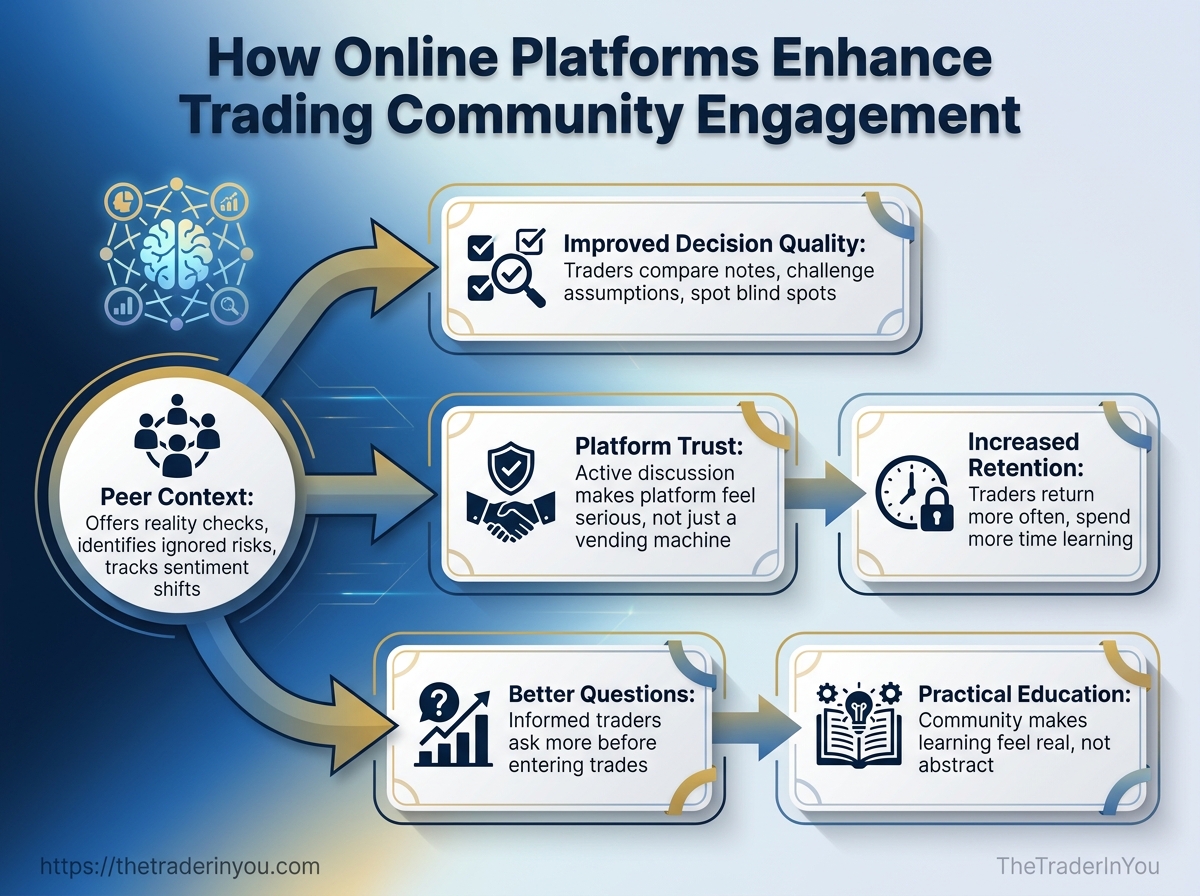
The stronger edge usually comes from community engagement inside the platform, where traders compare notes, challenge assumptions, and spot blind spots faster than they would alone.
A trader working in isolation sees only their own screens.
A trader inside an online trading community gets context: how others are reading the same currency pair, what risks are being ignored, and where sentiment is shifting across sessions.
That peer context matters even more in global Forex, where price action can change with a central bank comment, a surprise data release, or a quiet shift in risk appetite.
Platform features are useful, but features do not tell you whether your idea is being shared by other professionals or quietly fought by them.
Peer context changes decision quality.
It gives traders a reality check before they size a position too early or hold a trade too long.
It also builds trust in the platform itself.
When users see active, thoughtful discussion, a platform feels less like a vending machine for trades and more like a serious trading environment.
For brokers and platform owners, the business case is just as clear.
Traders who participate in communities tend to return more often, spend more time learning the platform, and develop deeper habits around research and execution.
Informed traders ask better questions before entering a trade.
Shared discussion can expose weak setups faster.
Community participation makes education feel practical, not abstract.
Active discussion also helps platforms retain serious users longer.
A strong trading platform is not only measured by speed or charting depth.
It is also measured by whether people come back because they learned something useful from each other.
That is where the real value sits.
The tools matter, but the conversation around them is often what turns a capable trader into a sharper one.
Why do some trading platforms feel alive while others feel like abandoned waiting rooms? The difference usually comes down to a few design choices that make people talk, react, and come back.
Discussion boards, live chat, and comment threads give traders a place to test ideas in real time.
Social feeds and trade idea streams add a faster layer, where market sentiment spreads almost as quickly as price moves.
That mix matters because an online trading community is not built on charts alone; it is built on repeated interaction.
The tricky part is trust.
A busy feed can look impressive and still be noisy, misleading, or plain useless if nobody checks who is posting and what gets removed.
How moderation and verification shape trust in the online trading community
| Platform feature | Engagement function | Trust benefit | Best use case |
|---|---|---|---|
| Discussion forum | Longer-form debate, question threads, and topic archives | Creates a searchable record and slows down knee-jerk claims | Strategy discussions, beginner questions, market breakdowns |
| Live chat | Fast back-and-forth around active setups and news | Works best when spam is filtered quickly and off-topic chatter is cut | Intraday trading, event-driven markets, active sessions |
| Trade idea feed | Broadcasts watchlists, setups, and entry or exit logic | Makes reasoning visible, so others can judge the idea, not just the call | Idea sharing, peer feedback, recurring trade patterns |
| Verified user profiles | Shows identity checks, experience markers, or account history | Reduces anonymous hype and makes accountability easier | Mentor-style communities, premium rooms, public contributions |
| Moderator oversight | Removes spam, abuse, manipulation, and duplicate posts | Keeps discussions readable and lowers the spread of low-quality signals | Large communities, open forums, high-traffic market events |
| Reputation badges | Highlights consistent contributors, helpful answers, or rule compliance | Helps members spot reliable voices faster | Expert Q&A, peer recognition, long-term participation |
It gives traders enough room to explain a setup, challenge an assumption, and see whether the idea still holds under pressure.
Live chat works differently.
It is best when speed matters, but speed without moderation turns into a loud room with bad manners.
A verified profile and visible reputation markers help the useful voices stand out before the crowd gets too noisy.
Trade idea feeds and sentiment sharing are powerful because they reveal how traders are thinking, not just what they are buying.
That can be useful for spotting crowded trades, fading overconfidence, or noticing when a market mood shifts before price fully reacts.
The strongest trading platforms treat engagement features like a trust system, not just a social layer.
That is where community engagement starts feeling useful instead of chaotic.
Why do some traders keep showing up, while others drift away after a few rough sessions? Often, the difference is not motivation.
It is access to the right educational tools at the right moment.
On strong trading platforms, education does more than teach basics.
It keeps the online trading community moving with fresh context, tighter routines, and fewer guesswork-driven decisions.
A trader who watches a market briefing before the open usually reads the day differently than someone scrolling random headlines at lunch.
Webinars, tutorials, and market briefings
A live webinar creates a sense of timing that static content never quite matches.
Tutorials help traders repeat the same process until it feels natural.
Market briefings fill the gap between “something is happening” and “this is why it matters.”
Webinars: Best for live context, question handling, and fast reactions to changing conditions.
Tutorials: Best for repeatable skills like order entry, watchlist building, and risk controls.
Market briefings: Best for framing the day, especially when news flow is noisy and mixed.
A good platform does not bury these tools in a menu.
It places them where traders can use them before a session, during a volatile move, and after the close.
Interactive learning paths for different skill levels
New traders need structure.
Experienced traders need depth.
The best educational paths treat those needs differently instead of forcing everyone through the same lesson sequence.
Starter tracks: These should cover platform basics, market vocabulary, and simple trade planning.
Intermediate tracks: These should focus on reading setups, reviewing mistakes, and understanding how catalysts affect price.
Advanced tracks: These should include scenario work, live commentary, and deeper analysis of execution and timing.
Progress checkpoints: Small quizzes or task-based milestones keep traders active instead of passively watching content.
Education also cuts through noise.
When traders understand what matters, they stop reacting to every headline, rumor, and chatroom hot take.
That usually improves decision quality fast, especially in fast-moving markets.
For sites building stronger community engagement, this matters because learning becomes part of the habit loop.
Traders come back not just for charts, but for clarity.
That is the kind of value that keeps an online trading community useful long after the first login.
Trust signals that make online communities worth joining
Would you trust a trader who shows only profit screenshots and no history? Probably not—and that instinct is healthy.
In platform communities, credibility starts with proof you can inspect. Section 5 covers the mechanics (verification, moderation, reputation). This section focuses on the behavioral signals that show whether people are actually contributing useful trading thinking—or just selling a narrative.
That matters even more in Forex, where leverage magnifies mistakes, the market moves quickly, and incentive-driven ‘certainty’ can spread faster than risk judgment.
Trust signals that separate real communities from noise
| Trust signal | Healthy example | Warning sign | What it means for traders |
|---|---|---|---|
| Activity history depth | Posts stretch across months and changing regimes (not just one hype cycle) | Burst activity only around major moves or “hot” events | You’re more likely seeing experience than opportunistic timing |
| Transparent posting rules | Sponsored posts, affiliates, and trade-idea labeling are clear and consistently applied | Promotions are disguised as “just sharing a view” or hidden behind vague invitations | You can tell education from sales pressure before you engage |
| Balanced commentary | Members discuss losses/drawdowns, not just winners—and explain what changed | Every post sounds like an unbeaten streak | Unrealistic success talk often means risk is being omitted or softened |
| Conflict disclosure | Mods/mentors disclose broker ties, course sales, coaching, or referral incentives when relevant | No disclosures while pushing a product or steering conversations to one link | Hidden incentives can bias what’s “recommended” and what’s ignored |
| Spam control | Copy-paste pitches get removed quickly, and repeat offenders are curtailed | Same pitch shows up under many accounts/usernames | The room may be coordinated promotion rather than an organic learning group |
| Dispute handling | Users can report issues and see follow-ups (not silent deletions with no closure) | Complaints disappear or get dismissed without resolution | You have less protection if a thread turns dishonest or manipulative |
A strong online trading community does not need to feel polished. It needs to feel accountable.
When the behavioral signals are visible—history depth, clear disclosures, realistic risk talk—community engagement becomes easier to trust. And in Forex, that trust is often worth more than the loudest trade call in the room.
Would you rather catch a weak trade idea in a discussion, or discover it after the loss is already booked? That is where community engagement earns its keep on trading platforms.
A good online trading community gives traders a place to pressure-test ideas against real market thinking, not just their own bias.
Peer discussion is most useful before entry.
One trader may love the setup, while another spots a messy volume pattern, a nearby event, or a level that is likely to hold.
That back-and-forth does not replace your chart work, but it does expose blind spots fast.
Crowd reaction matters too.
When the same market move triggers very different reactions, that disagreement is usually worth paying attention to.
It can point to crowded positioning, shaky conviction, or a narrative that looks stronger than it really is.
Where community input helps most
Trade validation: Compare your thesis with traders who use different timeframes or styles.
Sentiment reading: Notice whether people are calmly analyzing a move or chasing it with too much excitement.
Risk spotting: Catch things like event risk, thin liquidity, or price stretching too far too fast.
Scenario testing: Hear what would make other traders abandon the setup, then check whether your own plan says the same thing.
A simple example makes this clearer.
Imagine a trader sees a stock breaking resistance and wants to buy immediately.
In a live discussion, another trader points out that earnings are due tomorrow and the move is already extended.
That does not kill the idea, but it changes the risk conversation completely.
Where independent judgment still leads
Community input helps most when it sharpens your thinking, not when it hands you a decision.
If a trade only looks good because other people like it, that is usually a warning sign.
Your own rules still need to lead on position sizing, entry, invalidation, and exit.
A room full of confident voices cannot manage your risk for you.
The strongest traders use community feedback like a second set of eyes.
They listen, filter, and then make the call themselves.
What separates high-quality platforms from crowded, low-value communities
A busy online trading community can look impressive at first glance.
Posts fly by, opinions are loud, and there is always someone commenting.
Noise is not the same as value.
A strong platform for trading platforms and discussion gives you trade logic, context, and follow-through.
A weak one gives you recycled hot takes, vague charts, and applause for whoever shouts the loudest.
The difference shows up in the structure of the conversation.
On better platforms, people explain why a setup matters, what would invalidate it, and how they handled the trade after entry.
On lower-quality platforms, the feed rewards speed over thought, so engagement grows while useful judgment shrinks.
Design shapes that outcome more than most traders realize.
Clear topic lanes, searchable archives, and room for longer replies push people toward careful discussion.
Endless feeds, shallow reactions, and reward systems built around volume usually produce more posts, not better ones.
A simple way to judge depth is to ask whether the community remembers its own discussions.
If the same questions keep getting answered from scratch, the platform probably lacks structure.
If people can build on earlier threads and challenge each other with specifics, that is a much healthier sign.
Specificity: Good communities talk in levels, timeframes, risk, and invalidation points.
Weak ones stay stuck at “this looks bullish.”
Conversation shape: Strong platforms invite replies that add evidence, not just emojis or agreement.
Searchability: If useful threads are easy to find later, the community is built for learning, not just scrolling.
Moderation style: Quality spaces usually protect discussion standards without killing disagreement.
That balance matters.
Pattern memory: Better groups reuse lessons from past calls, which keeps the same mistakes from getting recycled.
Imagine two traders asking about the same breakout.
In one community, they get chart context, risk notes, and a few different views.
In the other, they get ten half-finished opinions and one confident guess.
That gap tells you almost everything.
A good platform should make you sharper after ten minutes, not just busier.
That is the real test when comparing trading platforms and any online trading community worth your time.
How traders can participate more effectively in platform communities
Ever notice how two traders can ask the same question and get completely different value back?
The difference usually comes down to how the question is framed.
Vague posts pull vague replies, while specific context tends to bring out useful chart reads, risk ideas, and hard-earned mistakes from people who have been around the block.
That matters because an online trading community can either sharpen judgment or flood it with noise.
The traders who get the most out of trading platforms usually do one simple thing well: they ask better questions, check claims against reality, and keep a steady learning habit.
The easiest way to improve reply quality is to make your question easier to answer.
Include the market, timeframe, entry idea, and what you have already ruled out.
A post that says, “Is this good?” gets guesses.
A post that says, “I’m watching ES on the 15-minute chart after a failed breakout, and I want feedback on the stop location,” gets real input.
A good reply filter helps too.
Promotional content often sounds confident but stays empty on details.
Bias shows up when someone pushes one setup as if it works everywhere, in every market, all the time.
Ask for process, not praise. Good questions invite reasoning, not applause.
Request the full setup. A useful reply should include entry, stop, target, and why the trade fits current conditions.
Check for one-sided certainty. Heavy claims with no downside discussion usually deserve extra caution.
Watch for repeated product pushing. If every answer ends in a sales pitch, the insight is probably thin.
A repeatable routine keeps community engagement useful instead of random.
Traders who check in without structure usually absorb whatever is loudest that day.
Traders who follow a pattern learn faster because they compare posts, test ideas, and revisit what actually worked.
Scan for one or two high-quality threads. Spend a few minutes looking for detailed charts, clear trade logic, and thoughtful disagreement.
Post one focused question. Tie it to a specific setup, not a broad market opinion.
Save useful replies in a notes file. Group them by topic, such as entries, risk control, or market structure.
Review the notes weekly. Look for patterns in the feedback, not just the loudest opinion.
That rhythm turns community engagement into a real edge.
It also keeps trading platforms useful long after the excitement of a new post fades.
Conclusion
The Real Edge Lives in the Conversation
The strongest lesson here is simple: community engagement turns an online trading platform into a place where judgment gets sharpened—not just a place where trades get posted.
When traders compare setups, challenge assumptions, and discuss what would make them wrong, decisions become less isolated and more disciplined.
But the edge only shows up when you convert what you learn from the community into what you do next.
- Start with one question: Pick a specific trade decision you’re wrestling with (entry timing, invalidation level, or event risk) and ask the community to help you stress-test that one point.
- Turn replies into rules: Capture the best reasoning into your own framework—what you will change, what you will ignore, and what evidence would confirm or invalidate your thesis.
- Review outcomes with intent: After a session or week, check whether the community’s input improved your process (clarity, risk control, and discipline), not whether a call “worked.”
That is how engagement becomes a repeatable habit—valuable long after the excitement of a new post fades.
If you want participation to lead to better decisions, use the community as a feedback layer alongside your education and your execution routine—so every discussion helps you trade your plan, not someone else’s narrative.
Follow Joshua for daily forex tips on X: @thetraderinyou or connect with him on LinkedIn: Joshua Okapes.
Source link