Far from the Wall Street Crowd – Fat Tail Daily

What lured us to Paraguay? Is it not a backwater? A disreputable refuge for war criminals and disgraced smugglers? A sweltering tropical island without a beach?
Not anymore. It is still hot — in the summer months. It is still landlocked, snuggled in between Brazil, Uruguay, Argentina, and Bolivia. But the old Nazis, if there ever were any, have died…and Paraguay has come alive.
A proximate purpose of our trip was revealed in the headline of the La Nacion (Paraguay) on Friday:
Shipments of beef to Europe will begin in June
Then, in Saturday’s paper came more motivation in the UltimaHora:
The Fall of the Dollar Means Recalculating Investments
It is always a mistake to base investments on macro guesses. Even if you’re right about the trends, they often don’t have the results you expect.
But we don’t expect people to stop eating beef. And if we can produce the meat efficiently, we might be able to eek out a modest living. No outsize profits. No serious capital gains. Just a decent business with decent returns. So, we’re teaming up with an Argentine family to raise cattle in Paraguay.
Why Paraguay? Because it has lush, low-cost pastures…low taxes…and low labor costs. And a cattle investment in Paraguay is about as far from Wall Street as possible. More important, our partners know what they are doing. They’ve been raising cattle in Argentina and Bolivia for many years. Now, they want to do it in the Chaco of Paraguay.
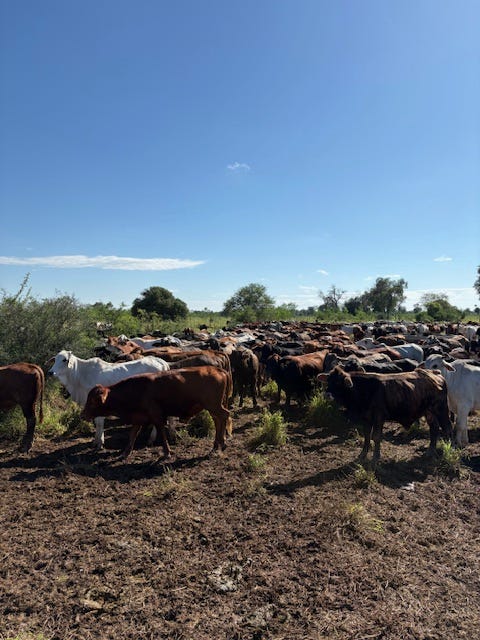
The logic of our business is simple. We buy the weaned calves at about 200 kilos. We let them eat grass, give them vaccines, watch over them…and then hope to sell them at 400 kilos. Generally, the young animals gain about a pound per day.
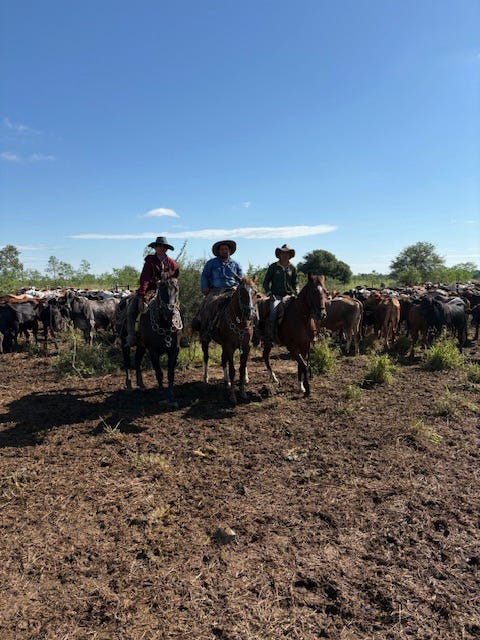
You just have to make sure they’re taken care of properly.
Here are the gauchos who do it:
Source: Author
The trip from Buenos Aires to Asuncion was uneventful. From the airport, we drove directly out to the project. It’s in the Chaco, a vast region to the west of the capital city, with few people, little infrastructure, and a rough past.
Along the way were the typical signs of Latin American poverty — trash next to the road, and smoke rising from where people were burning it…ramshackle houses of tin, plastic and rude lumber…..big gas stations…and dangerous potholes. It was not rare to see entire families on motorbikes. We watched nervously as a 7-year-old sat in front and steered, while his mother looked at her phone and his sister held onto her waist.
After we left the sprawl of Asuncion, however, we were on a new highway where the ubiquitous Toyota trucks flew by at 100 mph. On both sides of the road, for four hours, stretched vast fields of swampy wilderness.
Then, as we finally approached Filadelfia, in the Chaco, things changed. Houses were respectable. Tractors were in the fields. And our hotel, was unexpectedly nice. So far from civilization, in such a dusty little burg, we anticipated a very basic place to stay. But the hotel in Filadelfia was surprisingly large and well-run. Not at all fancy in its design or furnishings, it nevertheless had a very attentive and professional staff, full restaurant with a wide-ranging menu…and a bar with plenty of selections.
“The Mennonites developed this area,” explained our partner. “They came here because there was nothing here. Land was very cheap. Nobody wanted to come way out here.”
After the five-hour drive to ‘way out here’ we wondered if — even today — anyone wanted to come. But there we were. And around us was evidence of a boom. There were many shiny new tractors and harvesters on display. Huge trucks pulled huge trailers — laden either with animal feed or the animals themselves. And around us were big, blond people speaking Spanish…or German.
There were no suspenders, long dresses or white caps. But these people were definitely not like the mestizos of most of Paraguay.
“First, they cleared the thick trees and bushes away and raised a few cattle.” Our partner continued. “They imported the Zebu and Nelore breeds from India and mixed them with the local cows. They’re more ‘rustic’ animals. They don’t seem to mind the heat or the bugs.
“They only started raising crops a few years ago. But now that they’re producing corn, wheat, soybeans and other field crops, they have something to feed the calves; they can keep them longer and can fatten them up. And now they’re exporting them all over the world.
“They are also very well organized and capitalized. They set up a cooperative years ago. It’s very important down here. The Mennonite cooperative partners with banks, insurance companies, developers and farm suppliers. Even this hotel is a joint venture with the Mennonite cooperative. Really, it was the Mennonites who made this area what it is.”
After a hearty breakfast, we drove out to see our cattle. It had rained during the night. The moisture left a slick layer of mud on the unpaved farm lanes; even with four-wheel-drive, we almost slipped off the road several times.
Source: Author
When we finally got to the fields, we were greeted by the gauchos above and the veterinarian:
“They’re good animals. A mixture of Zebu, Brahmin, Nelore and Brangus. The whole business depends on putting on weight. So, we weigh them every couple of months. Then, we sell those that don’t gain weight…and those that gain it fastest. Together, they give us an average price per animal and it leaves us with a herd that is more or less what we want — animals that steadily gain weight at a predictable rate.”
One of the drawbacks of this operation is that it is a long way from anywhere. It is a long way from Asuncion. It is even farther for our partners — two young men from a large farming family. They are based in Argentina, a 10-hour drive away. They come up once a month to check on it. After a cup of coffee and a brief discussion of how it is going, they got back in their truck for the long drive home.
The Chaco area is flat. It is hot. It is not a place we’d like to live. But it may be a good place to raise cattle.
We’ll find out.
Source link