Buterin Calls Ethereum’s High-TPS Race “A Route to Mediocrity” as Capital Rotates to Hyperliquid and Zcash
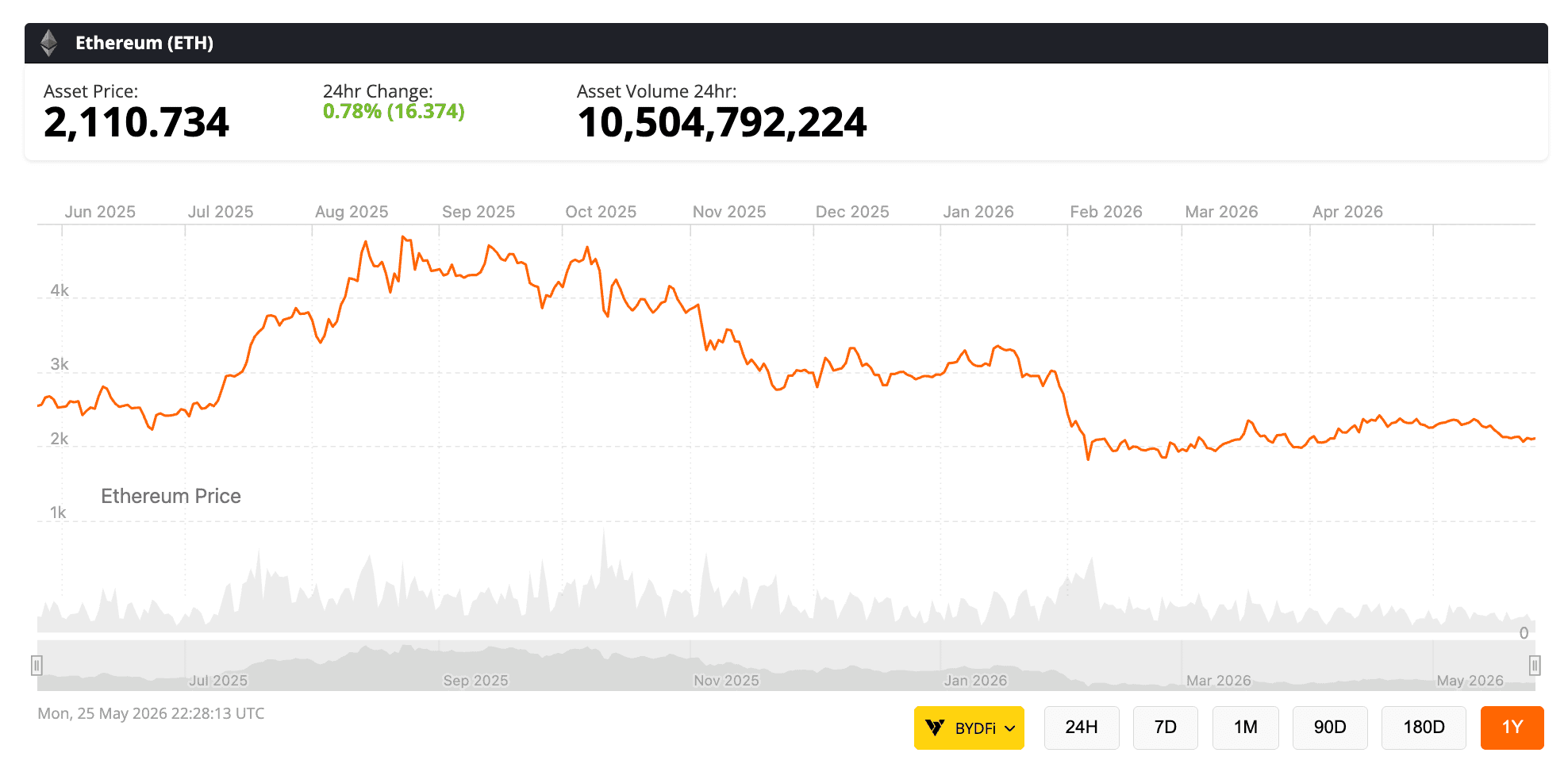
The timing was not subtle. Ether is trading around $2,120, roughly 57% off its August 2025 high near $5,000. Hyperliquid’s HYPE token has rallied 147% year-to-date to $63, briefly pushing its fully diluted valuation past Solana’s earlier this week. Zcash, the privacy-coin relic that spent most of the last cycle as a forgotten ticker, is up roughly 1,400% in 2026 and now sits inside the top 15 by market capitalization. The narrative trade has unmistakably moved on from ETH, and Buterin’s letter reads as a deliberate reframing of what Ethereum is actually competing for.
ETH is at 2,110.734, down from over $4,000 a year ago, Source: Brave New Coin
The “smaller ship” thesis
The foundation, Buterin wrote, is “choosing to use its remaining resources to pursue longevity over breadth. Yes, this means we sell less ETH.” The organization will narrow its scope to the four properties he grouped under the acronym CROPS — censorship resistance, openness, privacy, and security — and accept that mission-aligned people and projects working outside that core “is in fact necessary if we want important tasks to be able to attract outside capital.”
The EF, Buterin reminded readers, holds only about 0.16% of total ETH supply, valued at roughly $408 million — a fraction of what comparable foundations on other chains control. Its original mandate, defined in the 2014 token-sale documents, was completed in 2022 with the Merge. It “was not designed to be an eternal steward.”
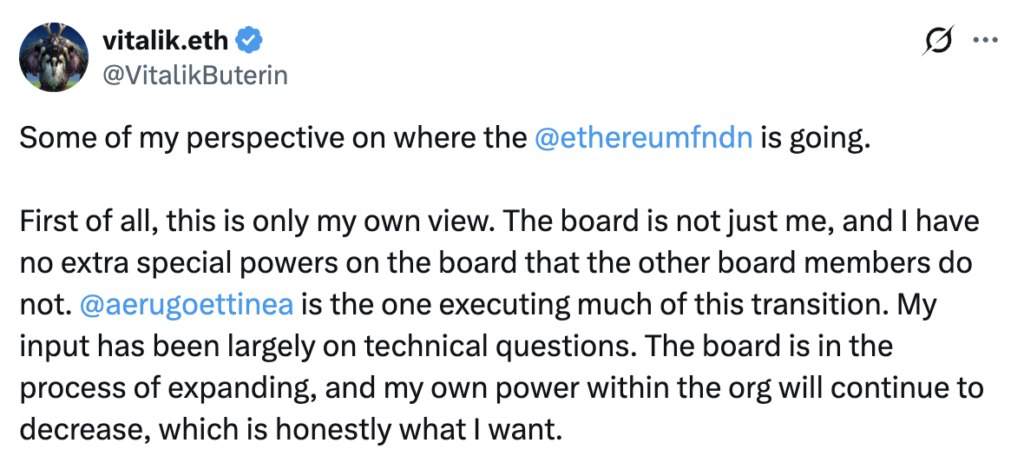
Interim co-executive director Bastian Aue, who took over from Tomasz Stańczak in February, is executing the transition. Aya Miyaguchi moved into the president role in early 2025. Buterin emphasized that his own influence on the expanded board “will continue to decrease, which is honestly what I want.”
The rejection of the throughput arms race
The most pointed passage was Buterin’s explicit dismissal of the high-TPS roadmap that has come to define competitor L1s including Solana, BNB Chain, and the newer entrant Tempo.
“Being as fast and as scalable as possible, and only a small epsilon more decentralized than the others, is a route to mediocrity,” he wrote, “and if we try it we will lose.”
Instead, Buterin laid out three technical priorities he wants Ethereum to be “deeply impressive” at: provably bug-free Ethereum via AI-assisted formal verification, which he said has shifted from impossible to plausible “in the last six months”; an “available chain” consensus design that preserves safety under both asynchrony and 49% attacker scenarios — a dual property he claims no other major chain is targeting; and aggressive intermediary minimization at the wallet layer, calling the current dependence on relayers and third-party servers for smart-contract wallets “honestly embarrassing.”
The shift away from speed isn’t entirely new. The foundation signaled a security-first reorientation late last year, pushing zkEVM teams to hit security milestones by year-end 2026, and a dedicated post-quantum team was stood up in January. Sunday’s post crystallized those moves into a single thesis.
A foundation visibly thinning out
The letter landed against a backdrop of departures. At least eight senior contributors have left or announced exits from the EF in 2026, with five of those landing in May alone. Stańczak stepped down in February. Long-time operations lead Josh Stark resigned in March after seven years. Three Protocol Cluster contributors — Barnabé Monnot, Tim Beiko, and Trent Van Epps — are all on the way out. Alex Stokes, another protocol researcher, departed earlier this month.
Buterin acknowledged that community criticism — specifically the gap between Ethereum’s stated decentralization-and-privacy ethos and the foundation’s actual actions — had been “a great burden and pain” for him personally, and framed the restructure as a direct response to that gap.
He also disclosed that “nearly 90% of my net worth is in ETH,” with the remainder largely allocated to open-source biotech, software and hardware initiatives. ETH-the-asset, he argued, is the most financially valuable product of the network and benefits directly from the CROPS-axis properties he’s pushing for — but supporting the asset itself is now out of scope for the EF. “This is where we need other heroes,” he wrote, “some of whom hold more ETH than the EF does, to step in and help.”
The market context Buterin isn’t naming
The strategic pivot is logical on its own technical merits. Whether it lands with traders is a different question.
The capital rotation toward what BitMEX co-founder Arthur Hayes recently described as crypto’s “holy trinity” — NEAR, Hyperliquid, and Zcash — is real and measurable. Zcash overtook Cardano on the market-cap table earlier this month after Multicoin Capital disclosed a significant ZEC position built since February, citing surveillance-resistance as the core thesis. Hyperliquid generates more weekly fees than Ethereum and Solana combined on some metrics, with annualized protocol revenue above $620 million driving an aggressive buyback program. HYPE’s spot ETF saw a record $25 million inflow on May 20, on a day when both BTC and ETH ETFs saw outflows.
For ETH holders, the discomfort is structural rather than tactical. Ether has materially underperformed both Bitcoin (down roughly 25% YTD per a Q1 Phemex report) and the narrative-leading altcoins for most of the year. Buterin’s own staggered ETH sales earlier in 2026 — disclosed and reasoned, but visible on-chain in real time — added to investor unease.
The foundation’s response, as articulated Sunday, is essentially that Ethereum should not chase the narratives running away from it. Trying to beat Hyperliquid on perp DEX throughput, or Solana on TPS, or the new Tempo L1 on raw performance, would put Ethereum into a market where it has no structural advantage. Trying to beat Zcash on privacy at the base layer — via the Privacy Stewards initiative, Kohaku at the wallet layer, and a native L1 zkEVM — is a different proposition.
Reception
Reaction from inside the Ethereum camp was largely supportive. Ethereum educator Anthony Sassano publicly thanked Buterin and singled out the framing of ETH as the network’s highest-value product. Early Ethereum advisor and author William Mougayar called the post “Ethereum’s own Clarity Act over the weekend. It was a crystal clear message, and the road ahead is super clear.”
Outside the core community, the verdict is less settled. The high-TPS L1 cohort and the perp-DEX narrative are both built on the bet that performance and product-market fit, not values, drive long-term value capture. Buterin is making the opposite bet: that one credibly neutral, censorship-resistant, privacy-preserving institutional asset, secured by a chain that refuses to compromise on its base properties, ultimately accrues more value than a faster, more centralized competitor.
It is, by his own framing, an Unreasonable bet. Whether it is also the right one will be answered not in the next quarter — Glamsterdam is targeting June, with follow-on upgrades pushed to a late-2026 release codenamed Hegotá — but over the longer arc Ethereum has now committed itself to.
For now, ETH’s holders are being asked to be patient while ZEC and HYPE traders are getting paid to be present.
Source link