Why fears of a global fuel crisis may be exaggerated – Fat Tail Daily
It’s been around three months since the US and Israel coordinated a devastating campaign against Iran. This armed conflict is more than just hostility between these nations. There are significant changes to political alignments, market structure, and how businesses operate.
This period may be one of history’s defining moments when everything comes to pass.
The most significant driver for this change has been, without a doubt, the blockade in the Strait of Hormuz. Iran initiated this by threatening to fire upon vessels that sail through it without its permission. The US Navy upped the ante by imposing a full blockade. Being a strategic chokepoint accounting for 20% of the world’s oil and 25% of gas flows, this created turmoil in the oil market. As oil underpins the world’s energy usage, the impact on the global economy is massive.
Concerns about this disruption in the oil supply escalated with each passing week. Governments, businesses and households felt the bite of rising oil prices. There were talks of fuel rationing, taking us back to the 1970s amidst the oil crisis.
Yet, for all the hand-wringing about how this disruption could send oil and gas prices to stratospheric levels, we haven’t seen that. Yet the chance of oil breaking the record of US$144 a barrel in July 2008 is enough to keep many awake. However, let us delve into the dynamics of national strategic oil reserves, import-export volumes, and the flow of oil.
You’ll realise things may not be as severe.
I’ll unpack this in today’s article.
Bracing for a repeat of the 1970s
Shortly after the conflict broke out, many countries braced for the worst, recalling the oil crises of the 1970s. Petrol stations saw their fuel supply dry up as many rushed to fill up their cars just in case.
As Iran took a massive pummelling that led to the death of Ayatollah Khamenei and several elite commanders in the Islamic Revolutionary Guard Corps, expectations started to rise that the conflict would end soon. These hopes soon dissipated. The fragmented Iranian leadership structure allowed it to continue operating its resistance in smaller units. Strategists saw that the US could end up fighting an unending war with little chance of a quick victory.
Meanwhile, Australians began to worry as rumours spread that our national petroleum reserves would last around 30 days. The diesel supply was less than that.
By mid-March, oil spiked to as high as US$120 a barrel, sending the world into a panic of a severe oil crisis. However, the price has since pulled back to around US$80-105.
Has the conflict ended? Have both sides reached an agreement?
No.
As we’ve seen, the negotiations have descended into a sideshow. Almost every week would see the two sides claiming to have reached an agreement, with President Trump usually posting it publicly. The Iranian state media would respond with conflicting messages, invariably denying a resolution before the two sides resumed their hostile rhetoric.
I’ve discussed in the past why the Iranian state media is behaving this way. It’s not Iran scoffing at the US and thinks it has the upper hand. Iran is in a much weaker position given its military is all but destroyed. What’s holding back Iran is the divided leadership vying for control yet a major struggle exists between its factions. On one side are the hardliners comprising the clerics and the IRGC who are ideologically opposed to Israel and the US, and the more moderate civilian government and the Iranian regular military on the other. Relations have become further strained since the US naval blockade, with news suggesting that resistance is fragmenting through internal purges, low morale and desertions.
Responding to disruption –
The changing market dynamics
While this was happening, the global oil market began to adjust itself. Tankers that had once transported oil to and from the Strait changed course to the US and other oil-producing nations. Furthermore, the United Arab Emirates completed its Habshan-Fujairah oil pipeline that bypasses the Strait and sends the oil to Oman. It even withdrew from OPEC on 1st May to increase its oil supply above the cartel’s quota.
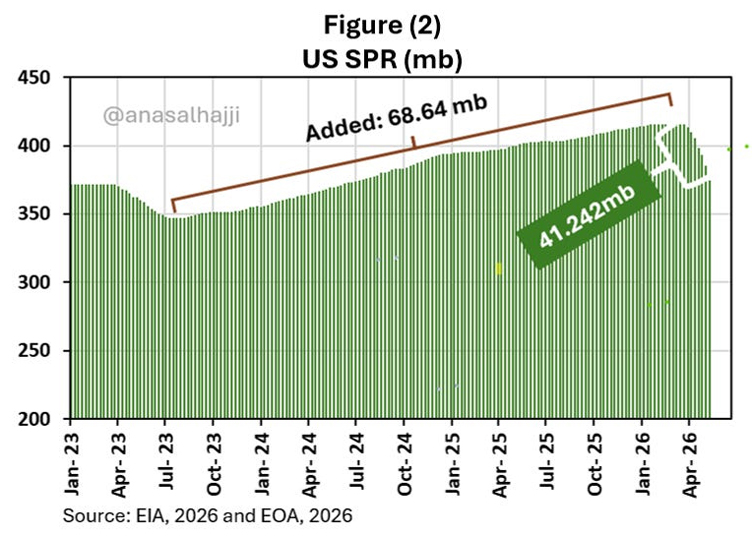
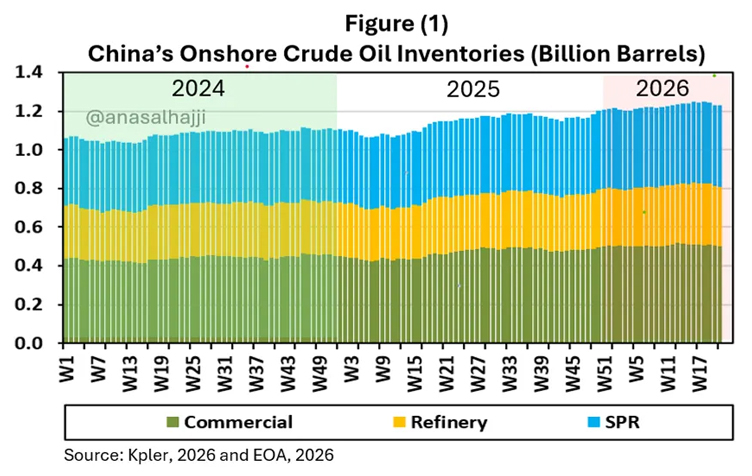
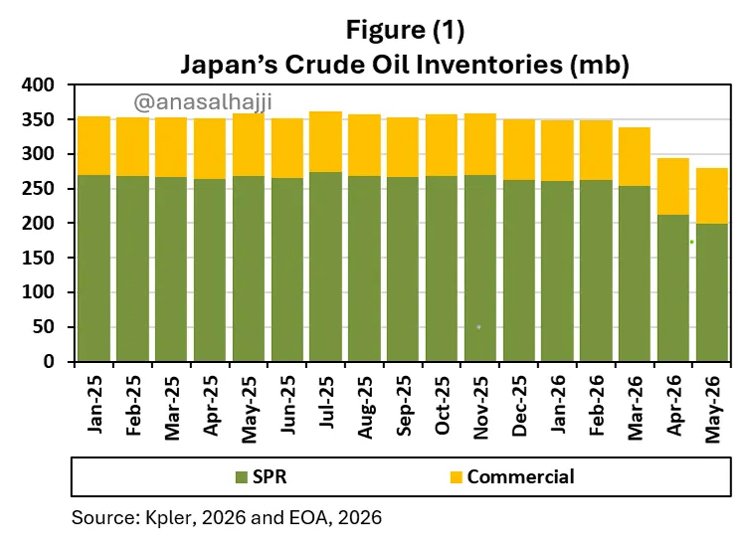
The US remained the world’s largest oil producer. It increased oil exports and drew down its strategic petroleum reserve to partly fill the gap and lower the oil price. Other countries, including China, and Japan have done likewise. The graphs below show their strategic reserves declining recently:
Source: Source: A.F. Alhajji, The Daily Energy Report
[Click to open in a new window]
Source: Source: A.F. Alhajji, The Daily Energy Report
[Click to open in a new window]
Source: Source: A.F. Alhajji, The Daily Energy Report
[Click to open in a new window]
Interestingly, Dr Anas Alhajji The Daily Energy Report noted that analysts had incorrectly conflated the declining fuel reserves of these major countries with an imminent oil shortage. Alhajji proposed that the drawdowns aligned more with these countries changing their strategy – to partly fill the gap in the oil supply and stem the rally in oil prices. At present, these drawdowns are helping the global oil market avert disaster.
You may have noticed how fuel prices nationwide have dropped back to levels similar to those at the end of February, before the conflict began. For petrol, we should account for a 26-cent reduction in the fuel excise. Meanwhile, diesel prices have fallen back to around $2.20-2.40 a litre.
Putting the oil market dynamics and what we’re seeing at petrol stations together, the picture is clearer. Rather than an imminent oil crisis, the Iranian conflict is prompting countries to shift their strategies for sourcing and supplying oil. Should the conflict escalate once again, the strain on the oil markets could become more severe, triggering an oil crisis. However, fears of an oil crisis now may be overstated.
Don’t guess what happens next –
Pick your trading strategy and stay put
So, what now? How should this affect you?
The 24-hour media cycle has lured many to follow the daily developments that are too confusing to grasp. Even the parties directly involved in the conflict are unsure of what the endgame would be and how much they can wager to get their way.
Therefore, don’t let the news cycle drive your decision making, especially your investments. You could change your portfolio more than Leonardo DiCaprio changes his dates.
Identify your preferred strategy – whether it’s in trading or long-term investing. Research the themes you consider compelling and are interested in delving deeper. Then, select the companies and have a disciplined approach to manage your holdings. Change your positions only on confirmed news, whether it’s specific to the company or on the broader economy that can affect the company’s prospects.
In uncertain times such as now, your strategy determines whether you win or lose. It’s easier to make bad decisions given the news cycle and pundits aren’t there to help you. Instead they can prey on your emotions and cause you to act rashly.
This is where we can help.
My colleague, Charlie Ormond, has spent months in refining a trading model that helps identify companies and price trends to enhance your returns. It’s a sophisticated framework that rises above market sensationalism or the latest fads.
To learn more, check out his Atlas Project in this presentation.
That’s it from me for today. Enjoy the weekend ahead!
Source link