Martingale vs. Paroli on Bitcoin Roulette: Which Wins? | BitcoinChaser
If you’ve spent any time playing Bitcoin roulette, you’ve run into the two most popular betting systems in the game: the Martingale and the Paroli. Both promise a smarter way to bet. Both have devoted followers who swear they work. And both get reached for by players hoping to tilt the wheel in their favor.
Here’s the honest verdict up front, before we get into the detail. Neither system changes the house edge, so neither one “wins more” over time. What they change is the shape of your session, how your bankroll rises and falls along the way, and how it feels while it’s happening.
This article breaks down exactly how each system works, what really happens to your money over time, and how to pick the one that fits the way you want to play. No magic systems, just the math.
First, the Part Everyone Skips: Roulette’s House Edge Is Fixed
Before comparing systems, you have to understand the surface they’re played on because it never moves. Every roulette bet carries a built in house edge:
- European roulette (single zero, 37 pockets): a 2.70% edge on every bet.
- American roulette (double zero, 38 pockets): a 5.26% edge which is nearly double, thanks to that extra green pocket.
- French roulette: a European wheel plus La Partage or En Prison rules, which return half your even money bet when zero lands. That cuts the even money edge to roughly 1.35%, the best odds on any roulette table.
The crucial point is that every spin is an independent event, and no betting system changes the expected value of your bets. Whatever progression you layer on top, Martingale, Paroli, or anything else, the math underneath is identical. So everything that follows is about how each system distributes risk, not about beating the edge.
The edge can’t be beaten by bet sizing. It can only be managed
How the Martingale Works
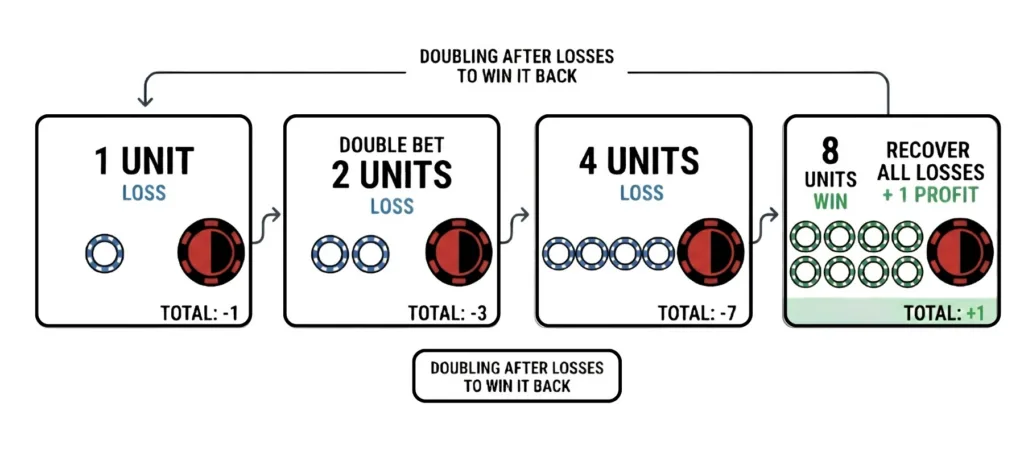
The Martingale is a negative progression system. You increase your bet after a loss. Specifically, you double it.
You bet on an even money outcome, red/black, odd/even, high/low , and double your stake after every loss. The moment you win, you recover everything you’ve lost plus one unit of profit, and you reset to your base bet.
A quick run, starting at 1 unit:
- Bet 1, lose (down 1)
- Bet 2, lose (down 3)
- Bet 4, lose (down 7)
- Bet 8, win → up 1 unit overall, loss – reset to 1
The appeal is obvious. In the short run it feels almost unbeatable. As long as you eventually win a spin, and you usually do, you come out one unit ahead. That “you always win it back” feeling is exactly why the Martingale has hooked gamblers for centuries. The catch is hiding in the doubling, and we’ll get to it.
How the Paroli Works
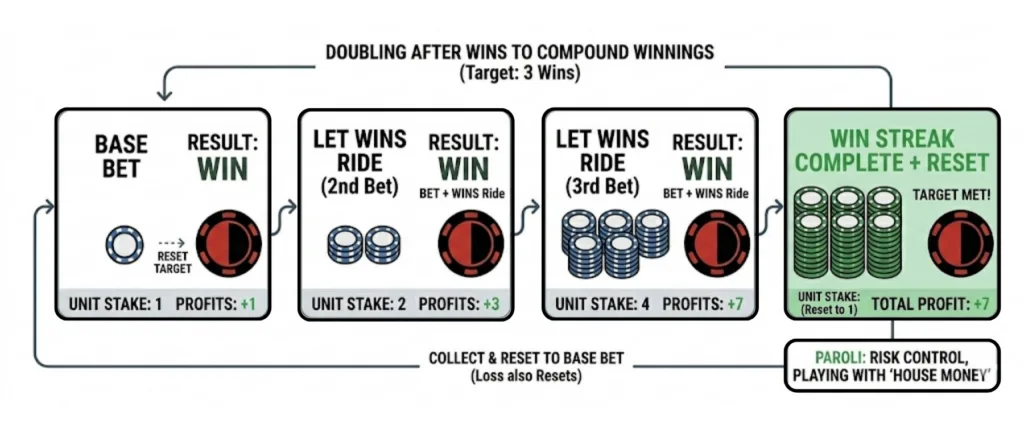
The Paroli is the mirror image. A positive progression system where you double after a win, not a loss.
You start with a base bet and let your winners ride, doubling after each win, then reset after a set number of consecutive wins (three is the most common target) or whenever you lose.
A quick run, starting at 1 unit with a three win target:
- Bet 1, win (now betting 2)
- Bet 2, win (now betting 4)
- Bet 4, win → three win streak complete, collect, reset to 1
The appeal here is risk control. You only ever risk your base unit out of pocket; the rest of the action rides on accumulated winnings. A hot streak compounds nicely, and a cold streak costs you only small base bets. Players often describe this as “playing with house money”, which feels great, but is a psychological frame, not a mathematical edge. The wheel doesn’t know whose money is on the table.
Martingale vs. Paroli: Head to Head
| Martingale | Paroli | |
|---|---|---|
| Progression type | Negative (chase losses) | Positive (ride wins) |
| Reaction to a loss | Double the next bet | Reset to base bet |
| Reaction to a win | Reset to base bet | Double the next bet |
| Bankroll risk | High — bets grow fast | Low — capped at base unit |
| Table limit problem | Severe — streaks hit the max | None |
| Variance profile | Frequent small wins, rare huge loss | Frequent small losses, occasional big win |
| What a session feels like | Steady winning… until it isn’t | Slow bleed punctuated by hot streaks |
| Worst case | Lose your whole bankroll on one streak | Give back accumulated winnings |
| Best case | Grind out small, consistent profit | Catch a long streak for an outsized win |
The Math: What Actually Happens Over Time
This is the part that matters, so here’s the truth without the spin.
Over enough bets, both systems lose the same amount. On a European table, you give back 2.70% of everything you wager, on average, no matter how you size your bets. Martingale and Paroli don’t change that number, they only change how the losses are distributed across your session.
The Martingale’s flaw is the doubling. Bet sizes grow exponentially, and a losing streak escalates fast. Say you start at $1 with a $500 table maximum. After eight straight losses you’re trying to bet $256; one more and you’re past the limit, unable to place the bet that recovers your losses. And those streaks aren’t rare.
On an even money European bet you actually lose slightly more than half the time (the zero counts against you), so a run of eight or nine losses comes around far more often than it feels like it should. When it does, you lose around $500 chasing $1 of profit. The Martingale trades a high chance of a tiny win for a small chance of a catastrophic loss. It looks like it works right up until the spin it doesn’t.
It’s also worth naming the trap underneath it: the gambler’s fallacy. After ten reds, black is not “due.” Every spin is independent, and the wheel has no memory
The Paroli inverts the risk. Because you only escalate on wins, a cold streak costs you a string of small base bets rather than a mounting pile. Your downside is capped, but so is your upside, the system needs streaks to pay off, and when one breaks at the final step, you hand back the gains. You’ll feel a frequent slow bleed, occasionally interrupted by a satisfying run.
Same edge, two different shapes. One is negatively skewed toward ruin; the other is positively skewed toward small, frequent losses. The house collects from both.
Which One Suits You?
Since neither wins long term, the real question isn’t “which is better”?, It’s “which fits how you want to play?”
You want frequent small wins and can genuinely stomach a rare wipeout. The Martingale delivers that steady winning feeling, but only play it with a strict stop loss and full awareness that a single bad streak can erase many good sessions. Never play it as a way to “guarantee” profit.
You want to limit your losses and chase the occasional hot streak. The Paroli is the lower stress choice. Your downside is capped at small base bets, the swings are gentler, and the ceiling is a fun streak rather than a payout you depend on.
You want to actually come out ahead over time. Be honest with yourself. Neither system, and no system, overcomes a negative edge game. Anyone selling you otherwise is selling you something.
The Only Real Edge: Game Choice and Bankroll Management
If you can’t beat the edge with bet sizing, where can you make smart decisions? Two places.
First, game choice. Play European or French roulette, never American. That single choice halves the house edge (and French roulette’s La Partage rule cuts it further on even money bets). It’s the closest thing to a free improvement in the game.
Second, bankroll discipline which is the same principles that apply to any chance based game:
- Set a session budget before you sit down and treat it as already spent.
- Use a hard stop loss and walk away when you hit it.
- Size your bets so you can survive variance, especially with the Martingale, where the bankroll needs to be far bigger than beginners expect.
- Respect table limits; they exist partly to break the Martingale.
This is the same honest framing we apply in our Bitcoin Plinko strategy guide. Betting systems reshape your variance, but they never beat a game with a built in edge.
Provably Fair Bitcoin Roulette
The real advantage of playing roulette with Bitcoin isn’t a better system, it’s verifiability. Provably fair RNG roulette uses a server seed, a client seed, and a nonce to generate each spin cryptographically, so you can confirm afterward that the result wasn’t manipulated. Live-dealer roulette offers transparency of a different kind, a real wheel you can watch in real time.
Either way, fairness verification confirms the spin was honest; it doesn’t change the house edge. For a step-by-step walkthrough of how to verify a provably fair result, see the verification section in our Plinko guide, the process is the same across crypto casino games.
Where to Play Bitcoin Roulette
These are established crypto casinos with strong roulette offerings. Look for ones with European or French tables (lower edge) and provably fair or quality live-dealer options. Check current bonus terms, since promotions change often.
A deep roulette selection including European tables and live dealers, with provably fair originals alongside. Read our full Stake review
A wide table-games library with multiple roulette variants and a strong live-casino section.
One of the original, most trusted Bitcoin casinos, with a large roulette and live-dealer range.
One of the longest-running crypto casinos, offering a strong roulette selection, provably fair, and fast Bitcoin withdrawals.
A well-established Bitcoin casino known for its extensive roulette options, crypto-friendly bonuses, and quick cryptocurrency payouts.
When choosing, weigh the following four things: which roulette variants are on offer (European/French beats American), provably fair or live-dealer transparency, withdrawal speed, and the bonus terms.
FAQs
Does the Martingale system actually work?
In the short term it often produces small wins, which is why it feels effective. Over time it doesn’t beat the house edge, and a single long losing streak, or the table limit, can wipe out your bankroll. It redistributes risk; it doesn’t remove it.
Is Paroli safer than Martingale?
Yes, in the sense that your downside is capped at small base bets rather than escalating. You won’t face the Martingale’s catastrophic loss scenario. But it still loses to the house edge over time, it’s lower risk, not winning.
Can you beat roulette with a betting system?
No. Every spin is independent and every bet carries a fixed house edge. No staking pattern changes the expected value. Betting systems only change how your wins and losses are distributed.
Which roulette is best for these systems?
European or French roulette. The single zero wheel halves the edge versus American, and French rules like La Partage lower it further on even money bets, which is exactly where both systems are played.
Is Bitcoin roulette fair?
Provably fair versions let you cryptographically verify that each spin was honest, and live-dealer tables let you watch the wheel directly. Neither changes the underlying house edge.
How big a bankroll do you need for the Martingale?
Bigger than you’d think. Because bets double each loss, surviving even a moderate streak takes a large bankroll relative to your base bet, and you’ll still hit the table maximum before a truly long streak ends. That gap between “feels safe” and “actually safe” is the system’s core danger.
Source link