How to Trade Commodity with Crypto: Complete Guide
Gold is up over 25% this year. Oil moved 8% in a week on a single OPEC announcement. Silver is tracking its highest level in a decade. If you’re not trading commodities in 2026, you’re leaving money on the table.
But accessing these markets the conventional way means opening a futures brokerage, wiring fiat, managing contract rollovers, and watching your position sit frozen every weekend when the news keeps moving.
BitMEX Commodity Perps remove every one of those barriers. Deposit BTC or USDT, trade gold, silver, and crude oil with leverage, 24/7, with no expiry, no fiat, and no broker.
This is the complete step-by-step guide to trading Commodity Perps on BitMEX.
In this guide:
Why trade commodities with crypto instead of a traditional broker
What commodity perps are available on BitMEX
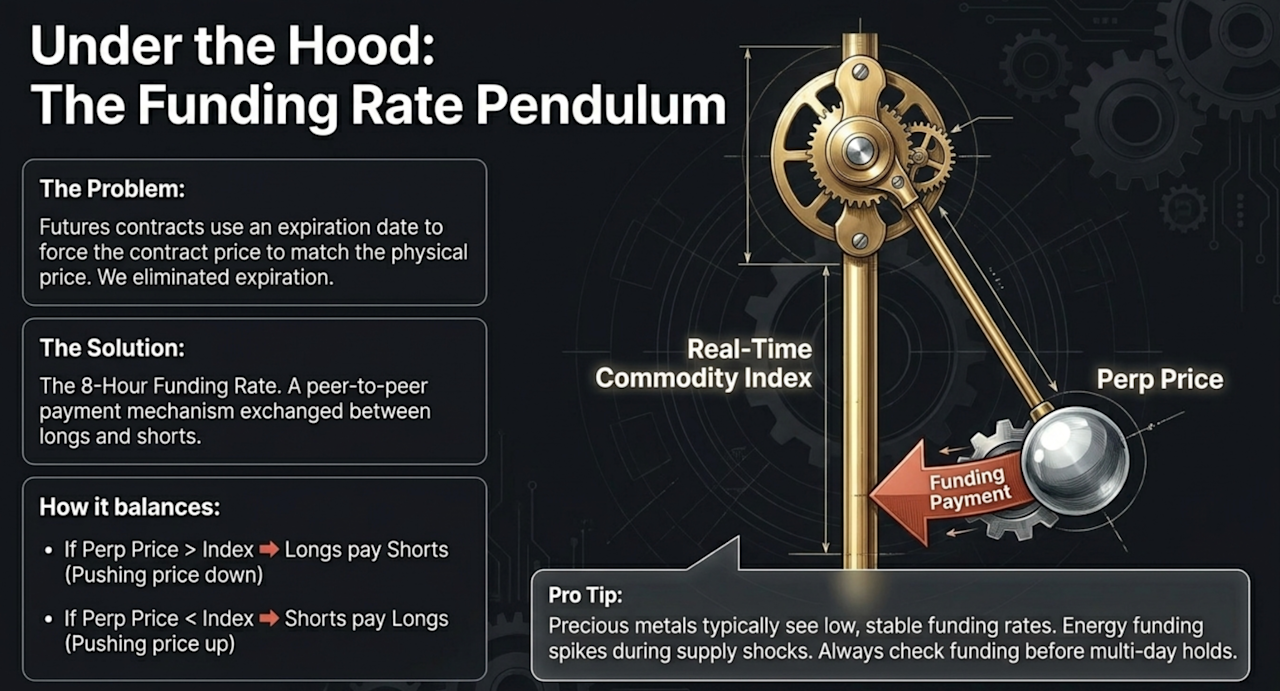
How commodity perps work
Step-by-step: how to open your first trade
Risk management for commodity perp trading
Why Trade Commodities with Crypto Instead of a Traditional Broker?
Traditional commodity trading is built for institutions. Retail access exists, but it comes with a stack of friction: a futures brokerage account, a bank account, fiat wire transfers, minimum margin requirements denominated in dollars, and rollover costs every time a contract expires.
That stack eliminates a large portion of people who want commodity exposure but live in crypto.
When you trade commodity perps on BitMEX:
No fiat required: Deposit BTC or USDT directly. No bank account. No wire transfer. No fiat conversion.
No contract rollover: Perpetual swaps never expire. Hold your gold position for a day, a week, or six months — with no rollover cost and no basis risk from contract transitions.
24/7 access: Comex gold closes on weekends. Oil futures have session breaks. BitMEX Commodity Perps trade every hour of every day, including weekends and public holidays.
Zero overnight swap fees: Traditional commodity brokers charge overnight financing on leveraged positions. BitMEX charges no overnight fees — the only periodic cost is the funding rate, which is market-driven and frequently near zero on commodity perps.
True peer-to-peer execution: You trade against other market participants, not against the house. No CFD model, no requotes, no conflicts of interest around your stop-loss.
What Commodity Perps Are Available on BitMEX?
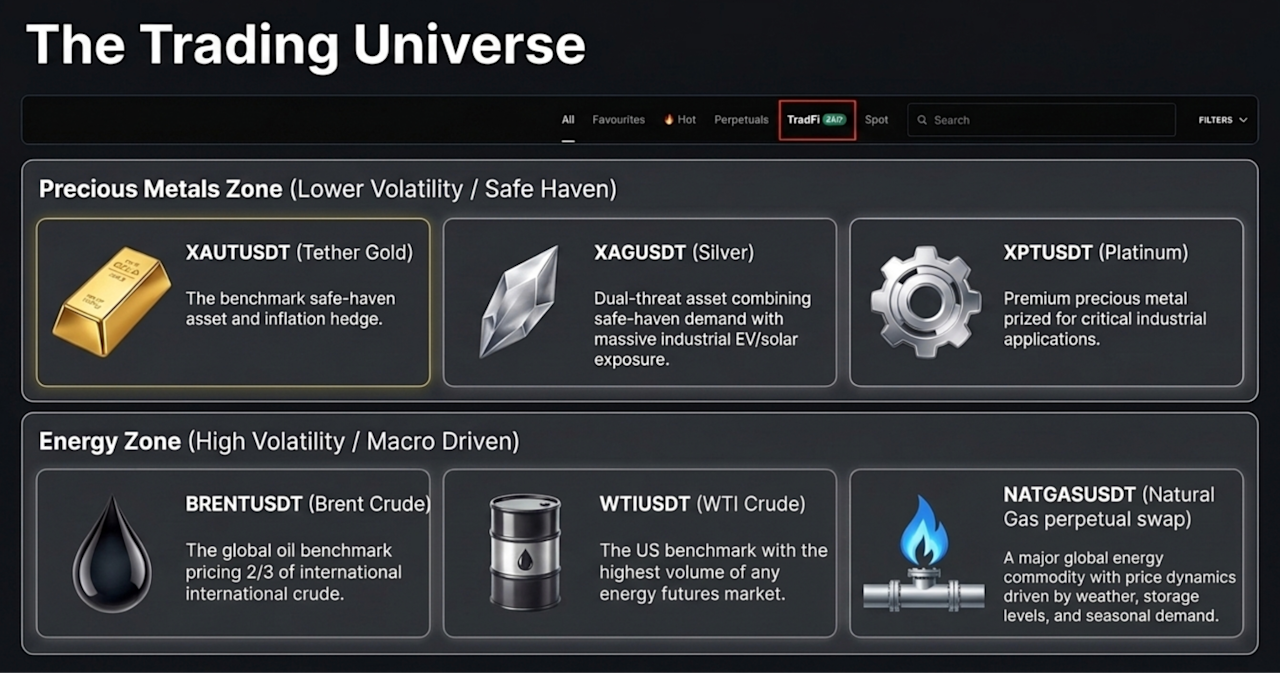
BitMEX offers Commodity Perps across the most liquid physical commodity markets:
Precious Metals
XAUTUSDT: Tether Gold perpetual swap. The world’s benchmark safe-haven asset and inflation hedge.
XAGUSDT: Silver perpetual swap. Combines safe-haven demand with industrial exposure across solar, EVs, and electronics.
XPTUSDT: Platinum perpetual swap. A precious metal prized for its safe-haven and critical industrial applications.
Energy
BRENTUSDT: Brent Crude perpetual swap. The global oil benchmark, pricing roughly two-thirds of internationally traded crude.
WTIUSDT: WTI (West Texas Intermediate) perpetual swap. The US oil benchmark with the highest volume of any energy futures market.
NATGASUSDT: Natural Gas perpetual swap. A major global energy commodity with price dynamics driven by weather, storage levels, and seasonal demand.
All contracts are quoted in and settled in USDT. No commodity is ever physically delivered.

How Commodity Perps Work
Commodity Perps track the underlying commodity’s price through a real-time index aggregated from major global pricing venues and functions similar to a crypto perpetual swap. Here are three mechanics that matter before you open a position:
Funding Rate
Every eight hours, a small payment exchanges between longs and shorts:
This anchors the perpetual price to the real commodity price without expiry. On precious metals, funding rates are typically low and stable. On energy contracts, they can spike during supply disruptions or macro events. Check the current funding rate before entering any multi-day position. Learn more here.

Leverage
Deposit crypto collateral (BTC or USDT) and select your leverage. The leverage multiplies your position size relative to your margin. Higher leverage means a smaller adverse price move can trigger liquidation.
Each commodity’s intrday volatility varies. For example:
Gold: Lower volatility means higher leverage is more manageable, but still requires disciplined stop-loss placement.
Oil: Higher volatility — a single OPEC announcement can move WTI 5-8%. Leverage on energy contracts warrants tighter risk management.
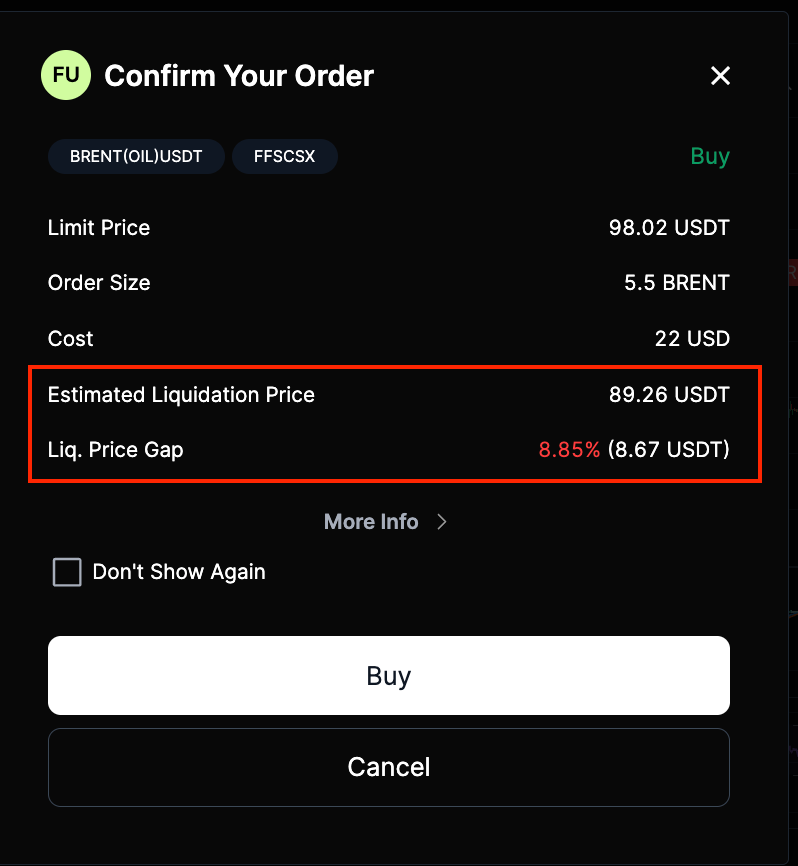
Liquidation Price
Liquidation occurs when your position size falls below the maintenance margin (the minimum margin required to keep the position opened). Before opening any position, check your liquidation price on the order form. This is the price at which your position is automatically closed to protect remaining margin. Your stop-loss should always trigger before you reach the liquidation price.

Step-by-Step: How to Open a Commodity Perp Trade on BitMEX
Step 1: Fund Your Account
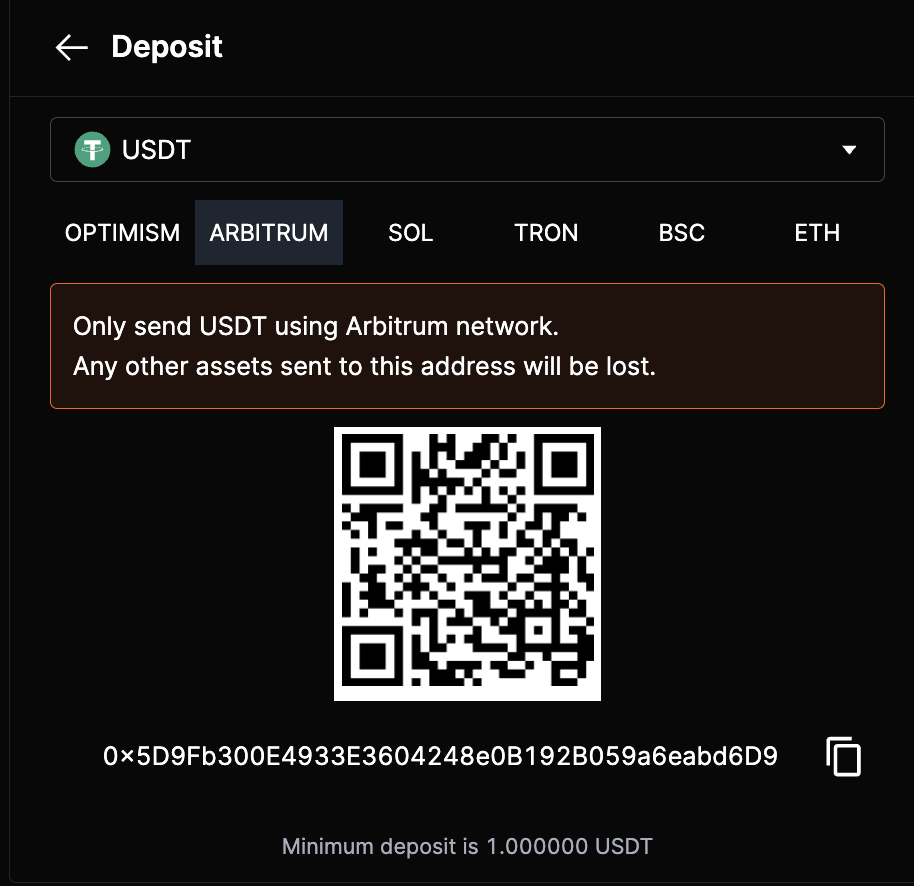
If your account is not already funded, deposit BTC or USDT via on-chain transfer. BitMEX also supports buying crypto directly using credit card, Google Pay, and Apple Pay. Try it out here.

If you haven’t signed up for a BitMEX account yet, we’re currently offering $5,050 worth of trading credits to new users – you can register here.
Step 2: Navigate to the Commodity Market
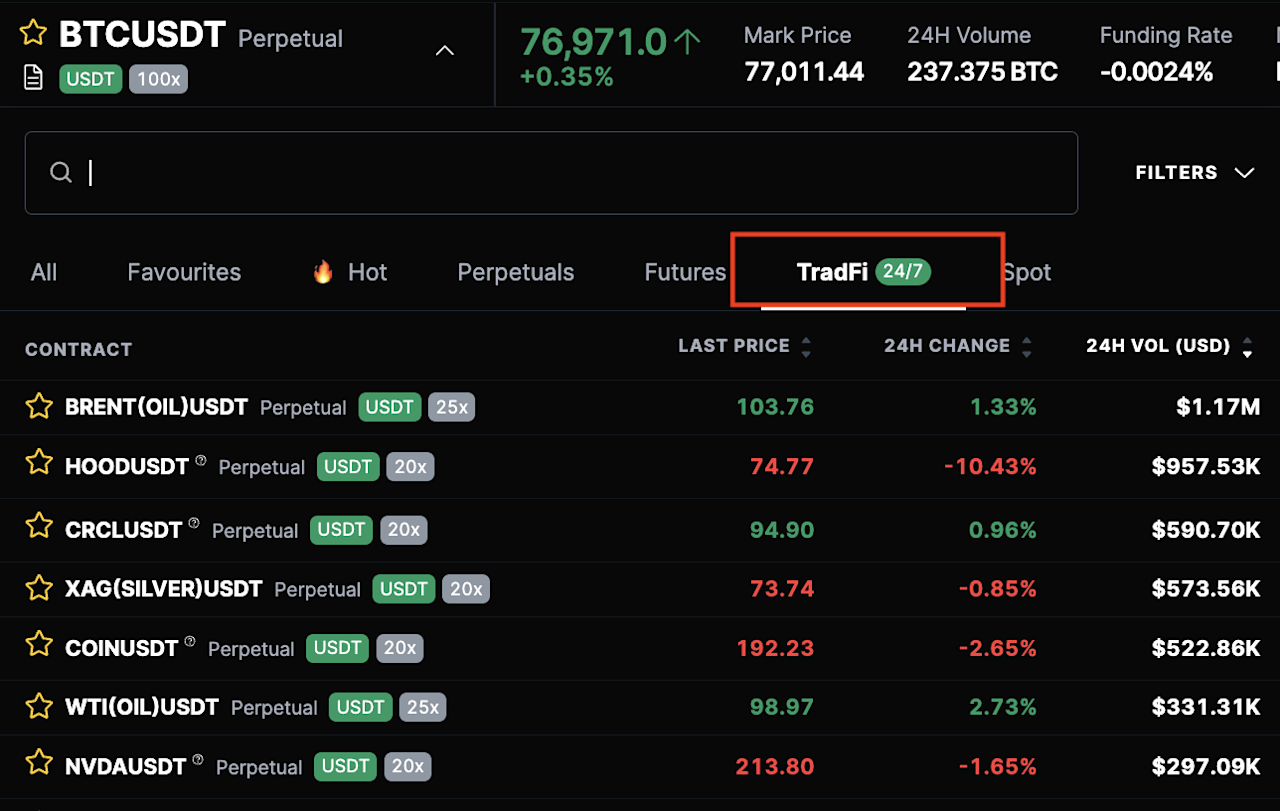
Open the BitMEX trading interface. Navigate to the TradFi category in the asset selector.

Select your commodity contract:
Step 3: Analyse the Market
Before placing any order, review:
Current price and recent price action — Is the market trending, ranging, or at a key level?
Funding rate — Check the current 8-hour funding rate and its direction. A large positive funding means longs are paying shorts; factor this into hold cost on multi-day positions.
Spread — Check the current bid-ask spread on the order book. During high-volatility events, spreads widen.
Step 4: Set Your Leverage
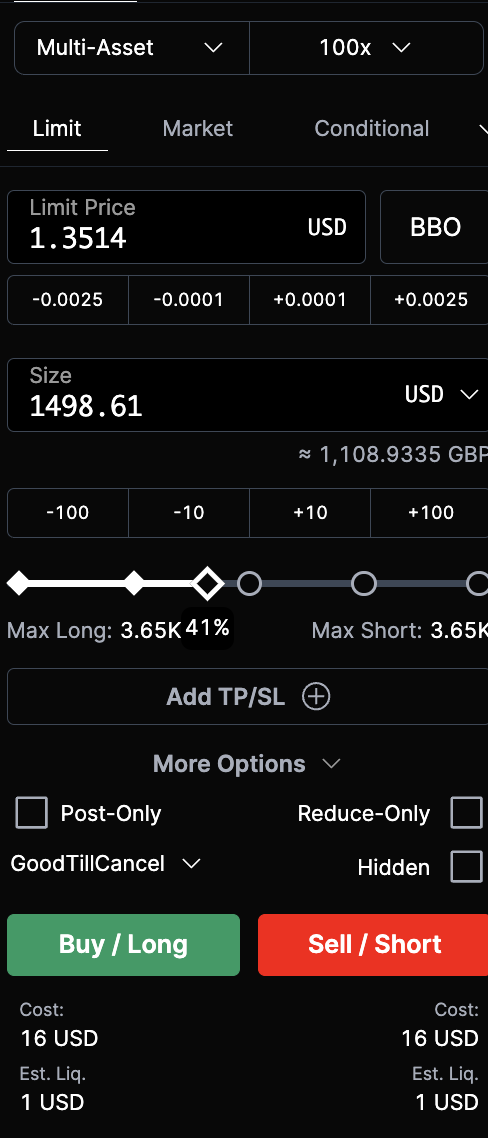
Set your leverage before placing the order. Start low — 2x to 5x is appropriate for commodity perps, especially when learning the instrument. Higher leverage compresses your margin for error: at 10x on gold, a 1% adverse move costs 10% of your margin.
You can adjust leverage in the trading interface before order placement.

Step 5: Place Your Order
Direction:
Long if you expect the commodity price to rise (e.g., gold rallying on rate cut expectations)
Short if you expect the commodity price to fall (e.g., oil declining on demand destruction data)
Order type:
Limit order — Sets the exact price you want to buy or sell. Qualifies for maker fee rebates on BitMEX. Use during normal market conditions.
Market order — Fills immediately at the best available price. Use when speed of entry matters more than exact price.
Learn more about order types here.
Step 6: Monitor Your Position
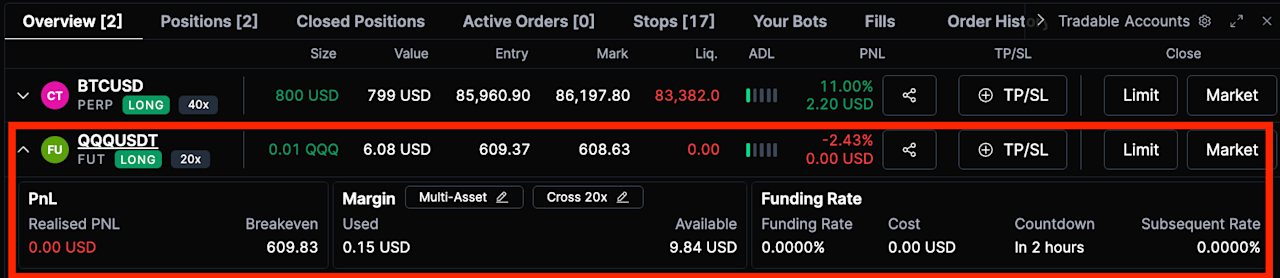
Once filled, your position appears in the Overview and Positions tab. Key metrics to track:
Unrealised PnL — Your current profit or loss at the mark price
Mark Price — The fair value price used for PnL and liquidation calculations
Liquidation Price — The price at which your position is auto-closed
Breakeven Price — The price at which your PnL is zero after entry fees

Step 7: Close Your Position
Close fully or partially through the Positions tab. Use a limit order to close at your target price, or a market order to exit immediately. If your stop-loss has been set as a Stop order, it will trigger automatically when the mark price reaches your stop level.
Risk Management for Commodity Perp Trading
Commodity markets move on macro data, central bank policy, geopolitical events, and supply-demand dynamics. These drivers are well-understood — but they can produce fast, large moves. Risk management makes the difference between a pro trader and a good trader. Here are a few tips you can implement.
1. Always use a stop-loss: Set it before you open the position, not after the trade goes against you. At 5x leverage, a 4% adverse gold move costs 20% of your margin. Know your number.
2. Size for the stop, not the upside: The most common mistake in leveraged trading is sizing a position based on how much you want to make, not how much you can afford to lose. Work backwards from your maximum acceptable loss.
3. Check funding before multi-day holds: On short-duration trades, funding rates have minimal impact. On positions held for days or weeks, accumulated funding can erode a profitable trade. Check the funding rate direction and magnitude before entering any carry-style position.
4. Watch macro event risk: Gold, silver, and oil are highly sensitive to scheduled macro events: Federal Reserve meetings, OPEC decisions, US CPI releases, Non-Farm Payrolls. In the hours before a major release, volatility typically compresses then expands sharply. Avoid entering new large positions immediately before high-impact events unless you have a specific catalyst view.
5. Do not over-leverage precious metals: Gold and silver have lower daily volatility than crypto but can still move 2-4% on a single session during macro stress. At 25x leverage, a 4% gold move liquidates a position with no stop. Keep leverage on commodity perps conservative until you have a track record.
6. Diversify across commodities: Gold, silver, and oil do not always move together. Gold and the dollar are often inversely correlated. Oil and gold can diverge sharply during supply-driven oil shocks. Spreading exposure across multiple commodity perps provides natural diversification and reduces single-event risk.
FAQ
Can you trade gold with Bitcoin on BitMEX?
Yes. BitMEX Gold Perps ( XAUTUSDT) let you trade gold price exposure using Bitcoin or USDT as collateral. You deposit BTC or USDT, open a long or short position on gold, and your profit and loss settle back into crypto. No fiat, no bank account, and no physical gold is ever involved. The contract tracks the real-time gold price through a multi-source index. You get the full economic exposure of a gold position — including leverage if you choose to use it — without touching fiat rails, opening a commodity brokerage account, or managing futures contract rollovers. Gold Perps on BitMEX trade 24 hours a day, seven days a week, including weekends.
Are there overnight fees on commodity perps?
No. BitMEX Commodity Perps do not charge overnight swap fees or overnight financing. Traditional commodity brokers and CFD platforms charge nightly financing on leveraged positions based on the interest rate differential plus a broker markup. The only periodic cost on BitMEX Commodity Perps is the funding rate — a market-driven payment exchanged between longs and shorts every eight hours to keep the perpetual price anchored to the commodity’s real-time index price. On precious metals like gold and silver, the funding rate is typically low and near zero outside of unusual market conditions. This makes BitMEX Commodity Perps materially cheaper to hold than equivalent leveraged positions at a traditional commodity broker.
What leverage is available on gold and silver perps?
BitMEX offers leverage on both XAUTUSDT (gold) and XAGUSDT (silver) perpetual swaps. The exact maximum leverage is displayed on the order form before you open a position. Gold and silver have lower daily volatility than most crypto assets, which makes leverage more manageable — but leverage still amplifies losses proportionally to the multiple you select. Start with 2x to 5x for commodity perps. At 5x on gold, a 4% adverse price move costs 20% of your margin. Always set a stop-loss that triggers before your liquidation price, and only increase leverage after building a track record with consistent risk management discipline.
How does the funding rate work on commodity perps?
The funding rate on commodity perps works identically to crypto perpetual swaps. Every eight hours, a payment is exchanged between long and short positions based on the difference between the perpetual contract price and the underlying commodity index price. If the perpetual trades above the index, longs pay shorts; if it trades below, shorts pay longs. This mechanism keeps the perpetual price anchored to the real commodity price without requiring an expiry date or physical settlement. On precious metals, the funding rate is generally small and stable. On energy contracts like WTI or Brent, the funding rate can widen during supply disruptions or periods of high speculative interest. The current funding rate and time until the next payment are visible on the BitMEX trading interface.
Can you short gold or oil on BitMEX?
Yes. Commodity Perps are bidirectional instruments. You can go short on any commodity perp — XAUTUSDT (gold), XAGUSDT (silver), BRENTUSDT (Brent crude), or WTIUSDT (WTI crude) — if you expect the price to fall. Short selling on BitMEX is structurally identical to going long: you deposit collateral, select your position size and leverage, and enter a short order. Your position profits if the commodity price falls and loses if it rises. Short commodity perps are useful for hedging existing physical commodity exposure, positioning for macro-driven commodity selloffs — such as dollar strength, demand destruction data, or OPEC production increases — or running relative value trades across multiple commodity contracts.
What is the minimum deposit to start trading commodity perps?
There is no mandatory minimum deposit. You can start with any amount of BTC or USDT. In practice, effective commodity perp trading requires enough margin to absorb normal price fluctuation before your stop-loss triggers. With $100 in collateral at 5x leverage, a 2% adverse gold move consumes $10 of margin — 10% of your account on a single small fluctuation. A starting balance of $200-$500 USDT equivalent gives you meaningful position sizing flexibility and room to practise risk management properly. Scale up only after demonstrating consistent performance at smaller size. The goal is building a reliable process before deploying larger capital.
How is trading commodity perps different from buying a commodity ETF?
A commodity ETF gives you passive, long-only price exposure through a fund that holds futures contracts or physical commodities. It trades during stock exchange hours, charges annual management fees, has tracking error relative to spot prices, and settles in fiat through your brokerage. You cannot short it directly, you cannot use leverage, and you cannot trade it over the weekend. Commodity Perps on BitMEX are active instruments. You can go long or short. You can use leverage. You can trade 24/7. You use crypto as collateral. There are no management fees. Settlement is in USDT. The tradeoff is that perps require active position management — stop-losses, leverage control, and funding rate awareness — which a passive ETF does not.
Source link