‘What if all cockroaches came together?’ The youth movement threatening to shake up India’s politics
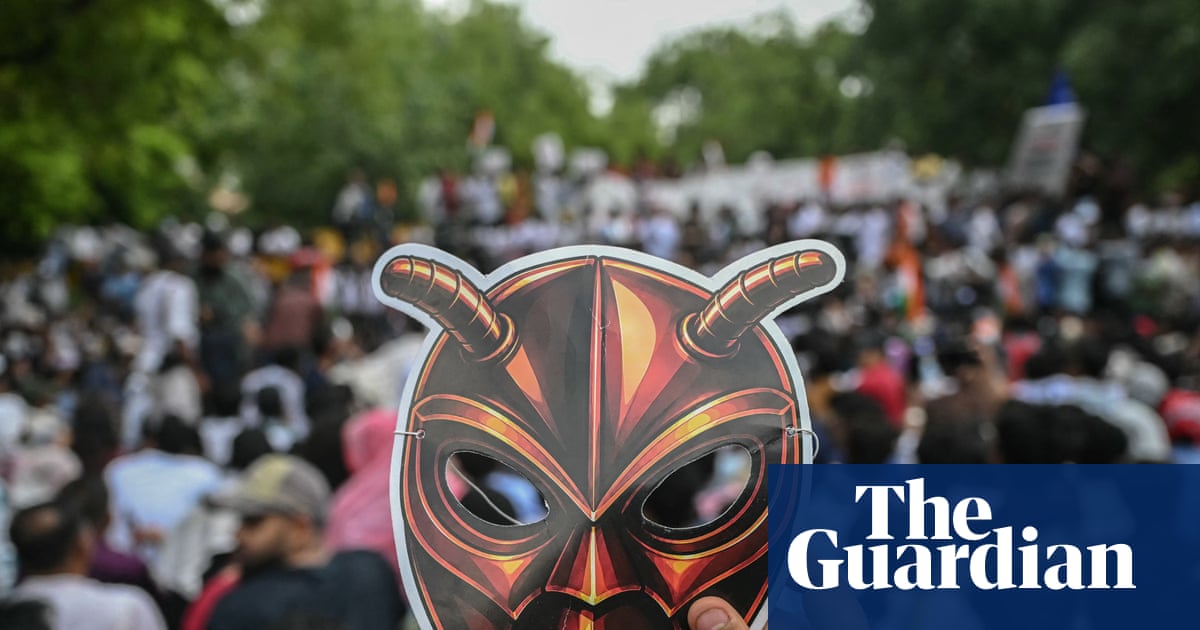
The call out to the youth of India was simple: “Get ready to swarm the streets of Delhi with peaceful and loving dissent.” They came in their thousands.
The weekend marked the first public protest of the Cockroach Janta party (CJP), a movement that began as an online joke, but which has swiftly grown into one of the most unexpected challenges to the indomitable power of the country’s rightwing Narendra Modi government – driven by millions of discontented and disillusioned young people.
“The youth of this country will no longer fear, they will fight,” said CJP’s founder, Abhijeet Dipke, who had flown in that morning from the US to lead the lively protest.
“For the government, we may be mere insects, but we are alive and capable of fighting for our rights.”
Among the gen Zs and millennials who gathered amid a heavy police presence, many expressed hope that a youth-led mobilisation, similar to movements that brought down governments in the neighbouring countries of Nepal and Sri Lanka, could be gathering pace in India. “The young people here have suffered enough too,” said Kriti, 21, a university student from Delhi.
The momentum behind the CJP has taken many by surprise, none more so than Dipke, who just a few weeks ago was living a quiet life in the US as an Indian graduate of Boston University.
It was only on a whim, enraged by the comments of the chief justice of India who had compared India’s unemployed youth to “parasites” and “cockroaches” during a supreme court hearing, that Dipke had jokingly put out a call on social media: “What if all cockroaches came together?”
The overwhelming response made him realise he had touched a nerve. He built a website and social media accounts for a satirical Cockroach Janta party – a poke at Modi’s ruling Bharatiya Janta party (BJP) – complete with a biting manifesto taking aim at the government, and a tagline: “A political party for the people the system forgot to count.”
Within two weeks, the CJP’s Instagram page had more than 22 million followers, far overtaking the BJP. Not long after, the Modi government, notoriously intolerant of dissent, had attempted to block its account on X on national security grounds.
Though initially cloaked in satire, for many of India’s gen Zs and millennials, the CJP has given voice to their growing frustrations over an education system in crisis, and a job market that has been systematically failing them. According to one recent study, almost 40% of India’s graduates below 25 are unemployed.
Questions still remain about whether the cockroach movement can transition from an online phenomenon to a genuine political mobilisation. To some, the turnout of thousands was heartening, while others viewed it as a disappointment when compared to the tens of millions voicing support online. But out on the streets of Delhi over the weekend few viewed the CJP as an AI internet meme any longer.
“We are the future of this country and they have the audacity to call us cockroaches,” said Mehima Fatima, 26, a student at Delhi University. “It is so sad to see what has happened to education in this country. I hope this is the beginning of the resistance.”
The rise of the CJP comes amid growing criticism of India’s “toxic” exam industry and its toll on the country’s youth. More is now spent in India on private tuition than the government’s entire higher education budget, with parents often getting into crippling debt to ensure their children get coveted places to study medicine and engineering or secure lucrative government jobs. The pressure on students to succeed has been linked to a growing number of suicides.
Writing in his newspaper column this week, the analyst Pratap Bhanu Mehta said that “these examinations are not merely instruments of evaluation. They are instruments of social control, and extraordinarily effective ones at that … The message of the system is no longer to ask why or how, but simply to do and die.”
Much of the “cockroach” movement has been mobilised around mounting student distress over exam chaos, after this year’s medical entrance exam – where more than 2 million students compete for just 130,000 places – was once again leaked to the highest bidder, forcing it to be scrapped and for students to face retaking the gruelling tests.
A core demand of Saturday’s protest was the resignation of the education minister, Dharmendra Pradhan, whom many hold responsible for the successive scandals. The leaks were widely seen as symptomatic of a “corrupt and broken” education system under the Modi government.
“We are here to demand accountability,” said Ratna Singh, 30, who clutched a rose and a copy of the constitution, which protesters had been instructed to bring to the demonstration to show they came in peace.
“People are slaving away for exams that get leaked, and at the end there are no jobs for us anyway. There is a need for a revamp of the entire education system.”
Nonetheless, many of those who took to the streets to proudly declare themselves as “cockroaches” also acknowledged that the movement was a David and Goliath battle. Under Modi, the BJP has consolidated unprecedented amounts of power across government, media and the judiciary, and the state has routinely gone after political opponents and critics.
Speaking to the crowds on Saturday, Dipke said he would be willing to sacrifice his freedom for the movement: “We have turned the joke into a revolution”.