The Surprising Truth Behind Soaring Interest Rates
Get Email Alerts and Follow Us:
The financial landscape is experiencing significant changes marked by rising interest rates, inflation risks, and a strengthening dollar. These shifts impact credit spreads, yield curves, and monetary policy. Interest rates have increased due to inflation risks, reducing the likelihood of rate cuts and widening credit spreads. The yield curve, initially steepening, is now stalling and showing signs of inversion, indicating potential economic slowdowns. Sticky inflation and debates on monetary policy effectiveness contribute to these developments. Market expectations for future rates have steadily increased, surpassing Federal Reserve projections, suggesting that the Fed may need to reassess its interest rate outlook. The market anticipates possible rate hikes, reflected in tightening financial conditions indexes, driven by economic data supporting higher inflation and economic activity.
Rising Interest Rates and Inflation Risks
Interest rates have seen a notable increase, driven by the resurgence of inflation risks. The prospect of rate cuts has diminished significantly, and the dollar has strengthened. This shift in the economic environment is reflected in the widening of credit spreads, as measured by the CDX high-yield credit spread index. The widening spreads indicate growing concerns about credit risk and the overall health of the economy.
Yield Curve Dynamics
Stalling Steepening Process
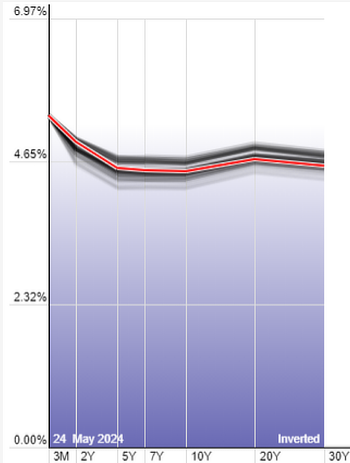
The yield curve, which had been in a steepening process, has now stalled, with signs of further inversion beginning to emerge. An inverted yield curveAn inverted yield curve is a type of yield curve in which long-term bonds have lower yields than short-term bonds. Typically, yield curves are upward sloping, meaning that longer-t… More, where short-term rates exceed long-term rates, is often seen as a precursor to economic slowdowns or recessions. The recent developments suggest that the inversion process, which appeared to be behind us, is making a comeback.
Sticky Inflation and Monetary Policy
Sticky inflation and ongoing debates about the restrictiveness of monetary policy have contributed to this shift. The yield curve is now in a position where 2-year rates may rise faster than 10-year rates, potentially deepening the inversion. This development signals market concerns about the effectiveness of current monetary policies in controlling inflation and fostering economic stability.
Bond Market Expectations
Shifts in Rate Projections
In May 2022, market expectations for rates in 2026 were around 2.8%. However, these expectations have steadily increased, reaching 3.4% in May 2023, 3.6% in November 2023, and 4.15% as of this week. The bond market is clearly indicating that the low rates of the past decade are no longer viable, and the neutral rate of the economy is higher than previously anticipated.
Comparing Market and Fed Projections
These market-based expectations are significantly higher than the Federal Reserve’s projections. As of the March Summary of Economic Projections, the Fed anticipated rates in 2026 to be at 3.1%, with a projected Personal Consumption Expenditures (PCE) rate of 2%, resulting in a real rate of 1.1%. In contrast, the market’s assumption of a 4.15% rate with a PCEPCE stands for Personal Consumption Expenditures. It is a measure of how much money households spend on goods and services. More rate of 2% suggests a real rate of 2.15%.
Implications for Fed Policy
The disparity between market expectations and Fed projections highlights the need for the Federal Reserve to reassess its interest rate outlook. The current market pricing suggests that the Fed’s view of restrictive policy is too conservative. Consequently, the 2-year rate is expected to move above the 5% threshold, indicating that the market is not only removing the possibility of rate cuts but is also beginning to price in the chance for future rate hikes.
Market Sentiment and Financial Conditions
Anticipating Rate Hikes
If the market perceives that rate hikes may be necessary down the road, pricing will adjust accordingly, well in advance of any official Fed announcements. This anticipation will likely manifest in financial conditions indexes, which should begin to show signs of tightening. While this does not necessarily mean that the Fed will raise rates immediately, it underscores the market’s growing expectation of such a move, especially if economic data continue to support the notion of a higher neutral rate.
The Role of Economic Data
The market’s assessment hinges on continuous economic data supporting the idea that the current Fed policy is not restrictive enough to push inflation back to target levels. If the data persistently indicate higher inflation and robust economic activity, the likelihood of rate hikes will increase, further influencing market expectations and financial conditions.
Insights
- Rising interest rates reflect increasing inflation risks.
- Yield curve inversion suggests possible economic slowdown.
- Market expectations for future rates exceed Fed projections.
- Economic data significantly influence market sentiment and financial conditions.
The Essence (80/20)The Origins and Evolution of the 80/20 Principle The Discovery by Vilfredo Pareto In 1897, Italian economist Vilfredo Pareto uncovered a striking pattern in his study of wealth and… More
- Rising Interest Rates and Inflation Risks: Interest rates have increased due to rising inflation risks, leading to a stronger dollar and widening credit spreads, indicating growing concerns about credit risk.
- Yield Curve Dynamics: The yield curve’s steepening process has stalled, with signs of inversion emerging, signaling potential economic slowdowns and concerns about current monetary policy effectiveness.
- Bond Market Expectations: Market expectations for future interest rates have risen significantly, surpassing Federal Reserve projections, indicating a higher neutral rate and the possibility of future rate hikes.
- Market Sentiment and Financial Conditions: Market anticipation of rate hikes is reflected in tightening financial conditions indexes, driven by ongoing economic data supporting higher inflation and robust economic activity.
The GuerillaStockTrading Action Plan
- Monitor Interest Rate Trends: Keep track of interest rate changes and inflation indicators to anticipate shifts in the economic environment.
- Analyze Yield Curve Movements: Regularly assess yield curve dynamics to gauge potential economic slowdowns or recessions.
- Compare Market and Fed Projections: Evaluate discrepancies between market expectations and Federal Reserve projections to understand potential adjustments in monetary policy.
- Stay Informed on Economic Data: Continuously review economic data to anticipate changes in market sentiment and financial conditions.
Blind Spot
Potential overlooked details include the impact of global economic conditions on domestic interest rates and inflation, as well as the role of geopolitical events in influencing market expectations and financial stability.
Looking Ahead
The financial landscape is undergoing significant changes as interest rates rise, inflation risks reemerge, and the dollar strengthens. The bond market is sending clear signals that the low rates of the past decade are no longer sustainable, and the neutral rate of the economy is higher than previously thought. The Federal Reserve’s projections may need to be adjusted to reflect these new realities, and the market is already starting to price in the potential for future rate hikes. As we move forward, close attention to economic data and market dynamics will be crucial in navigating this evolving environment.
Get Email Alerts and Follow Us:
We are entirely supported by readers like you. Thank you for your support.
This content is provided for informational purposes only and does not constitute financial, investment, tax or legal advice or a recommendation to buy any security or other financial asset. The content is general in nature and does not reflect any individual’s unique personal circumstances. The above content might not be suitable for your particular circumstances. Before making any financial decisions, you should strongly consider seeking advice from your own financial or investment advisor.
Source link