The Satoshi Papers Explores The Role Of The State In A Post-Bitcoin World: An Interview With Natalie Smolenski
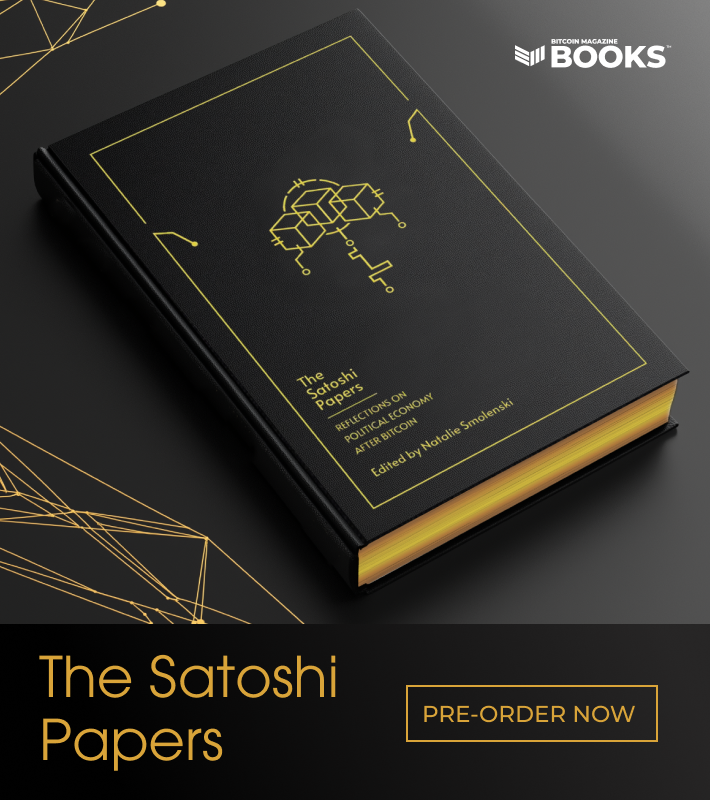

Natalie Smolenski has made a name for herself in the Bitcoin space in recent years by sharing her dynamic insights on Bitcoin and how it shapes the world moving forward.
The PhD-holding anthropologist is on the verge of upping the ante around her Bitcoin-related thought contributions with the new book she’s edited and to which she’s contributed, The Satoshi Papers: Reflections On Political Economy After Bitcoin (published by the Bitcoin Policy Institute‘s imprint of Bitcoin Magazine Books and available for pre-order now).
The book is a collection of texts from some of the most prominent academics who write about Bitcoin, including Andrew M. Bailey, Avik Roy and Leopoldo Bebchuk. With pieces entitled “Easy Money, Easy Wars? The Evolution of War Finance, Forever Wars, and the Prospects of a Bitcoin Peace” and “Dispute Resolution Without the State,” Smolenski and her colleagues explore the potential shifts in politics and power that may occur as a result of Bitcoin’s existence and proliferation.
I sat down with Smolenski to discuss why she chose to publish The Satoshi Papers at this moment in time, who she hopes to reach via the book and why the book isn’t an “apology” for Bitcoin.
What was the impetus to put The Satoshi Papers together?
Back in 2020, a friend of mine, Lee Bratcher, and I co-founded the Texas Blockchain Council, which was a trade association representing the Bitcoin industry in Texas. We also set up the Texas Blockchain Summit, which was our annual conference and one of the first policy-focused conferences around Bitcoin in the United States.
After the very first Texas Blockchain Summit, I was speaking with a good friend of mine who suggested that the time may be right to publish some essays about this moment in the historical adoption of Bitcoin — that this was kind of a refounding moment for the American Republic.
Bitcoin is a part of that story, but it’s not the whole story. So, there seemed to be an opportunity to collect works from interdisciplinary voices to talk about and investigate what the relationship between the individual, society and the state looks like in a post-Bitcoin world.
I took that as a kind of mission, and I founded the Texas Bitcoin Foundation, which is a 501(c)(3), an education-focused charity. I took a step back from the policy space in order to focus more on some of the theoretical and scientific issues that I think need to inform the policy conversation going forward.
How did you decide on the roster of contributors for the book?
There were some people we invited personally, because I knew them, and I knew that they were strong thinkers in the Bitcoin space. A number of them came back and said, “Yes, we’d love to contribute an essay.”
So, we had some personal invitations go out and then we also had an open call for papers and those went through a couple of rounds. Initially, people just submitted an abstract, and we gave the most promising abstracts feedback if we thought they could potentially be a fit for the paper.
We got initial drafts from some of those. Then, we had a second round of edits based on the strength of the scholarly argument.
Can you explain what political economy is?
Political economy is actually an old term. Back before political science and economics functioned as separate fields, there was this domain of political economy, which studied how states and societies generated wealth, like Adam Smith did in The Wealth of Nations.
Many of the people that we think of today as economists would have called themselves political economists back then because they recognized that markets are shaped in large part by the ways that human societies organize themselves politically. This is not the same thing as saying the market is downstream from the state. Some have made that argument recently, but it’s actually much more nuanced than that.
There’s been a kind of return or resurgence of interest in political economy in recent years, in part as a response to the perceived inadequacy of theoretical frameworks in traditional or mainstream economics today to understand the nuances of markets without taking into account the domain of the political.
How will political economy change now that Bitcoin exists?
Well, that’s a huge question, and that’s what the essays in this volume approach from different angles.
The issuance and maintenance of money is one of many functions of the state — legitimately or illegitimately — depending on your theory of the state.
There’s a way in which Bitcoin has automated one of the functions of the nation state. That said, what it doesn’t do is create a centrally managed token that functions as the jurisdictional medium of exchange of debt settlement in countries around the world.
So, there’s a way in which Bitcoin exists in tension with the nation state, but doesn’t necessarily undermine it, which is an interesting area to explore.
Bitcoin offers an alternative to government-issued currencies, but the presence of an alternative in and of itself does not mean that government-issued monies will go away. Rather, it forces governments to accept the reality that they do not, in fact, have a monopoly over what their people use as a store of value, unit of account, and medium of exchange.
Much in the same way, the Second Amendment to the U.S. Constitution reminds the government that it does not have a monopoly on violence. The state must exist in tension with the sovereignty of the individual — which includes the right to transact and the right to bear arms — and that means there are limits to state sovereignty.
What sets this book apart from all other books that have been published on Bitcoin thus far?
There have been very few book-length academic treatments of Bitcoin. The main example that I can think of is Resistance Money, which came out this year.
The Satoshi Papers is different in that, rather than being a consistently-authored volume, it is a compilation of articles by different scholars from different disciplines. It is a collection of different voices from various social sciences about Bitcoin. It’s the only book of its kind that does that.
The other thing that I would say sets The Satoshi Papers apart is that it is not an apology — and I use that term classically — for Bitcoin in any way. Apologia is a justification or an argument in favor. We’re not arguing for Bitcoin. Bitcoin is here. It is a fact. It is a material and social fact.
So, the questions that we are exploring in this paper are: What kind of force does Bitcoin have? What are the significant political and geopolitical trends that are influencing the expression of self sovereignty and shaping how self-sovereign technological architectures come about? What does this tell us about the nature of money as a social phenomenon?
Money, much like language and law, is an emergent social phenomenon that does not require the state. Nevertheless, there are top-down vectors of value issuance management that do impact the ways that money is used in human society. So, in some ways the volumes are exploring that tension between top-down and bottom-up vectors of social organization.
Why has academia not only been reluctant to discuss Bitcoin but seemingly by and large against it?
Unfortunately, academia has been the epicenter of what I think is rightly called a cultural revolution in Anglophone countries and in the West more broadly. I think there has been a drive toward emancipation for historically marginalized groups. That has not only significantly influenced scholarship, but has taken it in directions that increasingly have privileged the role of the state over the role of the individual and civil society in realizing the project of emancipation.
And so there is a widespread suspicion of anything smacking of individualism, which is in effect seen as a cover for exploitation. For this reason, movements like Bitcoin, which are more “anarchist-coded” or “right-coded” — even though I would argue that there’s nothing right wing or left wing about Bitcoin — exist in a highly-politicized tribal environment and are identified with political enemies.
So, this volume was very consciously crafted to intervene in that milieu, in large part by not apologizing for Bitcoin. No, we’re not going to take a demure posture here. Bitcoin’s existence is a material fact that you have to reckon with as social scientists. You may not like it. It may not fit into your model of emancipation, but it is here and it has been brought about exclusively by the volunteer labor of individuals around the world who often quite selflessly sacrifice their time and their life to create this avenue of liberty in a world of intense and intensifying state control.
There is a self-confidence to The Satoshi Papers that comes from being academically rigorous, being able to intervene into the debates in the academy. The authors are familiar with the traditions, familiar with the literatures, able to speak to them, and in no way apologize for what all of these academics eventually will simply pre-suppose as part of the architecture of the world.
Everyone’s going to be using Bitcoin. They may not realize it, but it’s just going to become folded into the fabric of their transacting. So, this is an opportunity for those in the academy who have eyes to see and ears to hear to engage proactively in a dialogue about these issues.
What audience do you have in mind for this book?
Anthropologists, economists, philosophers, historians, economic historians.
At the same time, is this the type of book that someone who reads The Bitcoin Standard might read, as well?
Yes, I think this book has unique crossover appeal. I think it is comprehensible and accessible for the educated lay reader, and it also checks the boxes for a scholarly reader who is looking for things like literature review, engagement with the historical debate, source criticism, etc.
The book’s epilogue, “Peer-To-Peer Is A Human Right”, is the transcript from a speech you gave this past April at the Bitcoin Policy Summit. Why do you feel that this point needs to be made so explicitly, especially to academics?
The majority of the social sciences and humanities today are, let’s say, left-oriented politically for lack of a better term, but what that means has changed. In the early-20th century/late-19th century, even early to the mid-19th century, the political left was strongly influenced by anarchist reform movements, and there was a strong tradition of like anarcho-leftist thought. That pretty much fell away after the Second World War.
It seems that the anarchist tradition of thought as it pertains to Bitcoin exists more in Europe than it does in The States. Have you noticed this?
That may be very true. I’m actually not that familiar with the shape of the academy in Western Europe right now, but I would see that as entirely plausible, particularly since there were quite a few thinkers in the French anthropological tradition in the early 20th century, who were very anarcho-leftist, anarcho-socialist.
There was kind of a triumph of a certain very statist approach to socialism and even communism in the American academy, in the Anglophone academy that has persisted to this day, where there’s, like I was saying earlier, a suspicion of anything smacking of individualism as bourgeois conceit or reinscribing social hierarchies, racial hierarchies, gender hierarchies, blah, blah, blah.
This is just a peculiarity of the historical moment that we’re in, and I suspect as the surveillance and control exercised by the state perhaps turns against some of these folks in the academy, there will be a greater level of awareness as to the value of bottom-up approaches to emancipation.
But right now, it’s hard for a lot of people to imagine. They really see the state as the solution to social inequality and oppression.
Many see the state as the mechanism to redistribute wealth, but don’t see the perniciousness of money printing by the Federal Reserve, which works in conjunction with the state. Why don’t academics talk about the harmful effects of currency debasement?
Well, I think the political imagination of many social scientists has been strongly shaped by imagining capitalism and the capitalist as the primary enemy of humanity.
What they’re looking for is the Leviathan, because they’re looking for something that has the power to crush the Elon Musks of the world, who they just hate and hold responsible for virtually every social ill. There isn’t a lot that is redeemable about that kind of caricatured social vision.
But I think there are people in the academy who even might partake of that prejudice who are rigorous thinkers and they want to be engaged with rigorous arguments from “a different perspective.”
The problem with culture war is that it tends to elicit responses that are just as petty and reductive as the originally-proposed points of view. So, if you come into the world spewing a caricatured points of view, you’re going to tend to attract other caricatured points of views. And then it just becomes this tit for tat and doesn’t get anywhere. Part of the objective of The Satoshi Papers is to enter that conversation orthogonally.
This is not a Republican book. This is not some kind of an apologia, like I was saying, for any political orientation or ideology. It is an intervention in a scientific conversation about the origin and nature of money.
So, if you want to take issue with its claims, you absolutely can. They’re right there. In fact, we welcome disagreement. If our authors are wrong about something, we want to know that, but we’re not going to be fighting ideological wars here.
What do you hope people will take away from The Satoshi Papers?
If there’s only one idea that people take away from it, it’s that your emancipation does not require the state. You do not need to wait for the government.
My God, take control of your life. You can, it is within your power to do so, and here are some examples of ways that people throughout human history have chosen to do so.
We have a couple of papers in the book that speculate on the following: What could credit look like on a bitcoin standard? What are different fiscal scenarios for the United States that future presidential administrations could pursue?
The horizon of political possibility is so much wider than we often imagine from our embattled position as culture warriors in the present day, and that’s what we’re trying to blow open.
Source link