Why Micron Technology Could Be the Biggest Winner in AI’s Explosive Growth Era!
The rapid rise of artificial intelligence (AI) is reshaping entire industries, and few sectors are as directly affected as the memory chip market. Micron Technology, one of the world’s leading semiconductor companies, finds itself at the forefront of this transformation. With a series of cutting-edge products, strategic partnerships, and timely investments, Micron is positioning itself as a critical supplier in an era when AI requires ever-more powerful hardware. Investors, analysts, and industry watchers are all taking note of the company’s remarkable growth trajectory, as it could provide significant returns for those who understand how AI is driving up demand for specialized memory solutions.
History & Memory: Where Yesterday Fuels Tomorrow
History of Memory Chips
- Early Beginnings (1940s–1960s):
- Before semiconductor memory, computers used technologies like magnetic drum storage and magnetic core memory to store data.
- The invention of the transistor at Bell Labs (1947) paved the way for solid-state electronics. By the early 1960s, the first semiconductor-based memory devices (using diodes and transistors) began appearing, though they were expensive and had limited capacity compared to core memory.
- Rise of DRAM (1970s):
- In 1970, Intel introduced the 1103, widely recognized as the first commercially successful DRAM (Dynamic Random Access Memory) chip. DRAM stored data in tiny capacitors, which needed constant refreshing but allowed for higher density and lower cost than earlier technologies.
- As the 1970s progressed, DRAM became the standard in main memory for most computer systems, thanks to improving manufacturing yields and the increasing demand for memory in emerging personal computers.
- Competition and Global Expansion (1980s–1990s):
- The 1980s saw fierce competition among American, Japanese, and later South Korean companies. Many Japanese firms (e.g., NEC, Toshiba, Hitachi) gained market share through advanced process technology and government support.
- South Korean companies like Samsung and SK Hynix (formerly Hyundai Electronics) rose rapidly in the global DRAM market by investing heavily in R&D and manufacturing.
- By the 1990s, the memory landscape began consolidating, with a few dominant players emerging. Samsung’s major push in DRAM and Toshiba’s leadership in flash memory set the stage for the modern memory market structure.
- Emergence of Flash Memory (1980s–2000s):
- In the late 1980s, NOR flash memory was developed, ideal for storing code in embedded systems. Shortly after, NAND flash memory was introduced by Toshiba (1987), eventually becoming the go-to storage technology for SSDs, USB drives, and memory cards.
- NAND offered higher density and lower cost per bit compared to NOR, though it had slower read speeds. Over time, NAND flash memory became ubiquitous in consumer electronics (smartphones, tablets) and data centers (SSD-based servers).
- Technological Advancements (2000s–2010s):
- Memory manufacturers pioneered new process nodes, moving from planar to 3D architectures in NAND (stacking layers vertically to increase density).
- In DRAM, generations evolved from DDR (Double Data Rate) to DDR2, DDR3, DDR4, and now DDR5—each offering higher bandwidth and lower power consumption.
- Constant innovation was (and remains) crucial to meet the growing demand for higher capacity, faster speeds, and more power-efficient memory in PCs, smartphones, and data centers.
- Industry Consolidation and Oligopoly (2010s–Present):
- High capital expenditures and advanced know-how led to fewer companies dominating the market. Today, Samsung, SK Hynix, and Micron are the primary DRAM producers. For NAND, Samsung, Kioxia (formerly Toshiba Memory), Western Digital, SK Hynix, and Micron are top players.
- This oligopolistic structure means memory supply is influenced by a small number of large manufacturers. Production decisions (like capacity expansion or cutting back) can have a significant impact on global prices and inventory cycles.
- Cyclical Nature of the Memory Market:
- Memory chips—especially DRAM—are often considered a commodity, meaning market prices fluctuate based on supply and demand.
- During boom cycles, strong demand (e.g., from data centers or new mobile device launches) can drive up prices and profit marginsIn the dynamic world of business, profitability is a fundamental metric that encapsulates a company’s ability to generate earnings from its operations. Profit margins, expressed as…. In downturns, oversupply or weakened device sales can lead to rapid price declines and inventory glut.
- These cycles can be sudden and pronounced, making timing and inventory management critical for both memory suppliers and their customers.
- New Frontiers and Emerging Technologies:
- Beyond DRAM and NAND, new memory types like MRAM (Magnetoresistive RAM), ReRAM (Resistive RAM), and 3D XPoint (co-developed by Intel and Micron, marketed by Intel as Optane) aim to combine the speed of DRAM with the non-volatility of flash.
- While none have overtaken DRAM or NAND in mass adoption yet, R&D in next-generation memory signals constant evolution and potential shifts in the market.
What Investors Need to Know
- Cyclical Risks and Timing:
- Memory prices swing dramatically based on market cyclesMarket cycles refer to the natural, repetitive phases of growth and contraction in financial markets. These trading market cycles reflect the behavior of investors and broader econ…. Understanding these cycles—often tied to global economic conditions, data center investments, smartphone demand, and other macro factors—is crucial.
- Capital Intensity and Technology Leadership:
- Building and upgrading fabs (fabrication facilities) is extremely expensive. Leading-edge processes often require billions in annual capital expenditures. Companies that lag in technology can quickly lose market share or face margin erosion.
- Supply-Demand Balance and Inventory:
- With only a handful of manufacturers, production decisions can significantly impact prices. Investors should watch for announcements regarding fab expansions or production cuts, as these can signal future shifts in the supply-demand balance.
- Diversified End Markets:
- Demand for memory chips comes from multiple sources: consumer electronics, automotive, enterprise IT, data centers, and more. A slowdown in one sector can sometimes be offset by strength in another. Understanding these end markets helps gauge overall demand.
- Geopolitical and Trade Factors:
- Semiconductor manufacturing is subject to export controls, trade disputes, and government incentives. Such factors can disrupt supply chains or catalyze new regional manufacturing initiatives, affecting production costs and market shares.
- Long-Term Growth Drivers:
- Despite near-term cyclical swings, long-term demand trends remain positive—driven by cloud computing, AI, 5G, automotive electronics, and IoT. These all require increasing amounts of memory and storage.
- Company-Specific Strategies and Innovation:
- Each major player has unique strategies, whether it’s focusing on premium segments (e.g., server or graphics DRAM), pushing the envelope on next-generation NAND, or diversifying into emerging memory technologies. Investors should assess how well a company executes on R&D, manufacturing efficiency, and product mix.
The memory chip industry has evolved from early magnetic core replacements to today’s advanced DRAM and NAND devices powering global computing infrastructures. Its history is marked by technological leaps, fierce international competition, consolidation into a small group of major players, and notoriously cyclical market swings. Investors venturing into the memory chip sector should keep a keen eye on supply-demand balances, technological roadmaps, capital expenditureIn the realm of corporate finance, Capital Expenditure (CapEx) play a crucial role in shaping the future trajectory of a company. From acquiring new assets to upgrading existing in… trends, and the macroeconomicAt its core, macroeconomics is the branch of economics that examines the behavior, performance, and structure of an economy as a whole. Unlike microeconomics, which focuses on indi… environment. While volatile, the industry’s long-term growth prospects remain strong due to the constant rise in data creation and consumption across nearly every facet of modern life.
In today’s data-driven era, memory chips serve as the engines that power the rapid storage and retrieval of information, fueling the technologies that define modern life. As AI algorithms become more complex, demand for faster, more efficient, and larger-capacity memory is surging. This demand has presented Micron with a golden opportunity to showcase its technological advantages. From record-breaking revenue growth to unique design features in its HBM3E chips, Micron appears ready to capitalize on an AI revolution that is only just beginning.
AI Technology and Micron’s Unprecedented Growth
Micron’s story of growth is closely tied to the explosion of AI technology. While AI has been around for decades in various forms, recent breakthroughs in machine learning and deep learning have created an insatiable hunger for computational power. This power is heavily dependent on high-performance memory chips capable of handling complex workloads.
Micron’s data center revenue offers a clear indicator of how well-positioned the company is for this shift. In just the last three months of 2024, Micron’s data center revenue soared by over 400% compared to the same period in the previous year, driven by the explosion of generative AI applications, the proliferation of large language models, and the growing adoption of data-heavy AI systems across industries. This growth reflects Micron’s ability to meet rising demand with innovative, high-performance memory solutions tailored to the needs of cutting-edge AI workloads.
Revenue growth is a fundamental indicator of a company’s health and potential profitability. A 400% uptick in data center revenue signals that Micron’s products are not only competitive but also in high demand. For investors, rapid revenue growth usually translates to higher earnings and can drive the company’s stock price upward. It also reflects strong product-market fit—a key factor that can sustain long-term profitability.
High Bandwidth Memory: A Cornerstone of AI Advancement
Among the most significant innovations in Micron’s product lineup is the company’s High Bandwidth Memory (HBM) technology. HBM chips are engineered for applications that demand fast data transfer rates, such as AI training and inference, high-performance computing, and advanced graphics processing. Micron’s latest version, called HBM3E, is so compelling that even industry giant NVIDIA has chosen it for their newest AI chips.
Traditional DRAM (Dynamic Random Access Memory) solutions often struggle to keep pace with the enormous data throughput required by modern AI models. HBM addresses this challenge by stacking layers of memory vertically and enabling extremely high data bandwidth. Micron’s HBM3E stands out due to its 12-high stack design, which packs 50% more memory into the same physical space compared to competitors’ 8-high designs. These chips also use 20% less energy than competing solutions—a crucial factor when dealing with massive data centers where power efficiency can translate into millions of dollars in operational savings.
xAI does not publicly disclose specific details about the components used in their hardware, including whether they use Micron memory chips. However, Micron Technology is a significant player in the memory chip market, providing a variety of memory solutions that are widely used across different industries, including technology companiesTechnology companies are businesses that focus on the development, manufacturing, and distribution of technology-based goods and services. These companies operate in industries suc… like xAI might require.
Micron is known for its DRAM, NAND, and high-bandwidth memory (HBM) products, which are crucial for advanced computing tasks, including those in artificial intelligence. For instance, Micron has been involved in producing memory chips for AI applications, as seen in their collaboration with Nvidia for AI GPUs using HBM3E memory chips. Given the demand for high-performance memory in AI development, it’s plausible that xAI could use Micron’s memory chips, but without explicit confirmation from xAI, this remains speculative.
HBM3E’s compelling performance metrics and power efficiency could allow Micron to charge premium prices, potentially boosting profit marginsIn the dynamic world of business, profitability is a fundamental metric that encapsulates a company’s ability to generate earnings from its operations. Profit margins, expressed as…. The fact that NVIDIA, a leader in AI hardware, has selected Micron’s HBM3E underscores the value and credibility of this technology. When a small number of companies control the majority of AI hardware supply, gaining a key partnership can be a game-changer for a supplier’s financial performance.
Micron is not resting on its laurels. The company is already developing the next-generation memory chip, HBM4, set to launch in 2026. According to Micron, HBM4 will deliver over 50% better performance compared to current HBM3E chips. Additionally, Micron plans to offer customization options for their customers, enabling part of the chip design to meet specific performance or power efficiency requirements for specialized AI applications.
Continuous innovation shows Micron’s commitment to staying ahead of the technology curve. The introduction of HBM4 signals that the company is determined to maintain its competitive edge, potentially setting the stage for future revenue streams. More importantly, customization often carries higher profit marginsIn the dynamic world of business, profitability is a fundamental metric that encapsulates a company’s ability to generate earnings from its operations. Profit margins, expressed as…, which can enhance shareholder value.
The Growing Market for AI-Specific Memory Chips
Micron projects that the market for AI-specific memory chips will grow from $16 billion in 2024 to more than $30 billion in 2025, a significant leap when compared to the overall memory market’s projected growth of around 10% during the same period. By 2030, the company predicts this segment will be worth over $100 billion, surpassing the value of the entire memory chip industry today.
Several factors are fueling this exponential growth. AI is becoming more prevalent in everything from self-driving cars and robotics to automated factories and personalized online services. Meanwhile, major technology companiesTechnology companies are businesses that focus on the development, manufacturing, and distribution of technology-based goods and services. These companies operate in industries suc… are rolling out advanced large language models, recommendation systems, and real-time data analysis tools—each requiring massive parallel processing power and, by extension, massive memory bandwidth. Micron’s robust product roadmap, focused on high-performance memory solutions, positions it to benefit from these trends.
Rapidly expanding market opportunities can drive higher stock valuations, especially for companies offering key enabling technologies for a disruptive trend. Investors looking at Micron will see not just present-day growth but also a clear runway for sustained demand over the next five to ten years. This dynamic can help counteract the historical cyclicality of the memory market by providing a consistent growth driver.
Micron’s Global Expansion and Partnerships
Micron is investing heavily in new manufacturing facilities to meet AI-related demand. In the United States, Micron is receiving $6.1 billion in funding under the CHIPS Act, designed to bolster domestic semiconductor manufacturing. Additionally, the company is building a facility in Singapore to manufacture advanced memory chips. This facility strengthens Micron’s presence in the Asia-Pacific region, enhances supply chain resilience, and positions production closer to key markets.
Strategic investments in manufacturing capabilities indicate strong preparation for future demand. Government incentives reduce financial burdens, enhancing Micron’s competitive positioning and lowering risks for shareholders.
Micron Stock Trading Plan
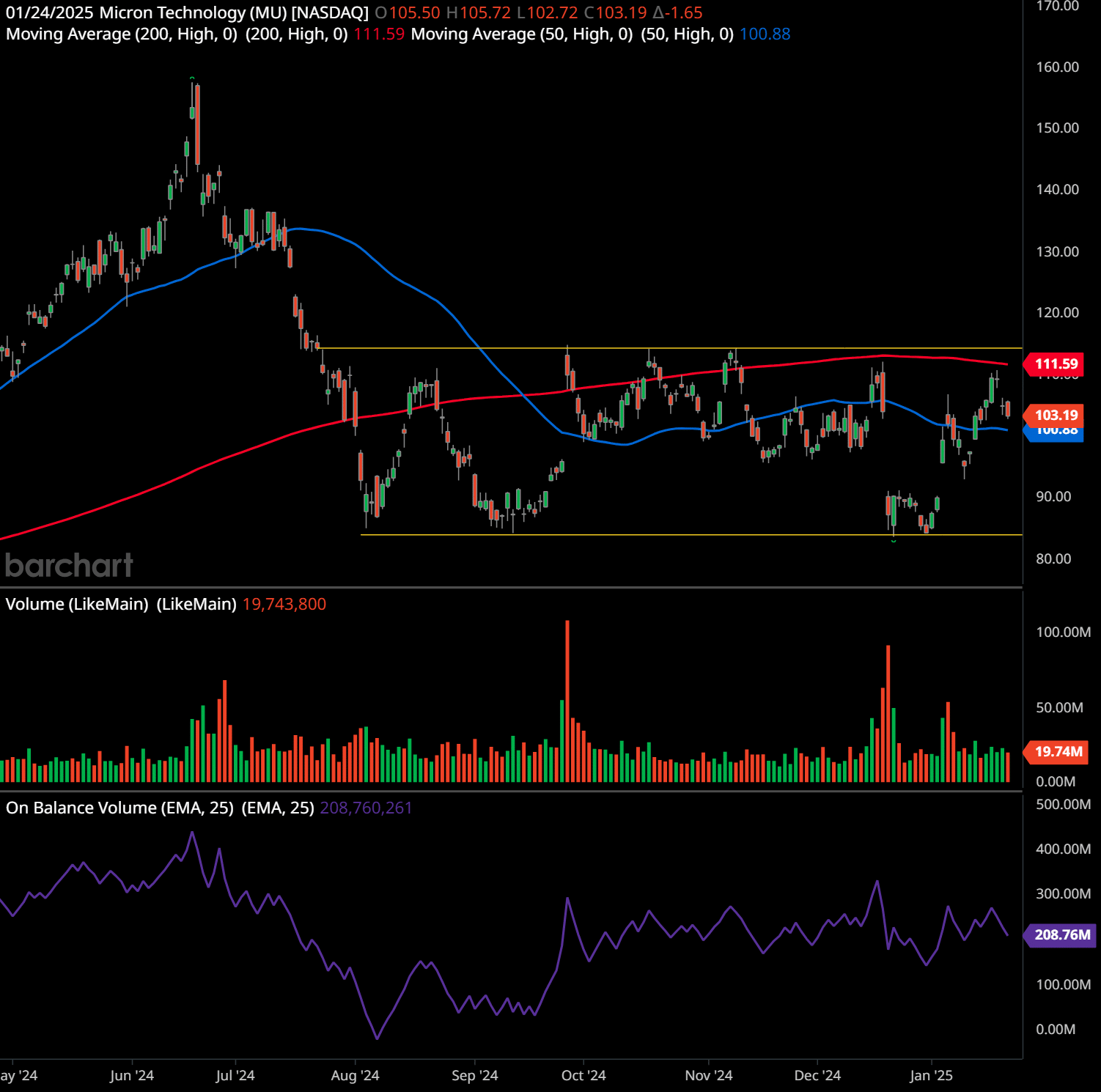
This chart for Micron Technology (MU) presents several key technical indicators and patterns that provide insights into potential future price movements. Here’s a comprehensive analysis:
Support and Resistance Levels:
- The support level is clearly visible around $85, where the price bounced multiple times in recent months, indicating strong buyer interest.
- The resistance level is at approximately $111.50, aligned with the 200-day moving averageThe concept of moving averages dates back to the early 20th century. While it is challenging to attribute the invention of moving averages to a single individual, W. P. Hamilton, a… (red line), which also acted as a ceiling for price action on multiple occasions.
Trend Analysis:
- The stock is currently in a range-bound consolidation phase, oscillating between the support around $85 and resistance at $111.50.
- The overall medium-term trend is neutral to slightly bearish, as the price struggles to break above the 200-day moving averageThe concept of moving averages dates back to the early 20th century. While it is challenging to attribute the invention of moving averages to a single individual, W. P. Hamilton, a… despite recent recovery from the $85 lows.
Chart PatternsChart patterns are visual formations on price charts that occur due to the behavior of buyers and sellers in the market. These patterns often signal potential future price movement… and Psychology:
- The stock appears to be forming a descending triangleThe descending triangle pattern is a bearish continuation pattern that is formed when a series of lower highs is followed by a series of equal lows. in the medium term, characterized by lower highs and a flat support level around $85 (previously tested). This pattern suggests bearish pressure as sellers become more aggressive.
- Buyer psychology at $85 shows strong support confidence, but repeated failures at $111.50 indicate hesitation to drive the price higher without a catalystIn stock trading, a catalyst refers to an event, news, or announcement that causes a significant and often rapid price movement in a stock or the broader market. Catalysts can be p….
Technical Indicators:
- The 50-day moving averageThe concept of moving averages dates back to the early 20th century. While it is challenging to attribute the invention of moving averages to a single individual, W. P. Hamilton, a… (blue line) is at $100.88 and trendingUnderstanding market trends is a critical component for businesses conducting industry analysis. For example, Netflix identified early on the growing demand for streaming services … upward, suggesting short-term strength. However, the downward-sloping 200-day moving averageThe concept of moving averages dates back to the early 20th century. While it is challenging to attribute the invention of moving averages to a single individual, W. P. Hamilton, a… (red line) indicates a longer-term bearish bias.
- Volume shows a notable spike in October, likely from an earnings report or news event. Since then, it has returned to average, indicating no major breakoutBreakout patterns occur when a stock price moves beyond a defined level of support or resistance with increased volume, signaling the potential start of a new trend. A breakout ind… or breakdown imminent.
- The On-Balance VolumeThe On Balance Volume indicator (OBV) is a technical analysis tool used to measure the flow of money into and out of a security over a specified period of time. It is a cumulative … (OBVThe On Balance Volume indicator (OBV) is a technical analysis tool used to measure the flow of money into and out of a security over a specified period of time. It is a cumulative …) line is relatively flat, suggesting a lack of strong accumulation or distribution, further reinforcing the range-bound activity.
Stock Price Forecast:
- In the short term, expect continued oscillation between $85 and $111.50. A decisive break above $111.50 with volume could indicate a bullish reversal, while a breakdown below $85 could signal further downside.
- Over the long term, breaking above the 200-day moving averageThe concept of moving averages dates back to the early 20th century. While it is challenging to attribute the invention of moving averages to a single individual, W. P. Hamilton, a… and sustaining it could transition the trend to bullish. Conversely, persistent failures at this level may result in the stock revisiting its lower support zones.
Trading Plans:
- Swing TradingSwing trading is a popular trading strategy aimed at capturing short- to medium-term gains by taking advantage of price swings in financial markets. Unlike day trading, which invol… Plan:
- Buy Entry: Near $85 support with a stop-loss at $82.
- Profit Target: $100 (first target) and $111.50 (second target).
- Bearish Scenario: If $85 breaks, consider shorting with a target of $75.
- Monitor volume and OBVThe On Balance Volume indicator (OBV) is a technical analysis tool used to measure the flow of money into and out of a security over a specified period of time. It is a cumulative … for confirmation of breakoutBreakout patterns occur when a stock price moves beyond a defined level of support or resistance with increased volume, signaling the potential start of a new trend. A breakout ind… or breakdown.
- Long-Term Trading Plan:
- Buy Entry: Upon a confirmed breakoutBreakout patterns occur when a stock price moves beyond a defined level of support or resistance with increased volume, signaling the potential start of a new trend. A breakout ind… above $111.50 with significant volume.
- Stop-Loss: Place at $100 to manage downside riskIn stock and crypto trading, risk refers to the possibility of losing some or all of the capital invested in a trade. It represents the uncertainty about the future performance of ….
- Profit Target: $130–$140 range, based on prior resistance levels from earlier in 2024.
- Alternatively, wait for a breakdown to $85 or below for a deep-value entry, targeting $100+ upon recovery.
While the chart presents potential trading opportunities, it is critical to stay cautious and wait for confirmation of a breakoutBreakout patterns occur when a stock price moves beyond a defined level of support or resistance with increased volume, signaling the potential start of a new trend. A breakout ind… or breakdown before committing to a position. Both swing and long-term traders should use tight riskIn stock and crypto trading, risk refers to the possibility of losing some or all of the capital invested in a trade. It represents the uncertainty about the future performance of … management strategies to navigate this range-bound market.
Past performance is not an indication of future results. This analysis should not be considered as investment advice. Always conduct your own research and consider consulting with a financial advisor before making any investment decisions. 🧡
A Bright Future in AI Memory
Looking ahead, Micron’s innovations, government support, and expanding AI applications point to a promising trajectory. For investors seeking exposure to the AI revolution, Micron offers a compelling opportunity to invest in foundational technologies powering the next generation of breakthroughs.
Do you have a news tip for GuerillaStockTrading? Please email us at
[email protected]
🗨️ JOIN OUR COMMUNITY OF STOCK TRADERS AND INVESTORS ON SOCIAL MEDIA
💥 GET OUR LATEST CONTENT IN YOUR RSS FEED READER
We are entirely supported by readers like you. Thank you.🧡
At GuerillaStockTrading, we maintain full transparency and impartiality; we never blog about stocks or crypto in which we hold a personal position unless explicitly stated in the article. Additionally, we do not accept paid promotions presented as content. All information shared is for informational purposes only and should not be construed as financial, investment, tax, or legal advice, nor as a recommendation to buy any security or financial asset. The content is general in nature and does not account for individual circumstances. It may not be suitable for your particular situation. Before making financial decisions, you are encouraged to seek guidance from your own financial or investment advisor.