How to Adjust a Bull Put Spread: Converting to an Unbalanced Iron Condor (Real Trade Example)
Your bull put spread is getting tested.
The stock has dropped, your short put delta is climbing, and you need to make a decision: take the loss, or adjust?
Today I’m going to show you exactly how I adjusted a real HOOD (Robinhood) bull put spread when the short put delta hit 29.
Instead of panicking or hoping for a reversal, I converted it to an unbalanced iron condor – cutting my delta dollars by 33% while collecting additional premium.
This is real money, real decisions, and a real adjustment technique you can use when your own trades get challenged.
Contents
When Bull Put Spreads Need Adjustment
Bull put spreads are high-probability income trades, but that doesn’t mean they always work.
When the underlying moves against you, the short put delta increases – signaling growing directional risk.
Standard adjustment triggers:
- Short put delta reaches 25-30 (your risk is increasing)
- Delta dollars exceed 2x your capital at risk
- Price alert triggered (halfway between current price and short strike)
The key is adjusting before the position becomes unmanageable. Once your short strike goes deep in-the-money, your options become limited and expensive.
The Original HOOD Position
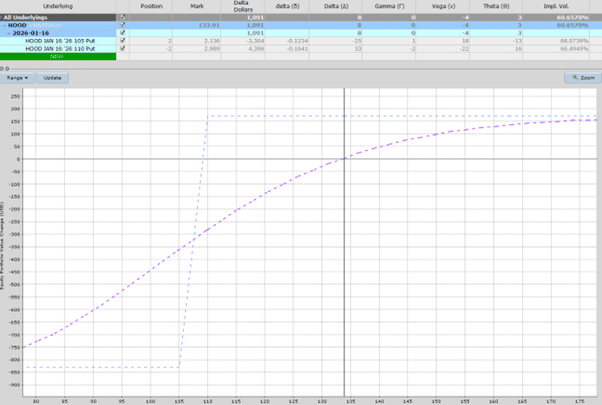
Here’s what the position looked like before adjustment:
Initial Trade:
- Date: Dec 3rd, 2025
- Underlying: HOOD (Robinhood) at $133.91
- Position: 2 contracts of bull put spread
- Short puts: JAN 16, $110 strike
- Long puts: JAN 16, $105 strike
- Short put delta: 16
- Delta dollars: 1,091
- Days to expiration: 44days
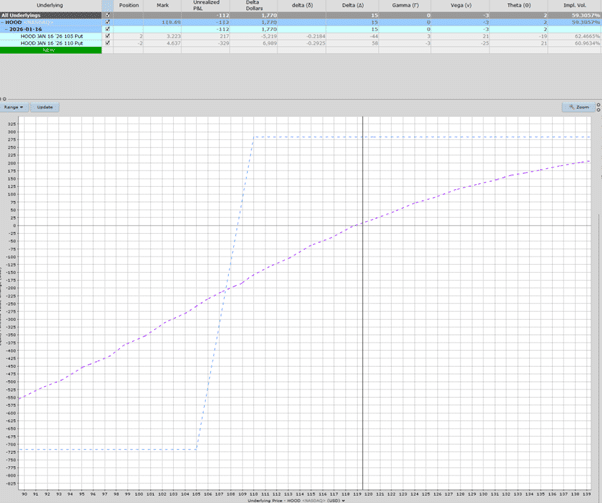
By December 14th, HOOD had dropped to 119.49 and the short put delta had blown out to 29.
- Underlying: HOOD (Robinhood) at $119.49
- Short put delta: 29
- Delta dollars: 1,770
- Days to expiration: 33 days
The short put delta of 29 was the red flag.
At this point, there’s roughly a 29% probability that HOOD finishes below $105 at expiration.
More importantly, the delta dollars of 1,770 represented significant directional risk if HOOD continued lower.
Why Adjust At 29 Delta?
You might wonder: why not wait to see if HOOD rebounds?
Why adjust at 29 delta instead of 35 or 40?
Because the further in-the-money your short strike goes, the harder and more expensive adjustments become.
At 29 delta:
- Still have reasonable time value in the options
- Adjustment spreads are liquid and fairly priced
- Can make changes for credits or small debits
- Position hasn’t spiraled into panic territory
At 45-50 delta:
- Options are close to ITM
- You’re in damage control mode rather than strategic adjustment mode
The rule: Adjust when the short strike reaches 25-30 delta, not when it reaches 50 delta and you’re desperate.
The Two-Part Adjustment Strategy
Instead of taking a single action, I used a two-part approach to transform the bull put spread into an unbalanced iron condor.
This accomplished three goals:
- Reduced delta dollars from 1,770 to 1,182 (33% reduction)
- Collected additional premium ($140-$150)
- Maintained defined risk with a clear profit zone
Let’s break down each step.
Step 1: Rolling Down And Adding Contracts
The first adjustment was rolling the put spread down and increasing to 3 contracts.
The mechanics:
- Close: 2 contracts of the JAN 16 105/110 put spread
- Open: 3 contracts of the JAN 16 100/105 put spread (rolled down $5)
Why add a contract?
This is the counterintuitive part.
By going from 2 to 3 contracts, I’m:
- Collecting more premium (3 contracts vs 2)
- Moving the strikes further from current price (from 105 short to 100 short)
Think of it this way: Would you rather have 2 contracts at 29 delta, or 3 contracts at 15 delta?
The 3 contracts at lower delta actually represent less directional risk.
Step 2: Adding Bear Call Spreads
The second part converted this into an iron condor by adding call spreads above the market.
The mechanics:
- Open: 2 contracts of JAN 16 145/150 bear call spreads (17 delta)
Why 2 contracts instead of 3?
This creates an unbalanced iron condor – more contracts on the put side (3) than the call side (2).
This maintains a slightly bullish bias since:
- The original position was bullish (bull put spread)
- HOOD had pulled back but wasn’t broken
- Having more puts than calls keeps slight upside preference
Why 17 delta for the calls?
This is aggressive enough to collect meaningful premium while staying far enough out-of-the-money to avoid early assignment risk.
The Results: Unbalanced Iron Condor
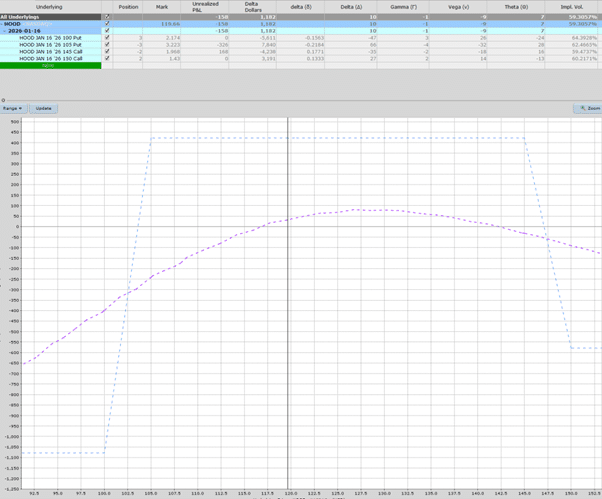
After both adjustments, here’s the new position structure:
Final Position:
- Underlying: HOOD at $119.66 (slightly higher after adjustment)
- 3 contracts: JAN 16 100/105 bull put spreads
- 2 contracts: JAN 16 145/150 bear call spreads
- Total delta dollars: 1,182 (down from 1,770)
- Additional premium collected: $140-150
Key improvements:
Delta Risk Reduced: From 1,770 to 1,182 delta dollars is a 33% reduction in directional exposure. If HOOD continues falling, the position won’t bleed as quickly.
Premium Collected: Instead of paying to adjust (which many adjustment techniques require), this brought in additional credit. That gives us more premium to play with if we need to do another adjustment.
Profit Zone Expanded: The original bull put spread only profited if HOOD stayed above $105. Now the position profits if HOOD stays between roughly $100-145 – a much wider range.
Time Still on Your Side: With 33 days to expiration, theta decay continues working in your favor across all four legs.
Risk Profile Changed: What was a one-sided bullish bet is now a range-bound position. You’re no longer purely exposed to downside – you can handle movement in either direction as long as it stays within range.
Key Takeaways
1. Adjust Early, Not Late
When your short strike hits 25-30 delta, that’s your signal. Don’t wait until 40-50 delta when options are deep in-the-money and expensive to adjust.
2. Delta Dollars Matter
This position went from 1,770 to 1,182 delta dollars – a meaningful reduction in directional risk. Always monitor delta dollars, not just delta percentages.
3. Credit Adjustments Are Possible
Many traders assume adjustments always cost money. By combining rolling with adding structures (like the call spreads), you can adjust for credits.
4. Unbalanced Structures Have Purpose
The 3-contract put side vs 2-contract call side maintained a slight bullish bias while creating a wider profit range.
5. Match Adjustment to Outlook
If you’re still somewhat bullish (like with HOOD), use adjustments that maintain directional bias while reducing risk. If your thesis has completely changed, close the position.
6. Have a Plan Before You Need It
Don’t figure out adjustment strategies when your trade is bleeding. Know your triggers and techniques before entering any position. This trade was adjusted calmly and systematically because the plan existed beforehand.
Final Thought
Bull put spread adjustments aren’t about saving every trade.
They’re about managing risk intelligently when your thesis is challenged but not broken.
The goal is turning potentially large losses into manageable situations while maintaining profit potential.
This HOOD adjustment collected premium, reduced delta risk by 33%, and expanded the profit zone.
Want to Master Options Adjustments?
Understanding when and how to adjust challenged positions separates profitable options traders from those who struggle. If you want systematic approaches to managing credit spreads and income strategies:
Options Income Mastery: Learn proven strategies for credit spreads, adjustments, and risk management ($397)
The Accelerator Program: Advanced training covering complex adjustments, portfolio management, and systematic trading approaches ($997)
Related Articles
We hope you enjoyed this article on how to adjust a bull put spread.
If you have any questions, please leave a comment below or send an email.
Trade safe!
Disclaimer: The information above is for educational purposes only and should not be treated as investment advice. The strategy presented would not be suitable for investors who are not familiar with exchange traded options. Any readers interested in this strategy should do their own research and seek advice from a licensed financial adviser.

Source link