
Bernstein: Long-Term Ownership Trend Makes Bitcoin Less Vulnerable to Sell-Offs
Bitcoin recent price recovery is supported by a growing base of long-term investors and steady institutional inflows, according to a new research note from Bernstein.
This evolving ownership pattern is gradually reinforcing the asset’s stability, even as global uncertainty continues to weigh on traditional markets.
Key Points
- Bernstein reports nearly 60% of Bitcoin’s supply has remained inactive for over a year, signaling growing dominance of long-term holders.
- Bitcoin gained ~6% last week, and Ethereum rose ~14%, outperforming gold and major equity indices amid global tensions.
- U.S. Bitcoin ETFs saw three consecutive weeks of inflows of over $2.1 billion, reflecting rising institutional interest.
- Bernstein notes corporate accumulation is significant, with Strategy acquiring over 66,000 BTC year-to-date, investing $5.6 billion at an average price near $85,000.
- Large holders, including ETFs, exchanges, and public companies, now control more than 3.75 million BTC, worth over $201 billion, reinforcing market stability.
Bitcoin Outperforms Traditional Assets Amid Global Tensions
Against this backdrop, Bitcoin delivered a weekly gain of about 6%, while Ethereum climbed roughly 14%. Bernstein noted that both cryptocurrencies outperformed gold and major equity indices during the same period.
Notably, these gains came despite escalating geopolitical tensions in the Middle East. This contrast has drawn attention to Bitcoin’s unique characteristics.
According to Bernstein analysts, its borderless nature and high liquidity make it attractive in uncertain times. They also highlighted its lack of counterparty risk, which can further strengthen investor confidence during global disruptions.
Shift Toward Long-Term Ownership Reshapes Market Dynamics
While price performance has improved, underlying ownership trends are also undergoing a meaningful shift. Bernstein highlighted that nearly 60% of Bitcoin’s total supply has remained inactive for more than a year, signaling the growing dominance of long-term holders.
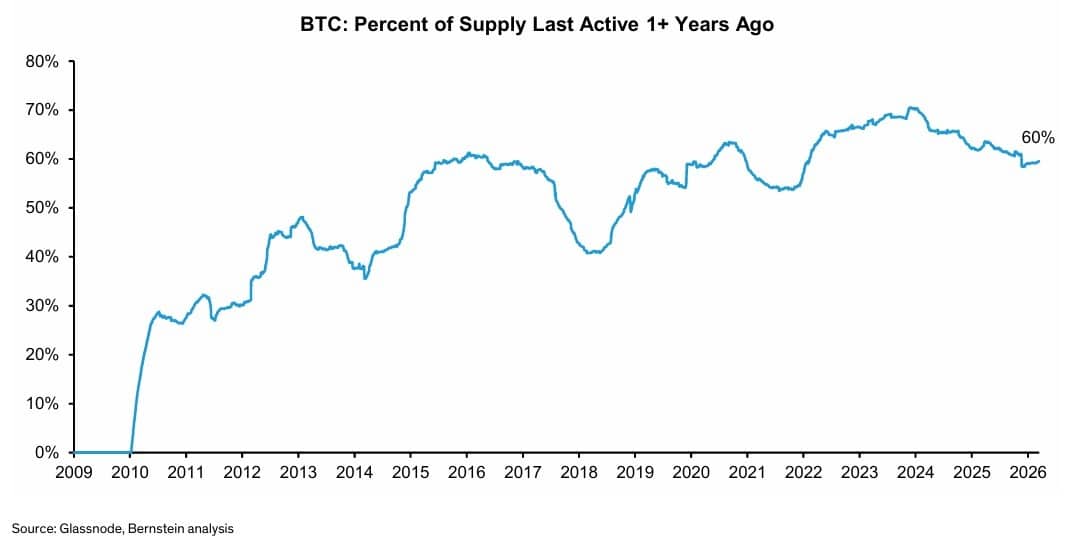
Consequently, the market is becoming less reliant on short-term trading activity. With more Bitcoin held in long-duration positions, sudden sell-offs may have a reduced impact on prices.
At the same time, increasing allocations into ETFs, corporate treasuries, and low-activity wallets are reinforcing this shift. Together, these factors are contributing to a more stable and resilient market structure.
ETF Inflows and Institutional Capital Drive Stability
Building on this trend, institutional participation continues to expand. According to data from SoSoValue, U.S. spot Bitcoin ETFs have seen inflows for the third week in a row, with the cumulative amount exceeding $2.1 billion.
Bernstein attributed these inflows to rising allocations from wealth managers and large institutional investors, including pension and sovereign funds. This steady capital movement suggests growing long-term confidence in the asset.
At the same time, earlier ETF outflows have begun to reverse. Net withdrawals have narrowed to around $460 million, compared with roughly $92 billion in total assets under management.
Supporting this trend, CoinGecko’s pricing data shows Bitcoin trading near $74,210, reflecting a weekly gain of over 5%.
Corporate Accumulation Adds to Long-Term Confidence
In parallel with ETF demand, corporate accumulation is emerging as another key pillar of support.
Strategy has continued to expand its Bitcoin holdings throughout the year. According to Bernstein, the company has acquired 66,231 BTC year-to-date, investing approximately $5.6 billion at an average price near $85,000.
More recently, between March 9 and 13, the firm purchased an additional 22,337 BTC for $1.57 billion, bringing its total holdings to over 761,000 BTC.
At current market prices, these reserves are valued at approximately $57.61 billion, underscoring strong corporate conviction in Bitcoin’s long-term potential.
Large Holders Dominate Bitcoin Supply Distribution
Taken together, these developments point to a concentration of Bitcoin ownership among large, long-term holders.
Data from Bitcoin Treasuries indicates that ETFs and exchanges collectively hold around 1.6 million BTC, worth more than $118 billion. Meanwhile, public companies control approximately 1.18 million BTC, valued at about $87 billion.
This growing institutional footprint reflects a structural shift in the market. As more supply moves into long-term hands, the influence of short-term trading continues to diminish, further reinforcing Bitcoin’s evolving role as a more stable asset.
DisClamier: This content is informational and should not be considered financial advice. The views expressed in this article may include the author’s personal opinions and do not reflect The Crypto Basic opinion. Readers are encouraged to do thorough research before making any investment decisions. The Crypto Basic is not responsible for any financial losses.