Trusted Editorial content, reviewed by leading industry experts and seasoned editors. Ad Disclosure
Bitcoin has remained under sustained pressure since losing the $70,000 level, entering a corrective phase that has gradually pushed price lower while defining a consolidation range just above the $63,000 zone. Momentum has weakened noticeably, with buyers struggling to regain control and volatility compressing as the market searches for direction. This range-bound behavior reflects a transitional phase rather than a confirmed trend reversal, as traders weigh macro uncertainty, liquidity conditions, and broader risk sentiment across digital assets.
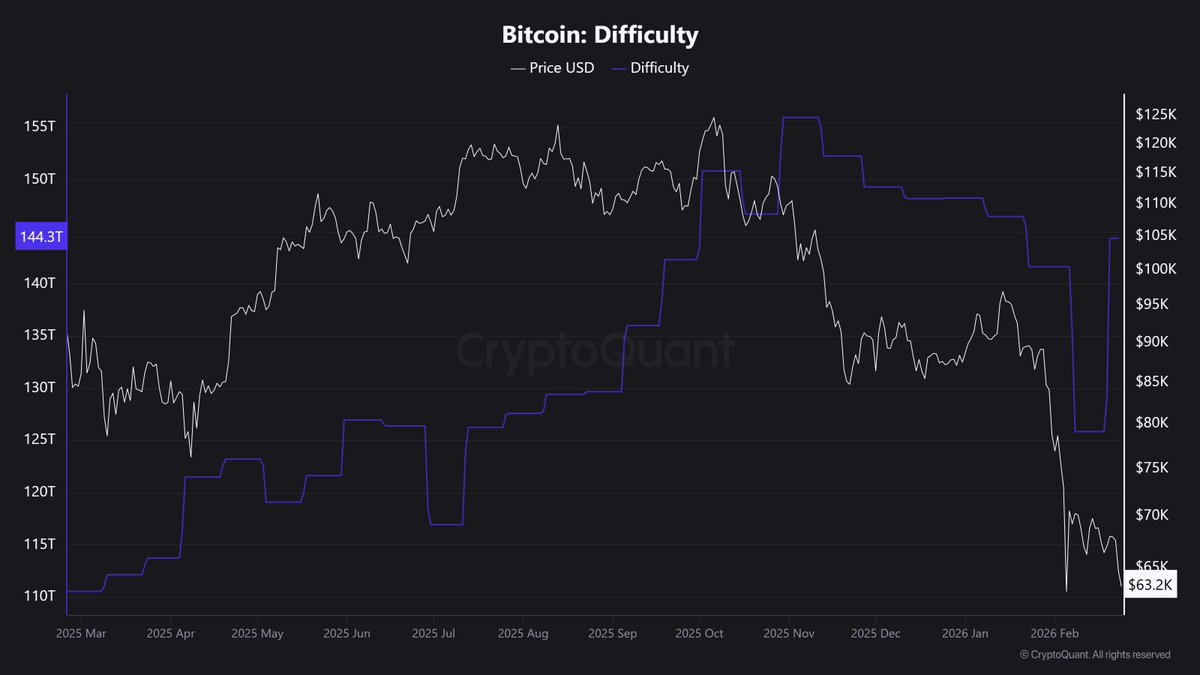
Amid this backdrop, Bitcoin mining difficulty has recently rebounded following a brief dip. Mining difficulty adjusts roughly every two weeks to maintain consistent block production timing. When difficulty rises, it typically signals that more computational power — or hashrate — has returned to the network. Temporary drops can occur when external factors, such as weather disruptions, energy constraints, or operational shutdowns, force some miners offline.
The recent rebound, therefore, suggests renewed miner participation and sustained network resilience. Greater difficulty often indicates confidence among miners in Bitcoin’s long-term viability, as maintaining operations becomes more competitive and capital-intensive. However, it can also increase cost pressure on less efficient miners, potentially influencing short-term supply dynamics if some are forced to liquidate holdings to cover expenses.
The recent dip in mining difficulty was largely weather-driven rather than structurally bearish. Severe winter storms temporarily disrupted energy supply in key mining regions, forcing portions of the network’s hashrate offline. As a result, the previous difficulty adjustment registered a short-lived decline, reflecting reduced computational power securing the network at that moment.
However, the disruption proved brief. According to on-chain data, the latest adjustment reversed the drop and pushed difficulty back to new highs, confirming that miners rapidly restored operations. Network hashrate has rebounded toward its prior range, signaling that the infrastructure impact was temporary rather than systemic. Block production times, which had briefly slowed, normalized quickly as computational power returned.
This rebound carries structural implications. Mining difficulty rising after a shock indicates that capital remains committed to the network despite price weakness below $70,000. It also suggests that the broader mining ecosystem retains operational resilience, even under adverse conditions.
At the same time, greater difficulty increases production costs, particularly for less efficient operators. If Bitcoin’s price remains compressed near the $63,000–$65,000 range, margin pressure could intensify for high-cost miners. Nonetheless, the swift recovery in difficulty reinforces the view that network fundamentals remain intact despite short-term volatility.
Bitcoin Tests Key Support As Downtrend Pressure Persists
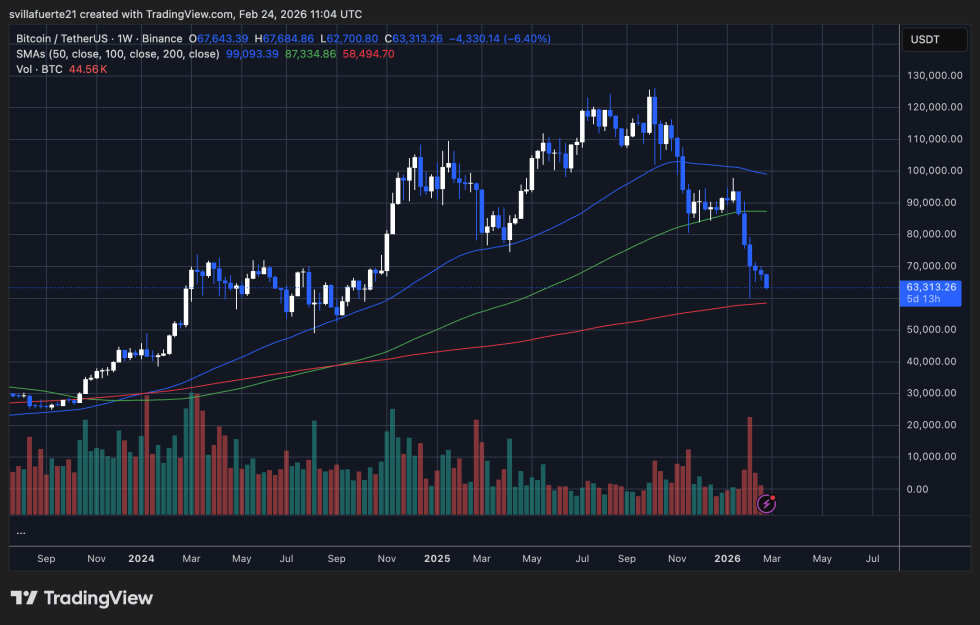
Bitcoin’s weekly chart shows a clear deterioration in momentum after losing the $70,000 level, with price now consolidating near the $63,000 zone. The structure reflects a sequence of lower highs since the late-2025 peak above $120,000, indicating that sellers remain dominant despite intermittent stabilization attempts.
Technically, Bitcoin is trading below the 50-week and 100-week moving averages, both of which have shifted from support into dynamic resistance. This configuration typically signals a transitional or corrective phase rather than a confirmed bullish continuation. Meanwhile, the 200-week moving average — currently much lower — remains the long-term structural support reference.
Volume patterns also suggest caution. Selling activity increased during the latest decline, pointing to distribution rather than simple low-liquidity drift. However, recent candles show some compression in volatility, implying that the market may be attempting to establish a short-term base around current levels.
From a structural perspective, the $60,000–$63,000 region now acts as immediate support. A sustained break below it could expose deeper retracement zones toward the mid-$50,000 area. Conversely, reclaiming the $70,000 threshold would be necessary to restore bullish momentum and shift sentiment toward recovery.
Featured image from ChatGPT, chart from TradingView.com
Editorial Process for bitcoinist is centered on delivering thoroughly researched, accurate, and unbiased content. We uphold strict sourcing standards, and each page undergoes diligent review by our team of top technology experts and seasoned editors. This process ensures the integrity, relevance, and value of our content for our readers.
A recent study reveals alarming environmental impacts of Bitcoin mining, with pollutants affecting communities far beyond mining locations. This groundbreaking research highlights that approximately 1.9 million residents in the U.S. are exposed to harmful air pollutants from Bitcoin mining operations. Dr. Francesca Dominici, leading the study at Harvard, emphasizes the staggering cross-state pollution issue that…
Ted Hisokawa
Aug 23, 2024 14:53
NVIDIA engineers to unveil advancements in the Blackwell platform, liquid cooling, and AI-driven chip design at Hot Chips 2024.
At the upcoming Hot Chips 2024 conference, NVIDIA engineers are set to present groundbreaking innovations aimed at enhancing data center performance and…
Enjoyed this article? Share it with your friends! Florida authorities have seized about $1.5 million in cryptocurrency after tracing funds from a Citrus County investment fraud case to a wallet linked to a Chinese national. The action followed a court order obtained by the Office of Statewide Prosecution’s Cyber Fraud Enforcement Unit. Attorney General James…
We do the research, you get the alpha! Get exclusive reports and access to key insights on airdrops, NFTs, and more! Subscribe now to Alpha Reports and up your game! Go to Alpha Reports The appetite Bitcoin whales have for more coins has returned for the first time since the price of Bitcoin reached its…
Securities and Exchange Commission chair Paul Atkins has confirmed a major shift in crypto regulation, stating that “very few tokens” should be classified as securities. His comments, which are a stark contrast to his predecessor Gary Gensler’s view that the vast majority of crypto assets were securities, came at the SALT Wyoming Blockchain Symposium 2025…
The Bitcoin developer says Brollups can support more than 90% of decentralized finance use cases, from NFT sales to token orders on DEXs. The Bitcoin developer famous for exploiting a bug in the Lightning Network, causing it to issue an emergency update in 2022, is working on a new Bitcoin layer 2 aimed at bringing…