Bitcoin vs Gold: The Debate is Over | BitcoinChaser
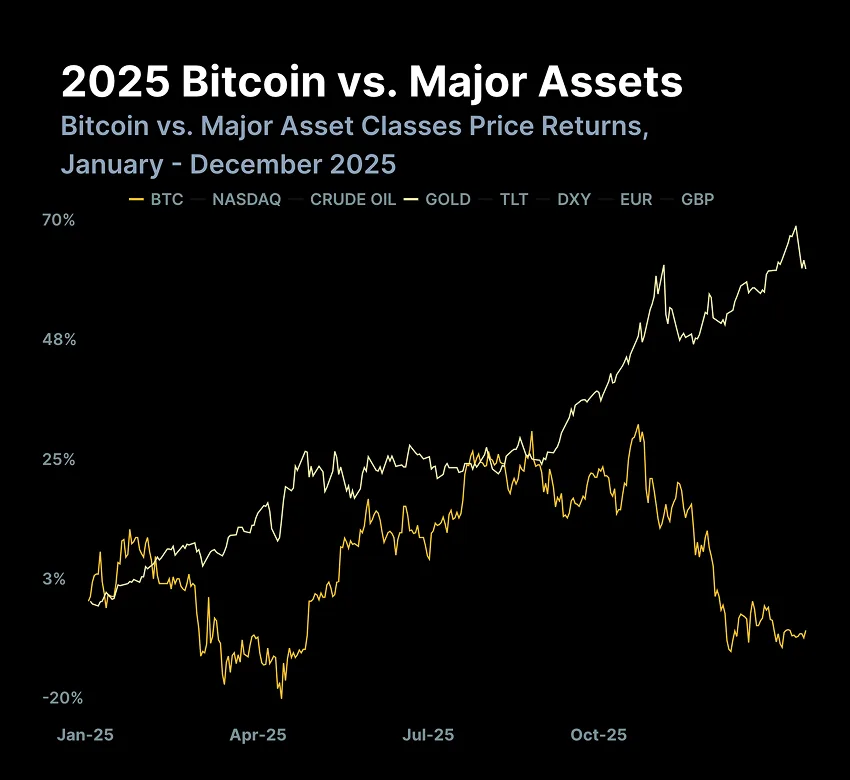
Gold and Bitcoin have taken very different paths in the last year. Bitcoin surged to a new all-time high of $126,000 in October but has since returned to around $85,000. Gold, on the other hand, broke through the $4,000 and $5,000 per ounce milestones, hitting new all-time highs.
The Bitcoin vs. Gold argument is an old one, dating back to some of the earliest messages sent between the founders of Bitcoin on forums and emails. Bitcoin has always been known as ‘Gold 2.0’ or ‘Digital Gold.’
But looking at things now, it’s hard not to say gold is the winner. Yet, there is more to this argument than just winners and losers.
So, has gold finally won the race, or has Bitcoin just stumbled at a hurdle?
The history
The Bitcoin vs. Gold debate is as old as cryptocurrency itself. From the very beginning, Bitcoin’s anonymous creator, Satoshi Nakamoto, used gold to frame their ideas about the currency.
Through Satoshi’s personal writings in forums and emails, they viewed Bitcoin’s monetary properties as almost identical to those of a precious metal.
In a forum post in 2010, Satoshi asked readers to imagine a hypothetical “base metal” that had no industrial use but possessed the same scarcity as gold.
“Imagine there was a base metal as scarce as gold but with… one special, magical property: it can be transported over a communications channel.”
Satoshi explicitly designed the “mining” process to mimic the effort required to pull gold from the ground, writing:
“It’s the same situation as gold and gold mining. The marginal cost of gold mining tends to stay near the price of gold. Gold mining is a waste, but that waste is far less than the utility of having gold available as a medium of exchange. I think the case will be the same for Bitcoin.”
Satoshi seemed to envision Bitcoin as a superior, modern version of gold: “Gold 2.0.”
Satoshi’s decision to hard-cap the Bitcoin supply at 21 million was a direct nod to the finite nature of precious metals. By using the term ‘mining’ to describe the creation of new coins, Satoshi anchored Bitcoin’s identity to gold before the first block was ever mined.
In an exchange from 2009, just one month after Bitcoin’s launch, Satoshi responded to a user on the P2P Foundation forum who questioned how Bitcoin could function as a currency without a central body, like the Federal Reserve, to adjust the supply to meet demand. Satoshi replied:
“There is nobody to act as central bank or federal reserve to adjust the money supply as the population of users grows… [Bitcoin is] more typical of a precious metal. Instead of the supply changing to keep the value the same, the supply is predetermined and the value changes.”
Gold is for boomers
As the price of Bitcoin climbed over the years, through the bull runs and the crashes, it became common for influencers to attack gold, overlooking the fact that Satoshi didn’t view gold as an enemy, but as a blueprint for a digital currency.
The shift began in earnest around 2019, when the industry moved from mimicking gold to trying to replace it. Grayscale launched its #DropGold television campaign, mocking the metal as “overrated and outdated,” while MicroStrategy’s Michael Saylor began describing gold as a “dead rock” and a “melting ice cube.”
By the mid-2020s, the Bitcoin vs. gold war had reached a fever pitch. “Gold is for boomers” became the standard battle cry on social media.
In March 2024, Will Clemente (@WClementeIII) captured the triumphalism of the Bitcoin ETF launch, writing:
“Bitcoin ETF inflows have absolutely blown gold’s out of the water. Not even close, utterly dwarfed, decimated. Thanks for playing, non-fixed supply boomer rock enjoyoors.”
By 2025, even the old guard of the “hard money” world began to defect. Robert Kiyosaki, the author of Rich Dad Poor Dad, had been one of the world’s most vocal gold and silver bulls for decades. But in 2025, he waved the flag of surrender and released a video titled: “I am selling my silver for Bitcoin.”
“I love gold and silver, but Bitcoin has won,” Kiyosaki declared. “Boomers don’t get it… they’re fucking stupid. They are tied to the past.”
The timing for Kiyosaki could not have been worse. The following twelve months saw Bitcoin finish lower than it began, while the “boomer rock” he abandoned shot up in value, hitting new all-time highs.
Crypto market uncertainty
By October 2025, Bitcoin had hit a new all-time high of $126,000. But the optimism fizzled out. As broader market concerns returned, investors started to move money out of crypto and into less volatile asset, particularly gold.
As we stand at the start of 2026, Bitcoin and the wider crypto ecosystem feel like they are stuck in a rut. Legislation is still mired in committee, the implementation of a national Bitcoin reserve seems to have stalled, and altcoins have suffered greatly.
But it has not all been bad for crypto, not if we are talking about Bitcoin.
| Year | Bitcoin (BTC) Price | Gold Price (Per Oz) | Annual Volatility (BTC / Gold) |
| 2010 | $0.30 | $1,410 | 175% / 15% |
| 2012 | $13.50 | $1,660 | 120% / 12% |
| 2014 | $320 | $1,180 | 85% / 13% |
| 2016 | $950 | $1,150 | 60% / 16% |
| 2018 | $3,700 | $1,280 | 75% / 12% |
| 2020 | $29,000 | $1,880 | 80% / 20% |
| 2022 | $16,500 | $1,820 | 65% / 14% |
| 2024 | $93,000 | $2,650 | 45% / 16% |
| 2025 | $105,000 | $4,300 | 42% / 28% |
| 2026 (Jan) | $88,000 | $5,200 | 38% / 22% |
Source: Compiled from historical exchange data and 2026 institutional volatility reports.
Has bitcoin changed?
Bitcoin is no longer the same asset it was during the early days of the “Bitcoin vs. Gold” debate; the landscape has fundamentally shifted. The widespread adoption by financial institutions – driven by the success of spot ETFs, 401(k) integrations, and serious legislative – makes the “Gold 2.0” argument more relevant than ever.
While its core properties remain finite and decentralized, Bitcoin has effectively graduated. It is now behaving less like a fringe experiment and more like a mature, traditional financial asset, reacting to the same global macro-drivers that move the world’s most established markets.
Bitcoin is now behaving more like a traditional asset.
The Binance “Full-Year 2025 & Themes for 2026” report note:
“Bitcoin’s correlation to traditional markets became a focal point in 2025, as overlapping investor bases and macro narratives led to closer alignment with equities at times. Notably, during risk-off episodes such as the April tariff shock and the October rate scare, Bitcoin’s correlation with the S&P 500 spiked markedly”
The BITCOIN Act of 2025, introduced by Senator Lummis, frames Bitcoin as a national reserve asset like gold. Section 2 of the act states:
“Just as gold reserves have historically served as a cornerstone of national financial security, Bitcoin represents a digital-age asset capable of enhancing the financial leadership and security of the United States”
Bitcoin is not the ‘Gold Killer’ it was once marketed to be. Instead, it has become Gold 2.0. They are no longer in competition: they are walking the same path of institutionalization.
While gold remains the silent, steady guardian of the old world, Bitcoin has matured into the high-velocity reserve asset of the new one. They are two different tools in the same shed, both serving the same purpose: protection in an era of unprecedented fiscal uncertainty
Gold 2.0
Satoshi Nakamoto’s original vision of a “magical base metal” has finally been realized, but with a twist. By becoming “Gold 2.0,” Bitcoin has accepted the responsibilities and correlations of a traditional asset.
As we look toward the rest of 2026, the debate is over. Gold didn’t win, and Bitcoin didn’t stumble. They simply grew up. They are two different tools in the same toolkit, both serving a world that is increasingly hungry for assets that no government can print.