How Does The Risk Graph Change After Assignment Of Credit Spreads?

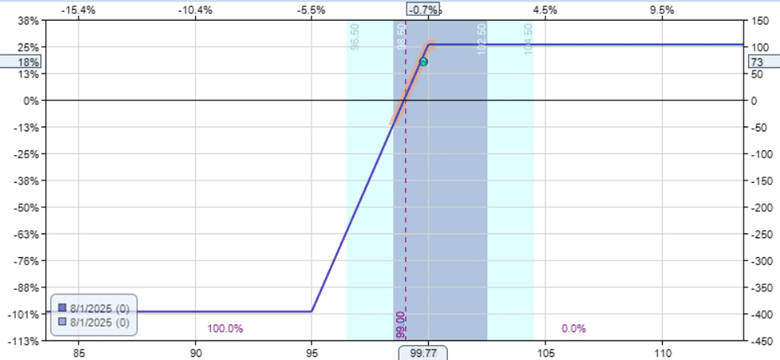
A credit spread commonly used by options traders is a defined-risk position, as shown in its risk graph.
But what happens if the trader is assigned stock?
How does the risk graph change, and is it still a defined risk?
These are the scenarios that the option trader needs to be familiar with when trading credit spreads.
Contents
Let’s look at a bull put credit spread on Target (TGT):
Date: July 3rd, 2025
Price: TGT @ $104.59
Buy one contract Aug 1st TGT $95 put @ $0.89
Sell one contract Aug 1st TGT $100 put @ $1.93
Net Credit: $103
Here, the trader is risking $400 to make $100 potentially.
The assignment risk is in the short option, the option that was sold.
In this case, the sale of the August 1 $100-strike put option is the leg that can result in stock assignment.
If Target’s share price is below $100 at expiration, the trader will be assigned 100 TGT shares.
As it so turns out, at the end of the session on expiration day, August 1st, TGT closed at $99.77, just under $100.
Therefore, the next day, the trader finds that he has 100 shares of TGT stock.
He was assigned (or obligated to buy) the 100 shares at the strike price of $100/share.
Since the market price of TGT at the time was $99.77, he had lost $0.23/share or $23 from the assignment.
But remember that he had received $103 in credit at the start of the trade.
Therefore, he actually had a net gain of $80 in the trade, minus any commissions and fees.
The short and long options have expired and are no longer in his account.
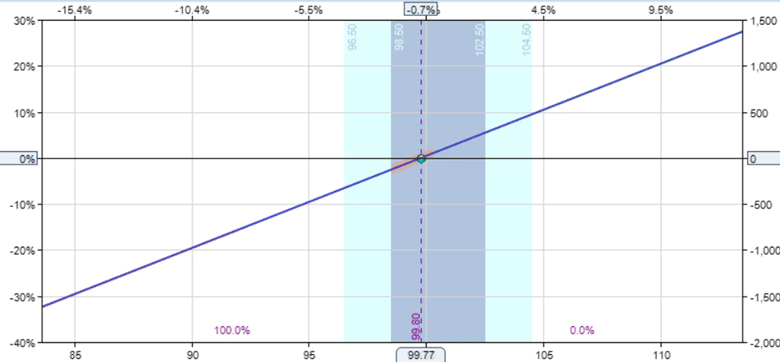
Because he now only has stock, he has the usual stock risk.
There is no more credit spread.
A stock without a stop loss is an undefined-risk position, with a risk graph that looks like this…
When a bull put credit stock expires, you may end up with stock with unlimited risk.
In theory, Target stock can go to zero, however unlikely, considering the number of customers seen in Target stores.
In the following example, we see how a trader can end up with a short stock position even before expiration.
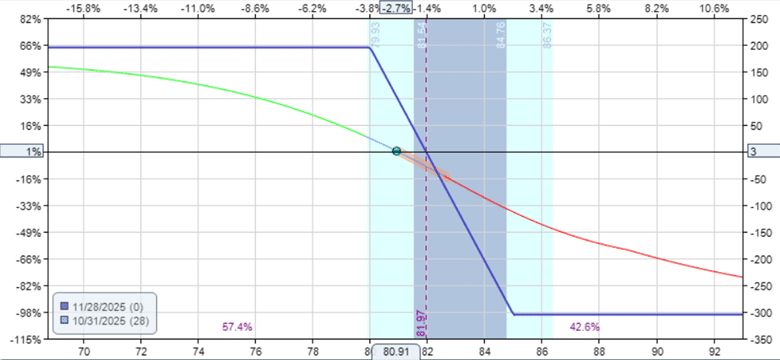
On Halloween, a trader initiates an at-the-money bear call spread for a directional trade, expecting Starbucks (SBUX) to go down in price.
Date: 10/31/2025
Price: SBUX @ $80.91
Sell one contract Nov 28 SBUX $80 call @ $3.06
Buy one contract Nov 28 SBUX $85 call @ $1.11
Credit: $195
From the risk graph, the trade risks about $300 to potentially make $200.
It is a defined-risk trade that cannot lose more than $305.
This is calculated by the width of the spread minus the initial credit received…
($80 – $85) x 100 – $195 = $305
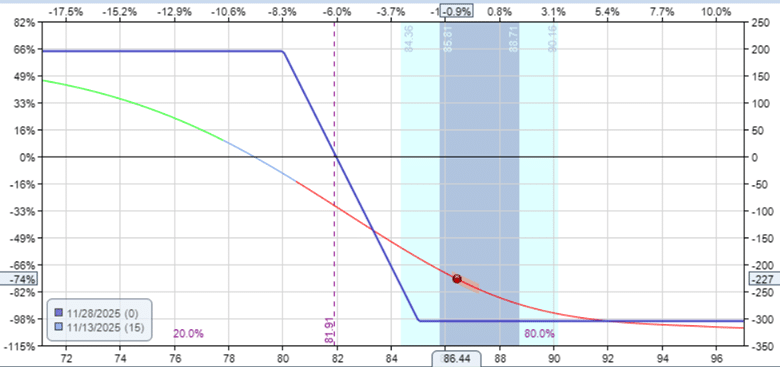
On November 14th, the trader gets an email notification from his broker that the short $80 80-call option has been assigned.
When the trader sells the $80 call option to another party at the start of the trade, the other party holding the option has the right to exercise it to buy SBUX at $80/share at any time.
In this case, they exercised that right to acquire 100 shares of SBUX at $80/share, which is now trading at $86.44/share.
There are still two weeks till expiration.
Yet stock assignment can happen at any time during the life of the options.
This is known as an early assignment.
This can happen especially if the short option is in-the-money as it is:
Clearly, SBUX has gone up in price (in the wrong direction that the trader anticipated).
The price had gone above the short strike price of $80 (which means that this option is in the money).
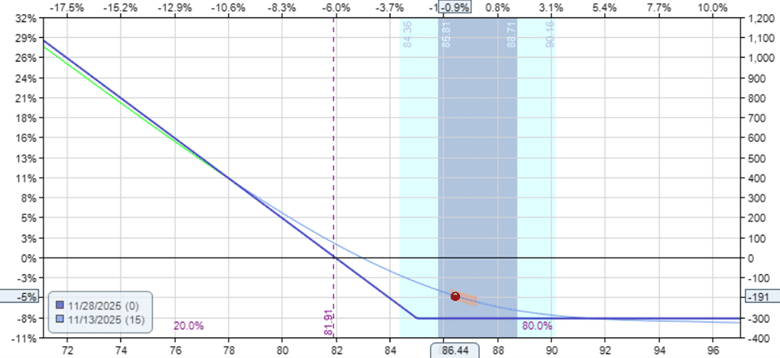
The risk graph no longer looks like the one above because the $ 80 call option is no longer in the account.
The trader was forced to sell 100 shares of SBUX at the price of $80/share.
He is now short 100 shares (assuming he didn’t already have 100 shares of SBUX).
He still has his $85 85-call long option, which has two more weeks till expiration.
There is no more short call option.
The correct risk graph now looks like this…
If the stock goes down, he will profit because he is short 100 shares.
This profit is uncapped because SBUX can, in theory, go to zero, however unlikely that may be, given the number of people drinking Starbucks coffee.
The trader can, at this point, exit the trade completely and be done with it.
Let’s calculate the P&L if the trader can buy back 100 shares of SBUX the next day at $86.30.
This closes the short stock position.
And then he sells the $85 call option for $3.00 per share, or for $300.
Initial credit for bear call spread: $195
Assigned to sell 100 shares at $80/share: $8000
Buy back 100 shares: -$8630
Sell to close $85 call option: $300
Net P&L in trade: -$135
The trader should buy back the stock before selling the long call, since the long call protects the trader from loss if SBUX continues to rise.
In the last example, we saw how the risk graph changes as a bear call credit spread is early assigned.
However, we can see from the resulting risk graph that as long as the long call has not expired, the risk of the trade still remains at around $300 (the same risk as the initial bear call spread).
This is because if SBUX is above $85 at expiration, the long call will automatically buy back the short stock at $85/share, closing out the short position.
In the end, it would be like…
Initial credit for bear call spread: $195
Assigned to sell 100 shares at $80/share: $8000
Buy back 100 shares: -$8500
Net P&L: -$305
For those who have never shorted a stock, note that there is a stock-borrowing fee that varies by broker.
For liquid, easy-to-borrow stocks like Starbucks, it is pretty low.
But it can be more significant for hard-to-borrow stocks.
Also, if a company pays a dividend, you would end up paying this dividend.
We hope you enjoyed this article on the effects of a credit spread assignment on the risk graph.
If you have any questions, please send an email or leave a comment below.
Trade safe!
Disclaimer: The information above is for educational purposes only and should not be treated as investment advice. The strategy presented would not be suitable for investors who are not familiar with exchange traded options. Any readers interested in this strategy should do their own research and seek advice from a licensed financial adviser.
Source link