Day 12: Breaker Blocks & Mitigation Blocks Explained — ICT & SMC Deep Dive | Trading Strategy Guides
Advanced Territory. This Is Where the Toolkit Gets Powerful.
Welcome back. In Day 5 you learned about order blocks — the institutional footprints that form before a major move. But here’s what most beginners don’t account for: what happens when an order block fails?
Does price just reverse for no reason and continue? Do you take the loss and move on? Or is there actually a new, potentially higher-quality setup forming right where the old one broke down?
The answer is the latter. And today we cover the two concepts that explain exactly what that new setup is — Breaker Blocks and Mitigation Blocks. We also cover what happens when both are combined with a Fair Value Gap — a setup ICT traders call the Unicorn. Understanding these three concepts will fundamentally change how you manage losing setups and find re-entry opportunities.
What Is a Breaker Block?
A Breaker Block forms when a high-probability order block fails — price breaks through it — and that same zone then flips to operate from the opposite side.
Here’s the sequence that creates one, using a bearish example:
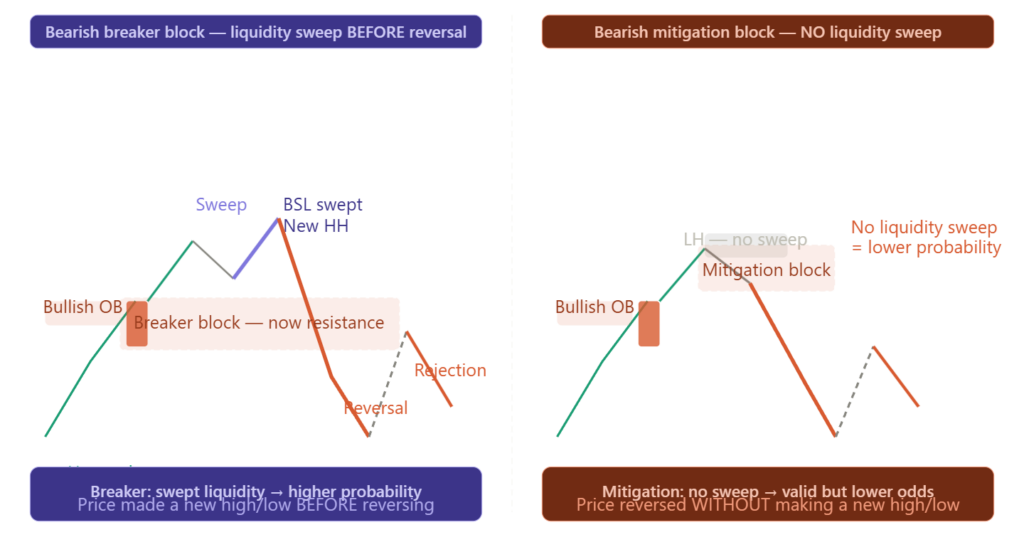
Price is in an uptrend. A bullish order block forms — the last bearish candle before a bullish impulse. Price later returns to that zone, but instead of bouncing, it sweeps through it and continues lower. The old bullish order block has been broken. But before reversing to the downside, price first made a new higher high — it swept the buy-side liquidity above the previous swing high, triggering retail long stops, collecting the fuel institutions needed to push lower.
That original bullish order block — now broken and flipped — is the bearish breaker block. When price eventually retraces back up into that zone, it no longer acts as support. It acts as resistance. Institutions who were caught long at that level are now liquidating as price returns, and smart money is selling into that bounce.
The mirror applies for bullish breaker blocks: a bearish order block gets broken to the upside (after sweeping sell-side liquidity first), and that zone flips to act as support when price pulls back.
The critical detail that defines a breaker: price must have swept liquidity — made a new high or new low beyond the previous swing — before the reversal. That liquidity sweep is what elevates a breaker block above an ordinary failed OB and makes it a higher-probability zone.
What Is a Mitigation Block?
A Mitigation Block is the closely related — but distinctly different — cousin of the breaker block. It too forms when an order block fails. The difference lies in one critical detail: there is no liquidity sweep first.
In a mitigation block scenario, price approaches a zone where a bullish order block should hold. Instead of bouncing, it forms a lower high — it never makes the new higher high that would define a liquidity sweep. Then it breaks below the previous swing low, shifting structure to the downside.
The area between the broken swing low and the newly formed lower high becomes the bearish mitigation block. When price retraces into this zone, smart money uses it as an opportunity to add to or open short positions.
The same logic applies in reverse for bullish mitigation blocks — price fails to make a new lower low from a bearish zone, forms a higher low instead, then breaks the previous lower high and shifts structure bullish.
In plain terms: the breaker block took liquidity on the way to the reversal. The mitigation block did not. Both act as fresh institutional zones after a structural shift, but the breaker block is the higher-probability trade precisely because it confirms a genuine liquidity sweep occurred before the direction changed.
The Difference in One Sentence
Breaker block = order block failed after sweeping liquidity first → higher probability. Mitigation block = order block failed without sweeping liquidity → valid but lower probability.
Both create fresh institutional zones after a structural shift. Both are worth watching when price retraces. But if you can only choose one to build a trade around, the breaker block — with its confirmed liquidity sweep — gives you a stronger foundation.
How to Trade a Breaker Block
The entry process is straightforward once you understand the logic:
First, identify the original order block and confirm it has been broken with a full candle close through it. Second, confirm that price made a new high or new low beyond the previous swing before reversing — the liquidity sweep must be present. Third, wait for price to retrace back into the zone of the old, now-flipped order block. Fourth, look for confirmation on a lower timeframe — a CHoCH or FVG forming inside the breaker zone. Enter there. Place your stop beyond the outer edge of the breaker block. Target the nearest draw on liquidity.
The Unicorn Model — When a Breaker Meets a Fair Value Gap
ICT traders gave a specific name to the highest-confluence version of this setup: the Unicorn. It occurs when a Fair Value Gap forms inside or overlapping a Breaker Block during the displacement move that created the reversal.
The logic is powerful: the breaker block tells you where institutions flipped their position. The FVG inside it tells you exactly where price moved too fast and left unfilled orders. When price retraces into that zone, it faces two simultaneous pressures — the institutional demand of the breaker and the market’s efficiency drive to fill the FVG. That dual pressure makes the reaction fast, clean, and more reliable than either concept alone.
The entry is simple: wait for price to retrace into the FVG that sits inside the breaker zone. Enter at the FVG — or at the consequent encroachment (50% midpoint) of the FVG for a tighter stop. Stop goes just beyond the breaker block’s outer edge. Target the next significant draw on liquidity.
How SMC Treats These Concepts
SMC traders use breaker blocks and mitigation blocks in the same structural way as ICT. The primary difference is in naming conventions and the degree of rule enforcement.
In some SMC communities, the term “mitigation block” is used more loosely to describe any zone where institutional orders are being filled on a retracement — not strictly the failed-OB-without-sweep definition that ICT applies. This creates confusion between communities. The cleanest approach is to use the ICT definitions precisely: breaker = failed OB with a liquidity sweep, mitigation = failed OB without one.
The Unicorn model is primarily an ICT concept but has been widely adopted by SMC practitioners as a high-confluence entry technique regardless of which methodology label they prefer.
Up Next — Day 13
Tomorrow we go into another cornerstone ICT entry model — Optimal Trade Entry (OTE) and the Fibonacci framework. This is the tool Huddleston built to pinpoint the highest-probability entry point within any retracement, using a specific set of Fibonacci levels that go beyond what most retail traders know.
If you’ve been struggling to time entries — entering too early on pullbacks or missing the precise zone — Day 13 solves that.
→ See you on Day 13.