Day 14: ICT PD Arrays Vs SMC POIs — The Full Comparison | Trading Strategy Guides
Closing Out Week Two. The Comparison That Ties Everything Together.
Welcome back. You’ve made it through fourteen days and two complete weeks of this series. You now understand market structure, liquidity, order blocks, FVGs, BOS and CHoCH, inducement, kill zones, multi-timeframe analysis, supply and demand zones, breaker blocks, mitigation blocks, OTE, and Fibonacci.
Today we close out Week 2 with the concept that unifies how both ICT and SMC organise all of those tools into an actionable trading framework.
ICT calls it the PD Array Matrix. SMC calls it Points of Interest.
They are not identical — but they solve the same problem. And understanding both will let you move fluently between either methodology without confusion.
The Problem Both Systems Are Solving
You’ve spent days learning individual tools — order blocks, FVGs, breaker blocks. But when you sit down at a live chart, the question isn’t “what is an order block?” The question is: “Of all the zones I can see on this chart right now, which one do I actually trade from?”
That is the problem PD Arrays and POIs both solve. They are filtering systems — ways of organising, ranking, and selecting the zones that matter most so you don’t waste time on the ones that don’t.
ICT PD Arrays — Premium and Discount Arrangement
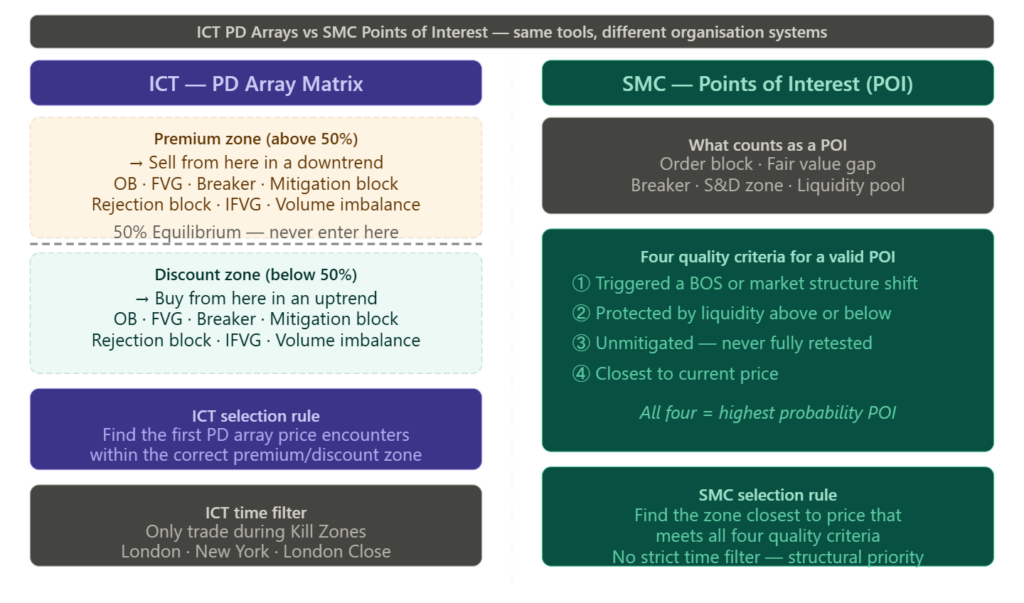
The ICT PD Array — which stands for Premium and Discount Array — is a comprehensive map of all institutional reference points on a chart, organised by whether they sit in a premium or discount zone relative to the current dealing range.
The name tells you everything: P = Premium (price is expensive, above the 50% equilibrium — sell here), D = Discount (price is cheap, below equilibrium — buy here), A = Array (the entire collection of tools and levels within that range).
Every ICT concept you’ve learned is a component of the PD Array. When Huddleston says “look for a PD array in the discount zone,” he means: scan the lower half of the dealing range and find whichever of these tools is present — an order block, an FVG, a breaker block, a mitigation block, a rejection block, a liquidity void, an inversion FVG. The first one price reaches — starting from the current price and working toward the discount — is your target zone.
The full PD Array component list, organised by priority (bullish setup, discount zone):
| PD Array Component | Description |
| Old lows / equal lows | External liquidity pool targets |
| Fair Value Gap (FVG) | Price imbalance — high probability fill zone |
| Order Block (OB) | Last opposing candle before impulse |
| Breaker Block | Failed OB after liquidity sweep — flipped |
| Mitigation Block | Failed OB without sweep — still valid zone |
| Rejection Block | Wick-dominant reversal zone |
| Volume Imbalance | Gap between candle bodies — internal inefficiency |
| Inversion FVG (IFVG) | Failed FVG now acting from opposite side |
In a bearish setup, the same list applies in the premium zone — above the 50% equilibrium.
The key rule: buy from discount PD arrays, sell from premium PD arrays. Never enter a long from a premium zone or a short from a discount zone, regardless of how clean the individual setup looks.
SMC Points of Interest — The Same Logic, Simpler Language
The SMC community uses the term Point of Interest (POI) to describe any price zone where institutional activity is expected to have left an unfilled order — and where a meaningful market reaction is anticipated when price returns.
In practical terms, an SMC POI is almost always one of the following: an order block, a fair value gap, a breaker block, or a supply and demand zone. The difference from ICT’s PD Array framework is not in the tools themselves — it’s in how they’re selected and prioritised.
Where ICT uses a strict hierarchical matrix tied to the premium/discount framework, SMC uses a set of four quality criteria to decide whether a POI is worth trading:
1. It must have triggered a market structure shift or BOS. A zone that produced an impulsive move confirming trend continuation or reversal is more significant than one that merely slowed price.
2. It must be protected by liquidity. A strong POI usually has liquidity — equal highs, equal lows, or stop-loss clusters — resting just beyond it. That liquidity gives institutions a reason to defend the zone.
3. It must be unmitigated. A POI that has already been revisited and fully tested has fewer unfilled orders remaining. Fresh, untouched zones react more reliably.
4. It must be the closest to current price. Of all valid POIs on the chart, the one price encounters first as it retraces is the most immediately relevant.
The Shared Toolkit — Where Both Systems Agree
Despite the different names and organisational logic, both PD Arrays and POIs draw from the same underlying set of tools. Whether you call it a “bullish PD array in the discount zone” or a “bullish POI,” you’re describing the same thing: an order block or FVG sitting in a structurally significant location that price is likely to react from when it returns.
The tools are identical. The filters are different.
ICT filters by where the tool sits (premium or discount) AND by when price reaches it (Kill Zone).
SMC filters by quality criteria — structure shift, liquidity protection, freshness, and proximity — without enforcing a strict time window.
A Practical Example — Reading the Same Chart Both Ways
Imagine EURUSD is in a bullish daily trend. Price has made a new high and is now pulling back. You open the chart and see:
ICT approach: Draw the Fibonacci from the swing low to the swing high. Mark the 50% equilibrium. Scan the discount zone (below 50%) for the first PD array component. You find a bullish order block at 67% retracement inside the discount zone. You check the time — it’s 2:30am EST, London Kill Zone is open. You mark this as your target zone and wait for price to reach it.
SMC approach: You scan the pullback and identify a bullish order block that: (a) caused a BOS when price originally launched from it, (b) has sell-side liquidity resting just below it, (c) has never been retested, and (d) is the first zone price will encounter on the current pullback. It meets all four quality criteria. You mark it as your POI and wait.
Both traders are watching the same zone. One called it a discount-zone PD array. The other called it a high-probability POI. The zone is identical. The analysis process is slightly different. The trade — if it sets up — is the same.
The Key Difference in One Line
ICT: “Is this tool in the correct premium or discount zone, and is it a Kill Zone?” SMC: “Does this zone meet all four quality criteria — structure, liquidity, freshness, and proximity?”
ICT adds time as a mandatory variable. SMC makes time optional but emphasises structural quality more explicitly. Advanced traders often apply both filters simultaneously — looking for a high-quality POI that also sits in the correct premium/discount zone AND forms during a Kill Zone. That triple confluence is where the highest-probability trades live.
Week 2 Complete — Here’s What You Now Know
Fourteen days. Two full weeks. You now have both the foundation and the advanced toolkit of ICT and SMC:
Week 1 covered: Origins, market structure, liquidity, order blocks, FVGs, BOS vs CHoCH. Week 2 covered: Inducement and AMD, kill zones, MTF analysis, S&D zones vs OBs, breaker blocks, mitigation blocks, OTE Fibonacci, and now PD Arrays vs POIs.
Starting from Day 15, we move into Week 3: Application. This is where everything comes together into actual trade plans — how to build a complete bullish or bearish trade narrative from the weekly chart down to the 5-minute entry. No more individual concepts in isolation. Full trade plans, start to finish.
→ See you on Day 15.