Day 6: Fair Value Gaps Explained — ICT & SMC FVG Trading Guide | Trading Strategy Guides
Day 6 — The Concept That’s Everywhere Right Now
Welcome back. If you’ve searched anything related to ICT or SMC on YouTube in the last two years, three letters have come up constantly: FVG.
Fair Value Gap. It’s arguably the most searched SMC concept on the internet right now, and for good reason. Once you understand it, you start seeing it on every chart, in every market, on every timeframe.
But most explanations make it sound more complicated than it is. Today we keep it clean, practical, and directly applicable to what you’re doing on the charts.
What Is a Fair Value Gap?
A Fair Value Gap is a price imbalance — a zone on the chart where price moved so fast, so aggressively, that it skipped over certain price levels entirely. No proper two-sided trading happened there. Buyers and sellers never met at those prices.
The reason this matters is simple: markets naturally seek efficiency. When price leaves a zone untouched like that, it tends to come back and revisit it — filling in what it skipped — before deciding its next move. That return visit is your trading opportunity.
In plain terms: a Fair Value Gap is the market’s IOU. It moved too fast and left an unfinished business zone. Price almost always comes back to settle the debt.
How to Identify One — The Three-Candle Rule
A Fair Value Gap forms within a three-candle sequence. The rule is precise:
Bullish FVG: In a rising move, look at three consecutive candles. If the high of candle 1 does not overlap with the low of candle 3 — meaning there is a visible gap between them — that space between is a bullish Fair Value Gap. Candle 2 was the aggressive impulse that created the imbalance.
Bearish FVG: In a falling move, if the low of candle 1 does not overlap with the high of candle 3, the space between them is a bearish Fair Value Gap.
The critical test: if the wicks of candle 1 and candle 3 overlap at all — even slightly — there is no FVG. The gap must be clean with zero overlap between those two wicks.
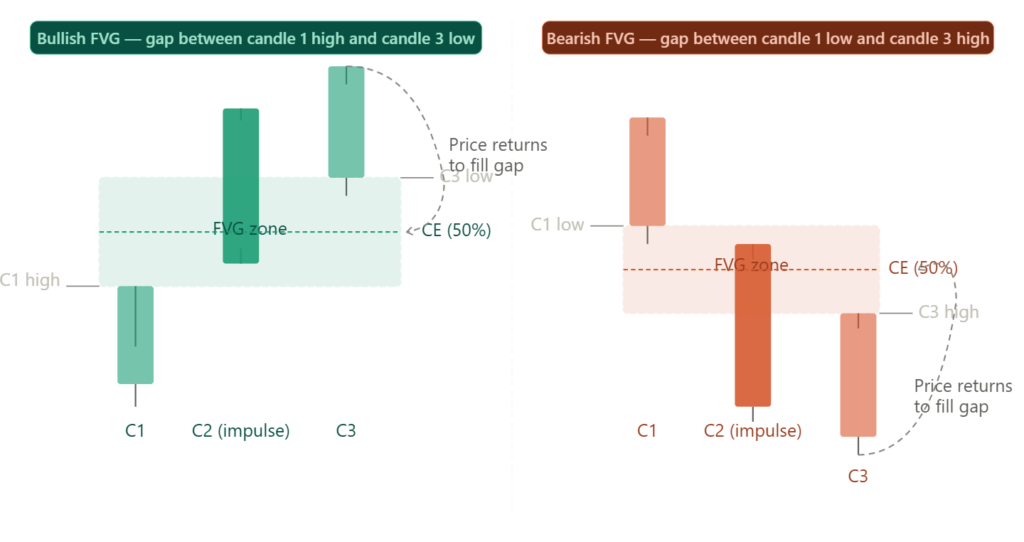
Alt text: Side-by-side diagram showing a bullish Fair Value Gap on the left — the shaded gap zone between candle 1’s high and candle 3’s low, with the CE midpoint marked — and a bearish FVG on the right with the same structure inverted, both showing price returning to fill the gap.
Consequent Encroachment — The Midpoint That Changes Everything
Here is one of the most practical refinements in all of ICT methodology, and it comes directly from Huddleston’s teachings: price does not need to fill the entire FVG to react.
The Consequent Encroachment (CE) is simply the 50% midpoint of the Fair Value Gap. It is found by applying a Fibonacci tool from the top to the bottom of the gap and marking the 0.5 level.
Why does this matter for you practically? Because in a strong trend, price often only retraces to the midpoint of the FVG before reversing and continuing. If you’re waiting for the entire gap to be filled before entering, you’ll frequently miss the move. Experienced ICT traders enter at the CE — the midpoint — because that is the level where institutional orders are most likely to be waiting.
In a bullish FVG: if price drops into the gap, reaches the CE, and closes back above it — that’s your entry signal. Stop goes below the FVG entirely. In a bearish FVG: if price rises into the gap, tags the CE, and closes back below — that’s your short entry. Stop goes above the FVG.
FVG Inversion — When the Gap Flips
Sometimes price doesn’t respect a Fair Value Gap. It blasts straight through. When this happens, the original FVG doesn’t become useless — it inverts.
A bullish FVG that gets broken to the downside becomes a bearish zone — resistance. A bearish FVG that gets broken to the upside becomes a bullish zone — support. ICT traders call this a Fair Value Gap Inversion (IFVG), and it follows the same logic as a support-resistance flip in traditional analysis, just grounded in institutional order flow.
How ICT and SMC Use FVGs Differently
Both methodologies identify and trade FVGs in the same structural way. The divergence — as with order blocks — comes down to time and context.
SMC traders use FVGs as standalone entry zones whenever price returns to them within a valid trend structure. Clean, flexible, accessible.
ICT takes it further. Huddleston treats FVGs as part of a broader algorithmic framework — price delivery through imbalances follows what he calls an Interbank Price Delivery Algorithm. ICT traders only trade FVGs during specific Kill Zone windows, preferring those formed after a market structure shift on a lower timeframe within a higher timeframe discount or premium zone. The FVG must occur at the right time in the right context — not just when price happens to return to a gap.
The practical takeaway: if you’re starting out, trade FVGs with structural context the SMC way. As you progress, layer in ICT timing to filter out the low-quality setups that form during dead sessions.
The One Rule That Saves Most Beginners
Not every FVG is worth trading. The ones that are carry these qualities: they form after a clear Break of Structure or Market Structure Shift, they sit in the correct premium or discount zone relative to the overall range, and they haven’t already been fully tested and filled on a lower timeframe. A gap that’s already been tapped once has far less magnetic pull than a fresh, untouched one.
Up Next — Day 7
You now have five foundational tools in your toolkit: structure, liquidity, order blocks, and fair value gaps. Tomorrow we bring the first week together with Day 7 — the concept that tells you when a trend is genuinely shifting versus when the market is simply faking you out.
Day 7 is all about BOS vs CHoCH — and the crucial difference between a trend continuation signal and an early reversal warning. If you want to stop getting caught on the wrong side of the market, this one is essential.
→ See you on Day 7.