Day 7: BOS Vs CHoCH — How To Tell If The Trend Is Continuing Or Breaking Down | Trading Strategy Guides
Welcome back. You’ve made it through the full first week of this series — and what a week it’s been. You now understand what ICT and SMC are, where they came from, how to read market structure, what liquidity actually means, how to identify order blocks, and how to read fair value gaps.
Today we close out Week 1 with the concept that ties all of it together — and the one that beginners consistently get wrong.
BOS vs CHoCH.
Two signals that look similar on the chart. Two signals that mean completely different things. Getting this distinction right separates traders who read markets clearly from traders who constantly feel like the market is “tricking” them.
Let’s get into it.
The Simple One-Line Distinction
Before we go deep — here it is, clean and simple:
BOS = The trend is still alive. Keep following it.
CHoCH = Something may have changed. Pay attention.
That’s the core of it. Everything else is detail.
Break of Structure (BOS) — Trend Continuation
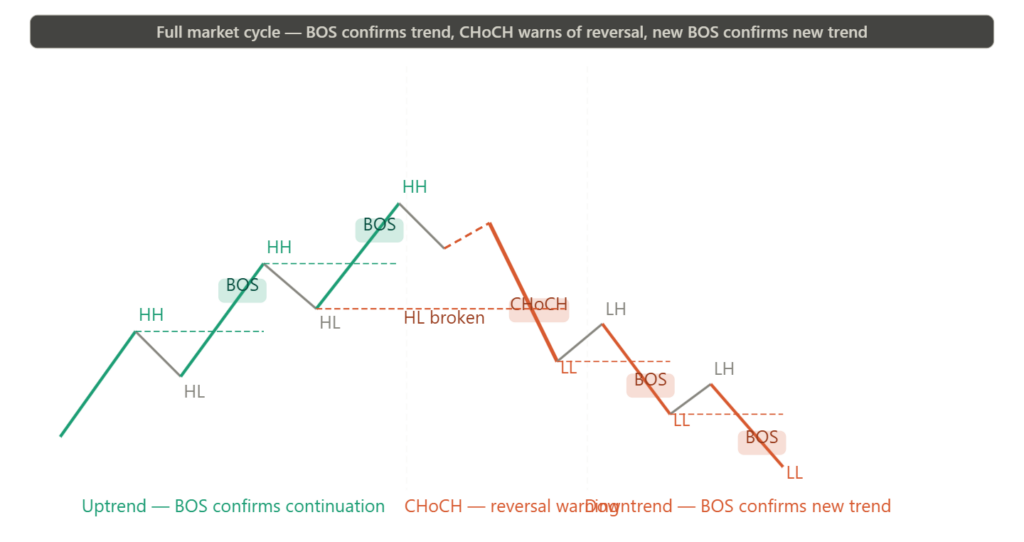
A Break of Structure happens when price breaks a swing point in the same direction as the existing trend. In an uptrend, price is making higher highs and higher lows. Every time it breaks above the most recent swing high with a full candle close, that is a BOS. It confirms buyers are still in control and the structure is intact.
In a downtrend, every new lower low confirmed by a candle close is a bearish BOS. It confirms sellers remain dominant.
Three things make a BOS valid. First, it must be a full candle body close beyond the structural level — a wick does not count. Second, it must break the correct structural swing point that defined the current trend, not some minor internal level. Third — and this is the one most beginners skip — there should be displacement behind it. A genuine BOS leaves an imbalance, an energetic move that shows institutional commitment, not a slow grind through a level.
Change of Character (CHoCH) — The Reversal Warning
A Change of Character happens when price breaks a swing point against the direction of the existing trend. In an uptrend, a CHoCH occurs when price closes below the most recent higher low — the low that was protecting the uptrend. That break tells you buyers may be losing control.
In a downtrend, a CHoCH occurs when price closes above the most recent lower high — the ceiling that had been capping every rally. That break suggests sellers may be weakening.
Critical rule: a valid CHoCH must break the swing point that was created by the most recent BOS — not any random internal low or high. This is the most common mistake. Traders see price dip into an internal swing low during a normal pullback, label it a CHoCH, go short — and get stopped out as the trend continues. You are only reading a genuine CHoCH when price breaks the structural swing created by the last confirmed BOS.
The Fake CHoCH — The Trap Most Beginners Fall Into
Here is the most costly mistake in SMC and ICT structure reading, and it happens to everyone at some point.
Price is in a clear uptrend. It sweeps a liquidity pool below a higher low — triggering everyone’s stops — and in that moment it looks exactly like a CHoCH. Beginners flip short. Then price rockets back up, continues the uptrend, and those shorts are stopped out.
What just happened? That was a fake CHoCH — or more accurately, a liquidity sweep. Price dipped below a structural low not to reverse the trend, but to grab the stop losses sitting there as fuel for the next leg higher.
The way you separate a real CHoCH from a fake one comes down to two things. First: displacement. A real CHoCH is followed by a large, energetic candle that leaves a Fair Value Gap behind it. A fake one produces a wick, a brief dip, then immediate rejection. Second: higher timeframe context. If the daily or four-hour chart is still clearly bullish, a CHoCH on the 15-minute chart is almost always a liquidity sweep, not a genuine reversal. Always check the bias above before reading structure below.
How to Use BOS and CHoCH to Build Your Trade Bias
Here is the clean, practical workflow that both ICT and SMC traders use every day:
Start on your higher timeframe — daily or four-hour. Identify the sequence of BOS events to confirm the active trend direction. That becomes your bias. You are only looking for trades in that direction.
Drop to your execution timeframe — one-hour or 15-minute. Wait for price to pull back into a discount zone during a bullish bias, or a premium zone during a bearish bias. Look for a lower-timeframe CHoCH — a genuine one, confirmed by displacement and a Fair Value Gap — as your entry trigger.
That CHoCH on the lower timeframe tells you the short-term retracement is over and the higher-timeframe trend is about to resume. That is your entry signal. Your stop goes below the low that created the CHoCH. Your target is the next draw on liquidity — the most recent BSL or SSL above or below current price.
BOS vs CHoCH at a Glance
| BOS | CHoCH | |
| What it means | Trend continuation | Potential reversal warning |
| Direction | Same as existing trend | Against the existing trend |
| When it forms | Throughout an active trend | At the end of a trend |
| Requires displacement? | Yes — strong move confirms | Yes — weak move = fake signal |
| What breaks | Previous swing high / low (with trend) | Previous higher low / lower high (against trend) |
| Risk if wrong | Low — trend was already established | Higher — reversals can fail |
Week 1 Complete — Here Is What You Now Know
You have just finished the foundations week. In seven days you have built a complete structural understanding of how ICT and SMC read markets. You know the origin, the philosophy, market structure, liquidity, order blocks, fair value gaps, and now BOS vs CHoCH — the signal that tells you whether to continue following a trend or prepare for a potential shift.
Starting from Day 8, we move into Week 2: Deep Dives. The topics get more specific, the tools get more refined, and the strategies get more actionable.
Day 8 kicks off with one of the most misunderstood concepts in the entire SMC space — one that institutions use deliberately to trap retail traders before making their real move: Inducement and Stop Hunts.
→ See you on Day 8.