Day 8: Inducement And Stop Hunts — How Smart Money Traps You Before The Real Move | Trading Strategy Guides
Day 8 — Welcome to Week Two. The Concepts Get Sharper From Here.
If Week 1 was about building your foundation — understanding structure, liquidity, order blocks, FVGs and BOS vs CHoCH — then Week 2 is about going deeper into how institutions actually engineer the setups you’re trading against.
And nothing makes that clearer than today’s topic.
Inducement. Stop hunts. The Power of Three.
These aren’t conspiracy theories. They’re observable, repeating patterns that show up on every chart, every session, every day — in every market. And once you understand them, you’ll stop being the trader who gets stopped out right before the move you predicted. Because you’ll recognise the trap before it springs.
What Is Inducement?
Inducement is the process by which price is deliberately moved to encourage traders to enter positions that are designed to fail.
Here’s the plain English version: institutions need liquidity to execute large orders. They don’t just buy into a rising market or sell into a falling one — they engineer conditions that create the opposing orders they need. They move price to where your stop losses and pending orders are sitting, trigger them, absorb that liquidity, and then move in their intended direction.
The move that triggers your stop? That was the inducement. It wasn’t a failed setup — it was the market doing exactly what it was designed to do.
The word “induce” is key. It means to persuade. Price is being moved specifically to persuade you — and thousands of other retail traders — to take a position at exactly the wrong moment.
The Three Most Common Inducement Scenarios
1. Support and Resistance Inducement A classic support level holds multiple times. Retail traders pile in long, stops just below. Price dips through the level, triggers every one of those stops — then immediately reverses and rockets higher. The support wasn’t broken. It was swept for liquidity.
2. Equal Highs and Equal Lows Inducement As covered in Day 4, equal highs and lows are magnets. Retail traders see double tops as strong resistance and go short. Institutions push price through those equal highs, trigger the stops of every short position, collect that buy-side liquidity, then distribute short positions into the flood of buying. Price then falls aggressively.
3. Post-BOS Inducement This one is particularly sneaky. After a Break of Structure, price pulls back and forms what looks like a perfect order block retest. Traders enter expecting the trend to continue. Instead, price pushes through the zone, sweeps the stops of everyone who entered there, and then continues in the original direction — just from a lower, more efficient entry that institutions preferred. The first OB after a BOS is frequently inducement. The real zone is usually deeper.
The Power of Three — ICT’s Blueprint for Every Day
Michael Huddleston formalised how these inducement patterns repeat every single trading day through a model he called the Power of Three — also known as AMD: Accumulation, Manipulation, Distribution.
It describes every trading day in three phases:
Phase 1 — Accumulation: The market opens and ranges quietly. Price is consolidating in a tight zone — often during the Asian session — while institutions are silently building positions. Retail traders see a range and either trade it back and forth, getting nowhere, or wait. Liquidity is building on both sides of the range as stop orders cluster above and below.
Phase 2 — Manipulation: This is the inducement move. Price breaks out of the accumulation range — but in the wrong direction. On a bullish day, price drops below the accumulation range first, triggering the stop losses of everyone who bought the range lows and inducing breakout sellers to go short. On a bearish day, price spikes above the range, triggers stops of short traders and lures breakout buyers in. This manipulation phase typically unfolds during the London session open.
Phase 3 — Distribution: After the liquidity has been swept and institutions have filled their positions at an efficient price, the real move begins. Price reverses aggressively and moves in the intended direction — which was the opposite of the manipulation. The New York session typically drives this phase home. This is the only phase you actually trade.
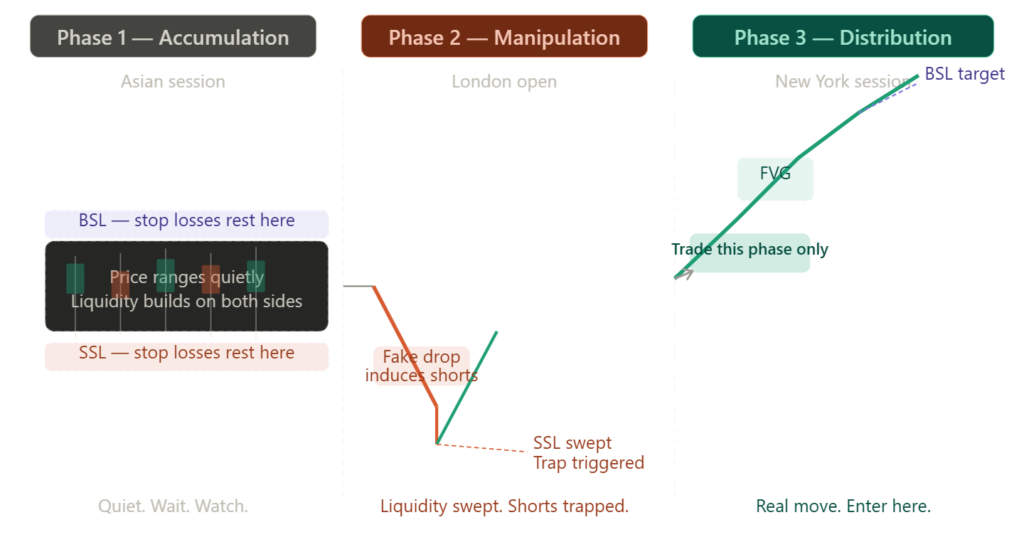
Alt text: Power of Three diagram showing three phases from left to right — Accumulation (Asian session, price ranges with BSL and SSL zones), Manipulation (London open, fake drop below SSL that sweeps stops and traps shorts), and Distribution (New York session, real bullish move targeting BSL with entry point and FVG labelled).
How SMC and ICT Differ on This Concept
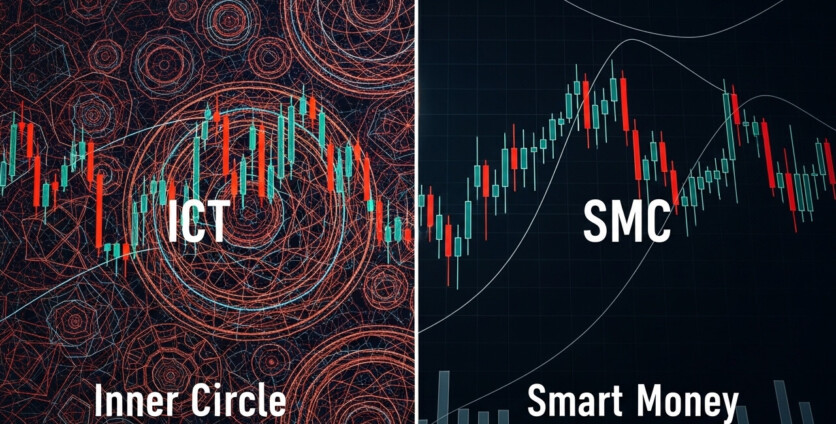
Both methodologies recognise inducement and the AMD cycle. The difference, again, is in the role that time plays.
SMC traders identify the manipulation phase purely through price action — they wait for the sweep, look for a CHoCH and FVG on the lower timeframe, and enter the distribution. Clean and functional.
ICT layers in session timing explicitly. The Asian session (roughly 8:00pm–2:00am EST) is the accumulation window. The London open (2:00am–5:00am EST) is where manipulation typically occurs. The New York session (7:00am–12:00pm EST) is where the distribution move runs. An ICT trader won’t just look for the manipulation pattern — they expect it to happen within a specific time window and treat setups outside those windows with far more scepticism.
This makes ICT’s approach to the Power of Three more precise but also more demanding. You have to be available at the right times. SMC’s version is more flexible — applicable across all sessions, but with slightly less temporal precision.
The Rule That Changes Everything
Here is the one rule that ties inducement, stop hunts and the Power of Three together into a single actionable insight:
Do not enter before the manipulation is complete.
The single most common reason retail traders get stopped out on correct directional calls is that they enter during the accumulation phase, expecting the distribution to start immediately. They’re right about the direction. They’re wrong about the timing. The manipulation move hits their stop, takes them out, and then the price goes exactly where they said it would — without them.
Wait for the sweep. Wait for the CHoCH that follows. Wait for displacement and an FVG to form. Then enter — into the distribution, not into the accumulation.
Up Next — Day 9
Tomorrow we go into one of ICT’s most specific and powerful contributions — the concept that sets it apart most clearly from SMC: Kill Zones and session-based trading. We’ll break down exactly when London and New York create their setups, why the Asian range matters so much, and how time precision can dramatically improve your win rate.
If you’ve ever wondered why your perfectly structured setup failed simply because it happened at the wrong hour — Day 9 answers that completely.
→ See you on Day 9.