Day 9: ICT Kill Zones Vs SMC Session Analysis — Why WhenYou Trade Matters As Much As Where | Trading Strategy Guides
Welcome back to Week 2. Yesterday we covered inducement and the Power of Three — the what and why behind institutional manipulation.
Today we answer the question every trader asks eventually:
Why does the same setup work brilliantly at 8am and fail completely at 2pm?
The answer isn’t structure. It isn’t liquidity. It isn’t your order block or your fair value gap.
It’s time.
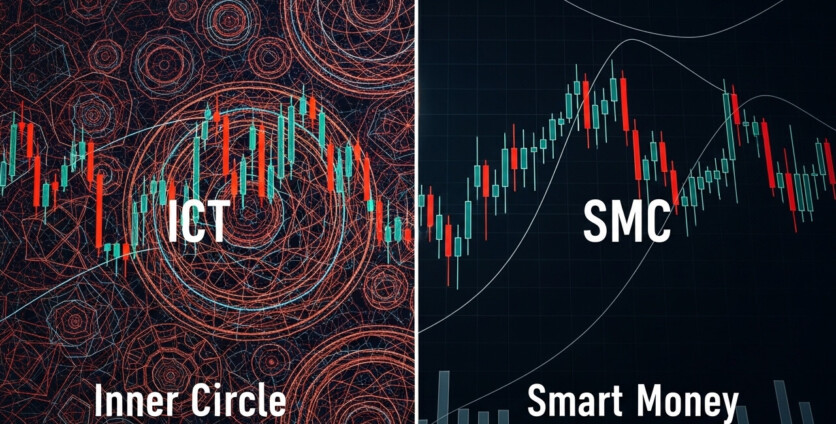
This is the single biggest differentiator between ICT and SMC. ICT insists that when you trade matters as much as what you trade. SMC is more flexible about timing. Today we break down both approaches — and you’ll walk away knowing exactly which trading hours deserve your full attention, and which ones to walk away from completely.
Why Time Matters in Institutional Trading
Large institutions — banks, hedge funds, sovereign wealth funds — don’t operate around the clock. They have specific trading desks that open at specific times. When those desks go live, order flow floods the market, volatility increases, and the setups you’ve been waiting for start printing.
Outside those windows? You get choppy, directionless price action driven by thin liquidity and algorithmic noise. The structure looks identical. The zones are the same. But the probability of a clean follow-through is dramatically lower.
ICT formalised this into what he calls Kill Zones — four specific time windows where institutional activity is highest and where high-probability setups are most likely to form and deliver.
The Four ICT Kill Zones (All Times in EST)
1. Asian Kill Zone — 8:00 PM to 10:00 PM EST
This is the quietest window. The USD typically consolidates, and major moves rarely originate here. The Asian session’s real value is not in trading aggressively — it’s in building your range reference. The highs and lows that form during this session become the liquidity targets that London and New York will hunt.
Best pairs: AUD/JPY, NZD/JPY, and other Asian-correlated crosses. Primary purpose: Range identification and bias preparation.
2. London Kill Zone — 2:00 AM to 5:00 AM EST
This is where the day’s direction is most often decided. European banks come online, order flow surges, and the Asian range — sitting quietly above and below — becomes the obvious liquidity pool for the manipulation move. On a bullish day, London frequently dips below the Asian lows first, sweeps sell-side liquidity, then reverses aggressively higher. On a bearish day, the opposite unfolds.
Best pairs: EUR/USD, GBP/USD, EUR/GBP. Primary purpose: Manipulation sweep of the Asian range, followed by the start of the real directional move.
3. New York Kill Zone — 7:00 AM to 10:00 AM EST (Forex) / 8:30 AM to 11:00 AM EST (Indices)
The New York session often continues what London started, or reverses it entirely if London’s move was itself the manipulation. The 8:30 AM EST window is particularly volatile due to major economic data releases — NFP, CPI, and similar — which can create explosive Fair Value Gaps and displacement moves. This is the deepest liquidity window of the day.
Best pairs: All major USD pairs, NAS100, S&P 500. Primary purpose: Distribution — the main directional move of the day.
4. London Close Kill Zone — 10:00 AM to 12:00 PM EST
European desks begin squaring positions. This creates counter-moves or continuation setups as the day’s earlier narrative plays out. Less predictable than London open or NY, but experienced traders find clean entries here as the day’s range consolidates before the afternoon.
Best purpose: Managing existing positions, occasional continuation entries.
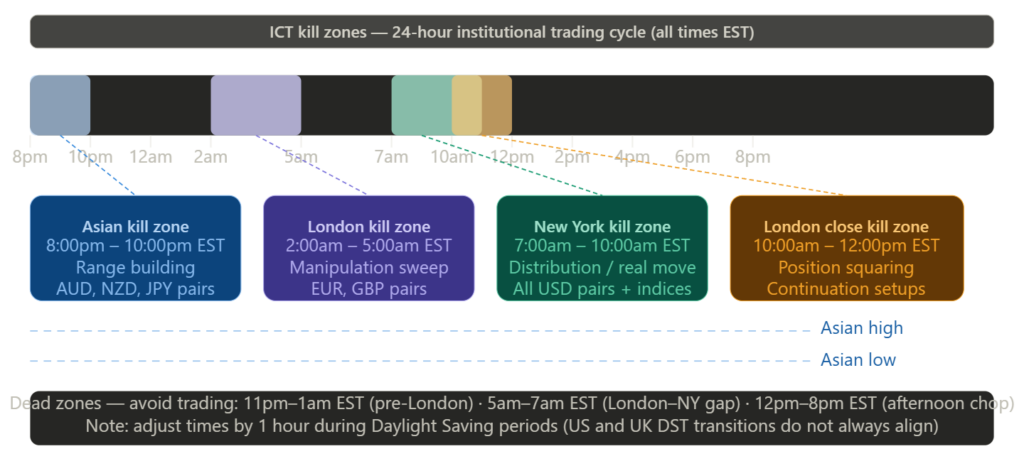
The Asian Range — Your Daily Roadmap
Understanding the Asian session isn’t just about whether to trade it. It’s about what information it gives you for the sessions that follow.
The high and low set during the Asian session create the two most important liquidity levels of the day. Above the Asian high sits buy-side liquidity — the stops of Asian session short sellers. Below the Asian low sits sell-side liquidity — the stops of Asian session long traders.
When London opens at 2am EST, one of the first things institutional order flow does is target one of these two levels. Which one it targets tells you the directional bias for the day. If London sweeps the Asian low and reverses sharply upward — that’s your bullish day signal. If it sweeps the Asian high and drops aggressively — that’s your bearish signal. You don’t need to predict which way it goes. You wait to see which level gets swept, then trade in the direction of the reversal during the New York session.
How ICT and SMC Differ on Session Analysis
This is one of the clearest and most practical differences between the two methodologies.
ICT is explicit and rigid about time. A Kill Zone is not just a preference — it’s a filter. An ICT trader will not enter a trade outside a Kill Zone, regardless of how clean the structure looks. If an order block retests at 1pm EST — dead session, no institutional participation — an ICT trader does not trade it. The setup may be textbook. The probability is still low. Time is treated as a non-negotiable variable.
SMC is structurally aware but more flexible about time. An SMC trader recognises that London and New York produce the best setups, and many SMC practitioners do observe the same session logic — but they don’t enforce Kill Zone windows as strictly. They may take a valid setup at 6am EST if structure and liquidity align, where an ICT trader would not.
Neither approach is wrong. ICT’s time discipline reduces overtrading dramatically and is particularly well-suited for traders who can be available at specific windows. SMC’s flexibility suits traders across different time zones who cannot always be at the screen during London or New York.
The Practical Rule That Will Cut Your Losing Trades
If you take nothing else from today, take this:
Stop trading between 12pm and 7pm EST. That window — the dead afternoon session — is where retail traders grind accounts down chasing setups that never deliver. There is no institutional conviction. There is no directional mandate. There is only noise.
Focus your attention on the two hours around the London open and the two to three hours around the New York open. Most of the week’s real price delivery happens in those windows. Everything outside them is optional at best and costly at worst.
Up Next — Day 10
Tomorrow we tackle multi-timeframe analysis — the framework that tells you how to use the daily chart for bias, the four-hour for structure, and the lower timeframes for precision entries. It’s the bridge between everything you’ve learned so far and actually executing trades with confidence.
Day 10 is where the full ICT and SMC methodology starts working as a system rather than a collection of individual tools.
→ See you on Day 10.