Does The Dividend Capture Strategy Work?
Contents
The dividend capture strategy is one in which an investor buys a stock just to receive the dividend.
They want to hold the stock for as short a time as possible to avoid stock risk and to free up capital.
Therefore, they buy as late as they can to qualify for the dividend and sell it right after they have been officially recorded as shareholders.
An investor who wants to collect the dividend of a stock must be an owner of the stock on the “record date”.
The record date is usually the “ex-dividend” date, with a few exceptions.
Stock trades in the U.S. follow a T+1 settlement cycle, meaning it takes one business day for a purchase to officially settle and for the investor to become the shareholder of record.
Therefore, to receive the dividend, the investor must buy the stock at least one trading day before the ex-dividend date so that the trade settles by the record date.
An investor buying the stock on the ex-dividend date will NOT receive the dividend.
That is because the trade will not settle in time.
Just remember that “ex-dividend” means “exclude dividend”, or without dividend.
Therefore, if an investor buys on ex-dividend date, they don’t receive the dividend.
Buy before the ex-dividend date.
That’s it.
The investor does not need to know the record date, whether it is the same as the ex-dividend date, or whether it is an exception, etc.
The company decides in advance when it will record shareholders on record, and, based on the stock settlement timeframe, it determines the ex-dividend date, which is the date after which stock purchases no longer qualify for the dividend.
This is why the ex-dividend date is shown on many platforms.
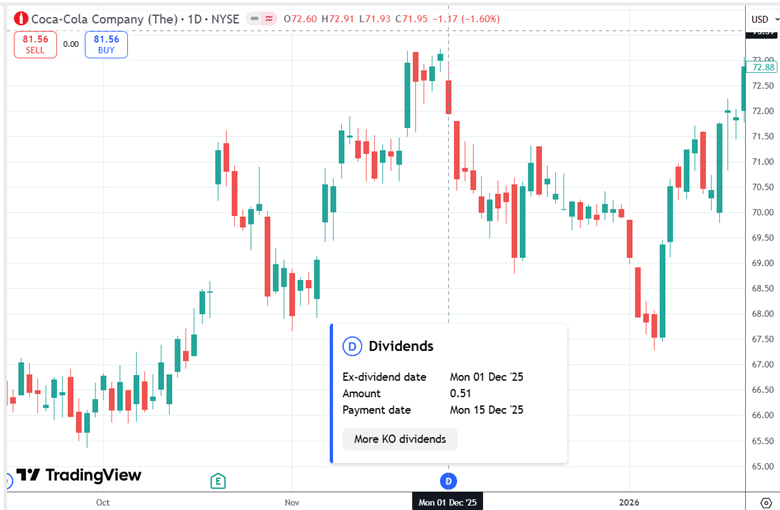
With the Earnings and Dividends icons enabled in TradingView, we see that Coca-Cola has an ex-dividend date on Monday, December 1st, 2025.
In this example, an investor who wants the Cola-Cola dividend must buy the stock on Friday, November 28, 2025, which is the trading day before the ex-dividend date.
Stock purchased on November 28 will settle on December 1st.
Once the market opens on December 1st, the shareholders are recorded.
So an investor can sell the stock during the regular trading session on the ex-dividend date and still get the dividend.
Investors engaging in dividend capture will purchase the stock on November 28th and sell it on December 1st (the ex-dividend date).
They will still receive the dividend on the payment date (about two weeks later, on December 15th).
This is legal.
But does it work?
No, it does not work.
If it did work, then everyone would buy right before the close on the trading day before the ex-dividend date.
And sell right after the open on ex-dividend.
In effect, they would receive free money in the form of a dividend, with minimal stock risk (except for overnight risk).
Since there is no such thing as free money, the strategy’s premise cannot hold.
On the ex-dividend date itself, the stock price typically drops by roughly the amount of the dividend because the dividend is not free money.
It is simply cash being removed from the company and transferred to shareholders.
As this money leaves the company’s value, the stock price adjusts downward.
This downward price shift makes the market fair.
So that a person buying before the ex-dividend date has no advantage over a person buying on the ex-dividend date, both are buying at the stock’s fair market value.
Options contracts similarly have dividend payouts priced into their premiums.
We used Coca-Cola in this example because it is a dividend aristocrat – a company in the S&P 500 that has increased its dividends for at least 25 consecutive years.
We see in the above that it paid $0.51 per share for its December quarterly dividend.
During that year, it also paid out $0.51 on September 15th, June 13th, and March 14th.
In total, it paid $2.04 per share that year.
At a price of around $73 per share, based on its last dividend in December, it yields 2.8% annually.
To be precise, KO closed at $73.12 on November 28th, and it opened at $72.60 on December 1st.
So it opened $0.52 per share lower on the ex-dividend date.
This accounts for the fact that $0.51 per share was allocated to dividends for the people who had bought the stock the day before.
Hence, a dividend-capture investor who bought KO on November 28 received $0.51 per share in dividends.
But they lost $0.52 in stock price when it opened the next trading day.
There is no edge in the dividend capture strategy.
You can try to find other examples of this price drop where the dividend comes out of the stock price.
But keep in mind that the stock’s opening price on the ex-dividend date is affected not only by the dividend payout, but also by overnight news, premarket/after-hours trading, and other factors.
So it is possible that other factors can boost a stock price, causing a price jump despite the dividend drop.
We hope you enjoyed this article on whether the dividend capture strategy works.
If you have any questions, please send an email or leave a comment below.
Trade safe!
Disclaimer: The information above is for educational purposes only and should not be treated as investment advice. The strategy presented would not be suitable for investors who are not familiar with exchange traded options. Any readers interested in this strategy should do their own research and seek advice from a licensed financial adviser.

Source link