Forex overview. EUR/USD Eases Despite Eurozone GDP Surprise as Attention Turns to Key US Data – ForexNews.PRO
Despite unexpectedly positive GDP figures released for the Eurozone this morning, the EUR/USD exchange rate failed to rally. Furthermore, traders seemingly disregarded yesterday’s concerning US data, which revealed a significant drop in consumer confidence amid ongoing trade uncertainties, thus casting doubts on US consumer spending. The US dollar’s surprising resilience in the face of this weaker data seems to stem from traders reversing their “Sell America” positions, fueled by renewed optimism surrounding potential trade agreements between the US and its major trading partners.
While it’s premature to declare the end of the dollar’s downward trend, this could signify the beginning of a broader recovery. Market focus will now shift to the upcoming US GDP report, particularly its consumer spending component, due later today.
However, recent price movements suggest that equity markets are currently driving FX direction. The recent stabilization in equities, coinciding with a more moderate tone from President Trump regarding tariffs, appears to be easing investor anxieties and offsetting negative data impacting the dollar.
Eurozone GDP Surpasses Expectations, but EUR/USD Declines
The Eurozone economy experienced a 0.4% quarter-over-quarter growth, doubling consensus forecasts. Nevertheless, the EUR/USD exchange rate failed to rise above the 1.14 level. Notably, Spain’s GDP led with a 0.6% increase, while Germany managed a 0.2% growth, thus avoiding a technical recession.
Concerns about stagflation persist within the Eurozone. It remains uncertain to what degree the stimulus measures approved months ago to counter the impact of US tariffs will boost the bloc. Consequently, it’s unlikely that these pre-tariff GDP figures will significantly influence the euro’s trajectory.
Markets seem fully persuaded by the ECB’s dovish stance, requiring a series of considerably stronger-than-expected data to shift sentiment. The ECB’s relatively unconcerned view on price pressures and the euro’s recent strength, which offers some insulation against imported inflation, suggest that any near-term surge in Eurozone inflation will not concern Christine Lagarde or her colleagues.
Meanwhile, another factor contributes to the EUR/USD’s minor weakness. The recent improvement in risk appetite has triggered some unwinding of the “sell America” trade, allowing the US dollar to recover slightly, resulting in moderate selling pressure on the euro. Although the EUR/USD trend isn’t overtly bearish, the loss of significant bullish momentum indicates a period of consolidation or a slight retracement.
EUR/USD: Key Levels to Watch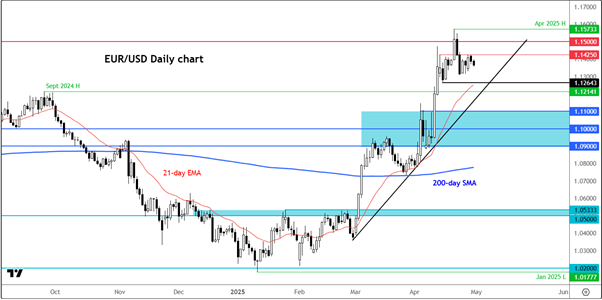
From a technical perspective, the EUR/USD outlook is starting to show a subtle shift towards a neutral or slightly negative leaning, especially after the recent strong upward trend. The momentum seems to be decreasing, especially since the currency pair couldn’t decisively overcome the 1.15 mark, mostly because of better risk appetite and a reduction in “Sell America” strategies. However, there’s not enough solid proof yet to confirm a change in the trend. Therefore, a gradual, level-by-level strategy is the most sensible approach until there’s more clarity on the direction.
Analyzing the charts, the main support area is now between 1.1095 and 1.1210, highlighted in blue, which previously acted as the final resistance zone before the latest breakout. If the pair retraces to this region, we’ll be watching for signals of a potential bounce, as this area could very well spark renewed buying activity.
In the shorter term, there are a few levels to watch closely. The 1.1300 level and the September high at 1.1214 could also provide some temporary support before the lower support zone becomes relevant.
Regarding resistance, the 1.1425 level is a short-term obstacle, while the 1.1500 mark is the next significant level, followed by the high for this month at 1.1573.