Get ready for the silicon carbide revolution, led by STMicroelectronics’ groundbreaking new factory 🏭

Get Email Alerts and Follow Us:
STMicroelectronics, a leading French-Italian tech firm, is set to receive a €2 billion ($2.2 billion) grant from the Italian government to build a €5 billion ($5.4 billion) silicon carbide (SiC) semiconductor factory in Sicily. This will be the world’s first fully integrated SiC semiconductor facility, aimed at producing chips for electric vehicles (EVs). The grant aligns with the European Union’s strategy to boost domestic chip production, similar to the US’s CHIPS Act and China‘s Big Fund. The new factory, which expects to start production by 2026 and reach full capacity in seven years, will significantly enhance Europe’s semiconductor capabilities. The investment highlights the critical importance of semiconductors in the global economy and aims to reduce dependency on single suppliers. Silicon carbide technology offers superior properties over traditional silicon, making it ideal for automotive, industrial, and AI applications.
Aligning with Global Semiconductor Investment Strategies
The grant falls under the European Union’s ambitious efforts to bolster domestic chip production infrastructure, paralleling similar initiatives like the US’s CHIPS Act and China‘s Big Fund. The substantial investments in microchip production underscore the critical importance of semiconductors to the global economy, especially highlighted by the chip shortage during the global pandemic of 2020, which exposed the vulnerabilities of trillion-dollar industries to supply chain disruptions.
Strategic Importance and Competitive Landscape
STMicroelectronics is the first company to secure approval for grants from the EU, with tech giants Intel and TSMC also vying for similar funding for their projects in Germany. Margrethe Vestager, the EU‘s Commissioner for Competition, emphasized the strategic significance of these investments, stating, “I think it’s really important that we do this, because it’s also signaling to the rest of the world, you should not build up capacity to think that you can own this market, because it’s so strategically important to us not to have single supplier dependencies.”
Vestager highlighted that STMicroelectronics’ grant approval demonstrates the EU‘s commitment to ensuring multiple sources for its chip requirements. She expressed confidence that more investments in other states would follow soon, although specific timelines remain uncertain.
The Advantages of Silicon Carbide Technology
One of the most intriguing aspects of this development is its focus on silicon carbide (SiC) technology. Unlike traditional silicon wafers, silicon carbide offers superior properties in terms of hardness, thermal conductivity, and thermal expansion. These characteristics make SiC highly suitable for automotive and industrial applications, including solar cells and artificial intelligence (AI) data centers.
The silicon carbide (SiC) semiconductor market is projected to experience significant growth in the coming years:
Market Size and Growth Projections
- The global SiC semiconductor market size was valued at around $1.59 billion in 2023.[1]
- It is expected to grow to $2 billion in 2024, at a compound annual growth rateThe world of finance is replete with complex concepts, but one that stands as a cornerstone for investors seeking to gauge returns is the Compound Annual Growth Rate (CAGR). Often … More (CAGRThe world of finance is replete with complex concepts, but one that stands as a cornerstone for investors seeking to gauge returns is the Compound Annual Growth Rate (CAGR). Often … More) of 25.2%.[1]
- The market is forecasted to reach $4.52 billion by 2028, growing at a CAGRThe world of finance is replete with complex concepts, but one that stands as a cornerstone for investors seeking to gauge returns is the Compound Annual Growth Rate (CAGR). Often … More of 22.7% during the forecast period of 2023-2028.[1]
- Another estimate projects the SiC semiconductor market to grow at a CAGRThe world of finance is replete with complex concepts, but one that stands as a cornerstone for investors seeking to gauge returns is the Compound Annual Growth Rate (CAGR). Often … More of 15.9% from 2023 to 2030, reaching $2.28 billion by 2030 from $692.78 million in 2022.[2]
Key Growth Drivers
- Rising demand for electric vehicles (EVs) and their powertrain components, as SiC semiconductors provide higher power densities and switching efficiency.[1][2]
- Expansion of renewable energy systems and 5G network deployment requiring high-power electronic devices.[2]
- Advancements in SiC manufacturing processes, improving scalability and cost-effectiveness.[2][3]
- Increasing power density requirements and adoption in the automotive industry.[1][3]
- Proliferation of renewable energy and growth in power transmission.[1]
Regional Outlook
- Asia Pacific dominated the SiC semiconductor market with a 30.07% share in 2021, driven by demand from various end-use industries.[3]
- North America and Europe are also expected to witness significant growth due to the adoption of SiC semiconductors in automotive and renewable energy applications.[2][3]
In summary, the SiC semiconductor market is forecasted to experience exponential growth over the next 5-10 years, primarily driven by the rising demand for electric vehicles, renewable energy systems, and advancements in manufacturing processes, with Asia Pacific leading the regional market.[1][2][3]
Innovations Beyond Silicon
Advancements in SiC technology complement ongoing research into post-silicon chips, a crucial area as Moore’s Law, which predicts that transistor counts on chips will double every two years, slows down to every three years. The new STMicroelectronics facility aims to integrate all of the company’s research and development on SiC chips. This includes work on processes, product design, packaging, and more, streamlining R&D and production in a single location for enhanced efficiency and innovation.
Future Production and Capacity
STMicroelectronics anticipates that the new facility will begin producing SiC semiconductors by 2026. It will take approximately seven years for the factory to reach full capacity, at which point it will produce 15,000 silicon carbide wafers per week. This long-term vision underscores the company’s commitment to leading the market in SiC semiconductor technology.
Insights
- The grant reflects EU‘s strategic push for semiconductor self-sufficiency.
- Silicon carbide technology is crucial for future automotive and industrial applications.
- STMicroelectronics’ new facility aims to streamline SiC R&D and production.
The Essence (80/20)The Origins and Evolution of the 80/20 Principle The Discovery by Vilfredo Pareto In 1897, Italian economist Vilfredo Pareto uncovered a striking pattern in his study of wealth and… More
- Core Topic 1: EU‘s Semiconductor Strategy
- Core Topic 2: Silicon Carbide Technology
- Silicon carbide (SiC) technology offers superior properties compared to traditional silicon, making it ideal for high-demand applications such as electric vehicles, solar cells, and AI data centers.
- Core Topic 3: Strategic Importance
- STMicroelectronics’ project underscores the strategic importance of having multiple semiconductor sources to avoid single supplier dependencies, a lesson highlighted by the 2020 global chip shortage.
The Action Plan – What STMicroelectronics Will Likely Do
- Investment and Construction
- Secure the €2 billion grant from the Italian government and allocate resources towards the construction of the €5 billion SiC semiconductor facility in Sicily.
- R&D and Production Integration
- Integrate all research and development activities related to SiC technology into the new facility to streamline processes and enhance efficiency.
- Market Positioning
- Leverage the advanced SiC technology to capture significant market share in automotive, industrial, and AI semiconductor applications.
Blind Spot
- Supply Chain Challenges
- While focusing on SiC technology, there might be an oversight in addressing potential supply chain disruptions for other critical materials and technologies needed for semiconductor production.
STMicroelectronics (STM) Technical Analysis
Price Movements:
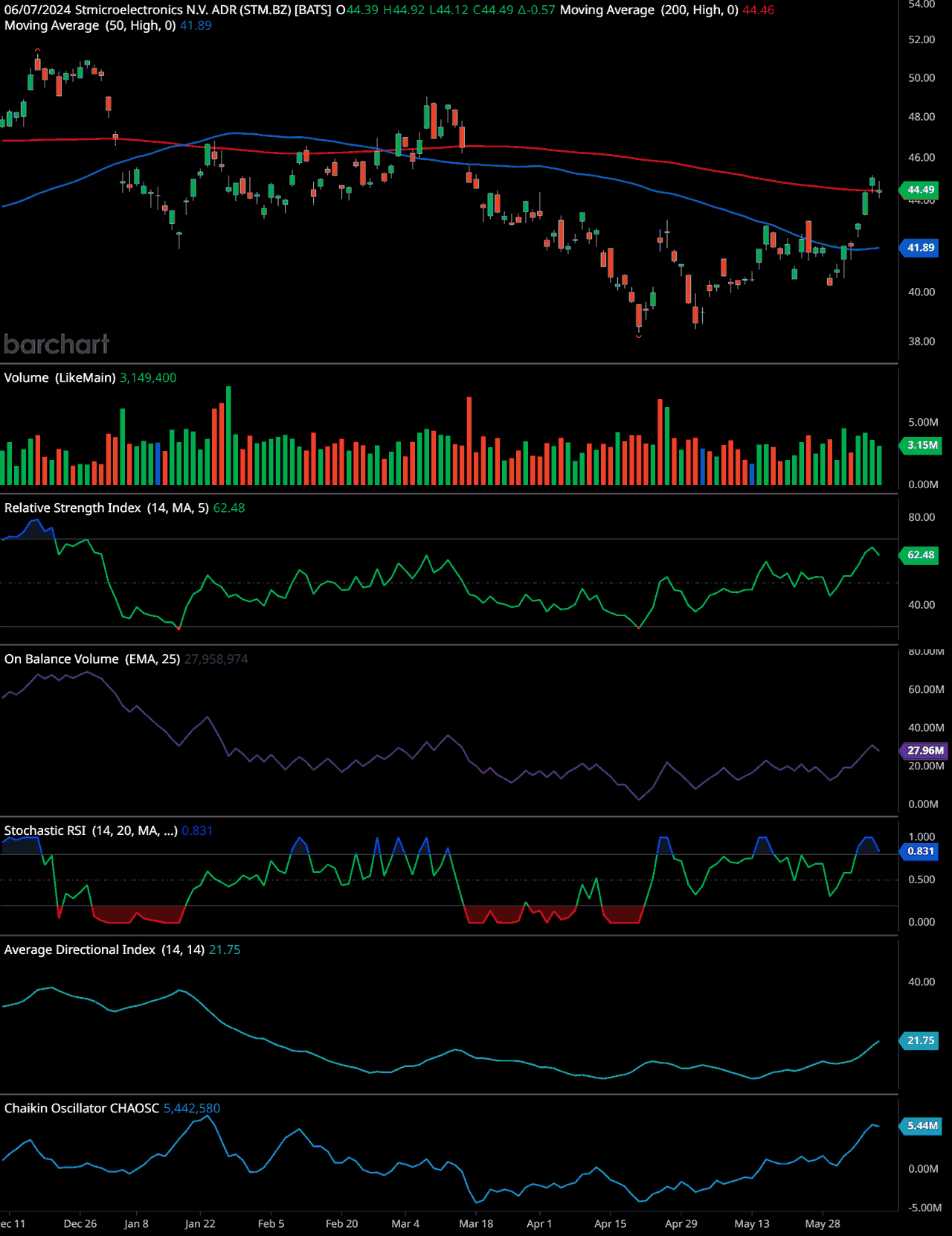
The stock price has been on a downward trend since the beginning of the year, evident from the series of lower highs and lower lows. Recently, there is a noticeable bounce off the lows around the $40 level, moving up to the current price of $44.49.
Moving Averages:
The 50-day moving average (blue line) is currently at $41.89, and the 200-day moving average (red line) is at $44.46. The price has recently crossed above the 50-day moving average, indicating a potential shift in momentum. However, it remains close to the 200-day moving average, which could act as resistance.
Volume:
The volume has been relatively high during the recent price increase, suggesting strong buying interest. The most recent trading volume is 3,149,400 shares.
Relative Strength IndexIn the world of technical analysis, the Relative Strength Index (RSI) stands as a cornerstone tool for traders seeking insights into market momentum. Developed by J. Welles Wilder … More (RSIIn the world of technical analysis, the Relative Strength Index (RSI) stands as a cornerstone tool for traders seeking insights into market momentum. Developed by J. Welles Wilder … More):
The RSIIn the world of technical analysis, the Relative Strength Index (RSI) stands as a cornerstone tool for traders seeking insights into market momentum. Developed by J. Welles Wilder … More is at 62.48, which is below the overbought threshold of 70. This indicates that the stock is not overbought and might have further room to run on the upside.
On Balance VolumeThe On Balance Volume indicator (OBV) is a technical analysis tool used to measure the flow of money into and out of a security over a specified period of time. It is a cumulative … More (OBVThe On Balance Volume indicator (OBV) is a technical analysis tool used to measure the flow of money into and out of a security over a specified period of time. It is a cumulative … More):
The OBVThe On Balance Volume indicator (OBV) is a technical analysis tool used to measure the flow of money into and out of a security over a specified period of time. It is a cumulative … More line has been relatively flat, indicating that the volume flow has not strongly supported the recent price movements. This could suggest that the recent price increase might not be sustainable without stronger volume support.
Stochastic RSIIn the realm of technical analysis, the Stochastic RSI (StochRSI) emerges as a powerful tool for traders seeking to navigate market dynamics with precision. Developed by Tushar S. … More:
The Stochastic RSIIn the realm of technical analysis, the Stochastic RSI (StochRSI) emerges as a powerful tool for traders seeking to navigate market dynamics with precision. Developed by Tushar S. … More is at 0.831, which is in the overbought territory (above 0.8). This suggests that the stock might experience a short-term pullback or consolidation.
Average Directional IndexThe Average Directional Index (ADX) stands as a cornerstone indicator in the toolkit of technical traders, offering insights into the strength of market trends. Developed by Welles… More (ADXThe Average Directional Index (ADX) stands as a cornerstone indicator in the toolkit of technical traders, offering insights into the strength of market trends. Developed by Welles… More):
The ADXThe Average Directional Index (ADX) stands as a cornerstone indicator in the toolkit of technical traders, offering insights into the strength of market trends. Developed by Welles… More is at 21.75, which indicates a weak trend. The trend strength is not strong enough to confirm a new bullish trend.
Chaikin OscillatorNamed after its creator Marc Chaikin, the Chaikin Oscillator stands as a formidable tool in the arsenal of technical analysts. This oscillator is designed to measure the accumulati… More:
The Chaikin OscillatorNamed after its creator Marc Chaikin, the Chaikin Oscillator stands as a formidable tool in the arsenal of technical analysts. This oscillator is designed to measure the accumulati… More is at 5,442,580, indicating accumulation. This suggests that there is buying pressure and the recent price increase might be supported by this.
Conclusion:
- The stock price has shown some recent strength by bouncing off its lows and crossing the 50-day moving average.
- The RSIIn the world of technical analysis, the Relative Strength Index (RSI) stands as a cornerstone tool for traders seeking insights into market momentum. Developed by J. Welles Wilder … More indicates there is still room for upside, but the Stochastic RSIIn the realm of technical analysis, the Stochastic RSI (StochRSI) emerges as a powerful tool for traders seeking to navigate market dynamics with precision. Developed by Tushar S. … More suggests the stock might be overbought in the short term.
- The ADXThe Average Directional Index (ADX) stands as a cornerstone indicator in the toolkit of technical traders, offering insights into the strength of market trends. Developed by Welles… More indicates a weak trend, so the recent upward movement may lack strong directional momentum.
- The OBVThe On Balance Volume indicator (OBV) is a technical analysis tool used to measure the flow of money into and out of a security over a specified period of time. It is a cumulative … More and Chaikin OscillatorNamed after its creator Marc Chaikin, the Chaikin Oscillator stands as a formidable tool in the arsenal of technical analysts. This oscillator is designed to measure the accumulati… More suggest that buying pressure is present, but not significantly strong.
Time-Frame Signals:
3-Month Horizon: Hold. The stock might experience some short-term consolidation or minor pullback.
6-Month Horizon: Buy. Given the recent bullish indicators, the stock could have more upside potential if it breaks above the 200-day moving average.
12-Month Horizon: Hold. While the long-term trend needs more confirmation, holding could be beneficial if the stock sustains its recent upward momentum.
Keep an eye on the stock’s ability to break above and hold the 200-day moving average and monitor volume to ensure that the upward movement is supported by strong buying interest.
Remember, past performance is not an indication of future results. Always conduct your own research and consider consulting with a financial advisor before making any investment decisions. 🧡
A Leap Forward for the Semiconductor Industry
The establishment of the world’s first fully integrated silicon carbide semiconductor factory marks a significant milestone for STMicroelectronics and the semiconductor industry at large. With the support of a substantial government grant and alignment with EU strategic goals, this development not only enhances the company’s competitive edge but also strengthens the EU’s position in the global semiconductor market. The focus on SiC technology positions STMicroelectronics at the forefront of innovation, paving the way for advancements in automotive, industrial, and AI applications. As the facility progresses towards full capacity, it promises to play a pivotal role in meeting the growing demand for high-performance semiconductors, driving the future of technology forward.
1. What is the recent grant STMicroelectronics has received?
STMicroelectronics has received a substantial €2 billion ($2.2 billion) grant from the Italian government to support the construction of a €5 billion ($5.4 billion) chip production facility in Sicily.
2. What is the significance of this new facility in Sicily?
This facility will be the world’s first fully integrated silicon carbide (SiC) semiconductor factory, specifically designed to manufacture microchips for electric vehicles (EVs).
3. How does this grant align with global semiconductor investment strategies?
The grant aligns with the European Union’s efforts to boost domestic chip production, similar to the US’s CHIPS Act and China‘s Big Fund, highlighting the critical importance of semiconductors to the global economy.
4. Who are the other major companies competing for similar funding in the EU?
Other major companies like Intel and TSMC are also seeking similar funding for their semiconductor projects in Germany.
5. What are the advantages of silicon carbide (SiC) technology?
Silicon carbide offers superior properties compared to traditional silicon wafers, including better hardness, thermal conductivity, and thermal expansion, making it ideal for automotive and industrial applications.
6. How does SiC technology complement advancements beyond silicon?
SiC technology complements research into post-silicon chips, which is crucial as Moore’s Law slows down, allowing for enhanced efficiency and innovation in chip production.
7. When is the new facility expected to begin production?
The new STMicroelectronics facility is expected to start producing SiC semiconductors by 2026.
8. What is the anticipated production capacity of the new facility?
It will take approximately seven years for the facility to reach full capacity, at which point it will produce 15,000 silicon carbide wafers per week.
9. What is the strategic importance of STMicroelectronics’ grant approval?
The grant approval demonstrates the EU’s commitment to ensuring multiple sources for its chip requirements, avoiding single supplier dependencies.
10. What impact will this new facility have on the semiconductor industry?
The facility will enhance STMicroelectronics’ competitive edge, strengthen the EU’s position in the global semiconductor market, and drive advancements in automotive, industrial, and AI applications.
Book Recommendations:
“Chip War: The Fight for the World’s Most Critical Technology” by Chris Miller
- Relation to the Article: This book provides an in-depth look at the global importance of semiconductor technology, mirroring the article’s emphasis on the critical role of semiconductors in the global economy. It discusses the geopolitical and economic struggles over chip production, similar to how the article describes the EU’s strategic move to bolster its semiconductor production capabilities through significant grants and initiatives.
“The Innovators: How a Group of Hackers, Geniuses, and Geeks Created the Digital Revolution” by Walter Isaacson
- Relation to the Article: This book chronicles the history of technological advancements and the key figures behind them, which aligns with the article’s discussion on the innovation within the semiconductor industry. The development of silicon carbide technology at STMicroelectronics represents a significant technological leap, akin to the innovations described in Isaacson’s narrative.
“Materials for High-Temperature Semiconductor Devices” by National Research Council
- Relation to the Article: This book delves into advanced materials like silicon carbide, which are pivotal in high-temperature semiconductor applications. The article highlights the unique properties and advantages of silicon carbide technology for automotive and industrial uses. This book provides a scientific and technical foundation that complements the article’s discussion on the importance and future potential of silicon carbide semiconductors.
These books collectively provide a broader understanding of the technological, economic, and geopolitical contexts surrounding the semiconductor industry, deepening the insights derived from the article.
Citations:
[1] https://www.thebusinessresearchcompany.com/report/silicon-carbide-semiconductor-device-global-market-report
[2] https://finance.yahoo.com/news/silicon-carbide-semiconductor-market-size-151500835.html
[3] https://www.grandviewresearch.com/industry-analysis/silicon-carbide-semiconductor-devices-market-report
[4] https://www.marketsandmarkets.com/Market-Reports/silicon-carbide-electronics-market-439.html
[5] https://www.globenewswire.com/news-release/2024/05/09/2879324/0/en/Silicon-Carbide-Market-Size-Projected-to-Surge-11-28-Billion-Growth-by-2033-Exhibit-a-CAGR-of-11-82.html
Get Email Alerts and Follow Us:
We are entirely supported by readers like you. Thank you for your support.
This content is provided for informational purposes only and does not constitute financial, investment, tax or legal advice or a recommendation to buy any security or other financial asset. The content is general in nature and does not reflect any individual’s unique personal circumstances. The above content might not be suitable for your particular circumstances. Before making any financial decisions, you should strongly consider seeking advice from your own financial or investment advisor.
Source link