Gold holds on to gains with softening stance on tariffs and slight recovery in rates
- Gold faces some doubts after the Trump administration loosens tariff pressure for Mexico and Canada.
- US yields recovered a touch while Fed’s Waller sees chances for two or even three rate cuts this year.
- Traders gear up for the Nonfarm Payrolls release for February this Friday.
Gold’s price (XAU/USD) ticks up slightly and consolidates for the third day in a row this week. The rally in Bullion stalls after US President Donald Trump shielded off all goods from Mexico and Canada that fall under the USMCA trade agreement from its freshly baked tariffs that got implemented earlier this week. Meanwhile, US equity markets trade below where they were on President Trump’s inauguration day.
On the rates side, traders got some support from Federal Reserve (Fed) official Christopher Waller, who said on Thursday that he wouldn’t support lowering interest rates in March but sees room to cut two, or possibly three, times this year. This coincides with what markets expected, with June being the first pivotal moment for the Fed to cut interest rates this year.
Daily digest market movers: Crypto hangover
- Tensions rise between the world’s two largest economies, the US and China. Chinese Foreign Minister Wang Yi defended his nation’s actions on stemming the flow of fentanyl to the US on Friday at a high-profile briefing and accused US President Donald Trump of using the issue as a pretext to pressure his government, Bloomberg reports.
- Anticipations were high for the crypto industry after President Donald Trump signed a long-awaited order creating a strategic Bitcoin reserve and an additional stockpile of other digital assets. However, Bitcoin tanked below $90,000 after it turned out that only already owned tokens would be centralized and no new Bitcoin would be bought with taxpayers’ money, Bloomberg reports.
- “If the labor market, everything, seems to be holding, then you can just kind of keep an eye on inflation,” Fed’s Waller said on Thursday at the Wall Street Journal CFO Network Summit. “If you think it’s moving back towards the target, you can start lowering rates. I wouldn’t say at the next meeting, but could certainly see going forward.”, Waller added, Reuters reports.
- Australia shipped a record amount of Gold to the US in January, as fears over potential tariffs saw traders rush to deliver metal into New York warehouses in order to capitalize on extreme price dislocations between key markets. Exports to the US totaled A$4.6 billion ($2.9 billion) in the month — the highest amount in records dating back to 1995, the Australian Bureau of Statistics said in its latest monthly trade report, Bloomberg reports.
Technical Analysis: Small pause
Bets on interest rate cuts by the Federal Reserve are now starting to get support from the central bank’s policymakers. This should support Gold’s price throughout the year, though it might not be enough to push Gold to fresh all-time highs for now. For that, a fresh catalyst, such as new tariffs or another page in the trade war book, would need to occur.
While Gold trades near $2,917 at the time of writing, the daily Pivot Point at $2,910 and the daily R1 resistance at $2,928 are the key levels to watch for on Friday. In case Gold sees more inflows, the daily R2 resistance at $2,945 will possibly be the final cap ahead of the all-time high of $2,956 reached on February 24.
On the downside, the $2,900 psychological big figure and the S1 support at $2,893 acts as a double support barrier. If Bullion bulls want to avoid another leg lower, that zone must hold. Further down, the daily S2 support at $2,874 should be able to catch any additional downside pressure.
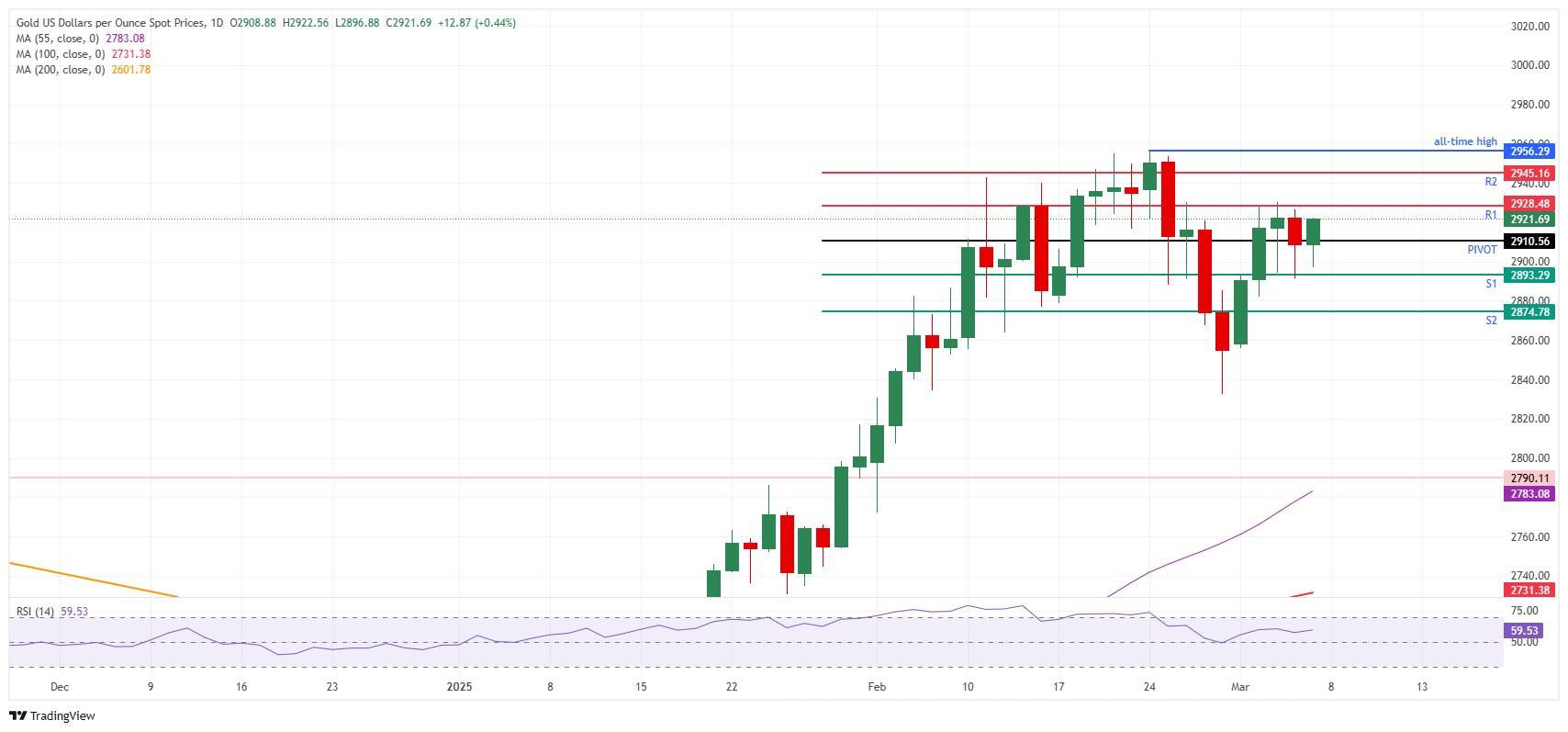
XAU/USD: Daily Chart
US-China Trade War FAQs
Generally speaking, a trade war is an economic conflict between two or more countries due to extreme protectionism on one end. It implies the creation of trade barriers, such as tariffs, which result in counter-barriers, escalating import costs, and hence the cost of living.
An economic conflict between the United States (US) and China began early in 2018, when President Donald Trump set trade barriers on China, claiming unfair commercial practices and intellectual property theft from the Asian giant. China took retaliatory action, imposing tariffs on multiple US goods, such as automobiles and soybeans. Tensions escalated until the two countries signed the US-China Phase One trade deal in January 2020. The agreement required structural reforms and other changes to China’s economic and trade regime and pretended to restore stability and trust between the two nations. However, the Coronavirus pandemic took the focus out of the conflict. Yet, it is worth mentioning that President Joe Biden, who took office after Trump, kept tariffs in place and even added some additional levies.
The return of Donald Trump to the White House as the 47th US President has sparked a fresh wave of tensions between the two countries. During the 2024 election campaign, Trump pledged to impose 60% tariffs on China once he returned to office, which he did on January 20, 2025. With Trump back, the US-China trade war is meant to resume where it was left, with tit-for-tat policies affecting the global economic landscape amid disruptions in global supply chains, resulting in a reduction in spending, particularly investment, and directly feeding into the Consumer Price Index inflation.