Guide to Advanced Tokenomics for Blockchain Ecosystems
Lesson Objectives
By the end of this lesson, learners will be able to:
- Understand the key classifications of tokens and their roles in blockchain ecosystems.
- Analyze various token supply models, including fixed, inflationary, elastic, and dual-token systems.
- Explore incentive mechanisms such as staking, liquidity mining, and token burnsToken burning refers to the process of permanently removing cryptocurrency tokens from circulation. This is done by sending the tokens to an unrecoverable or “burn” address (a wall…, and their impact on network security and participation.
- Examine the role of stablecoinsA stablecoin is a type of cryptocurrency designed to maintain a stable value relative to a specific asset or basket of assets. Unlike traditional cryptocurrencies such as Bitcoin o…, vesting schedules, and game theory in maintaining ecosystem stability and encouraging strategic interactions.
- Apply case study insights to real-world scenarios to evaluate the success and challenges of tokenomics implementations.
- Discuss governance models and their significance in decentralized decision-making.
Introduction to Tokenomics
Tokenomics is the study of the design, distribution, and economic mechanisms of cryptocurrenciesA cryptocurrency is a digital or virtual form of currency that uses cryptography for security. Unlike traditional currencies issued by central banks, cryptocurrencies operate on de… and digital tokens. Think of tokenomics as the rules of an economic game, where tokens act as the currency and participants are the players. For example, it’s like a board game where players collect resources (tokens) to build and sustain their cities (blockchain ecosystems), while following specific rules to ensure fair play and balance. It plays a critical role in determining the success and functionality of blockchain-based ecosystems. This lesson delves into the advanced aspects of tokenomics, focusing on economic models, incentive structures, governance mechanisms, and real-world applications.
Key Components of Tokenomics
1. Token Classification
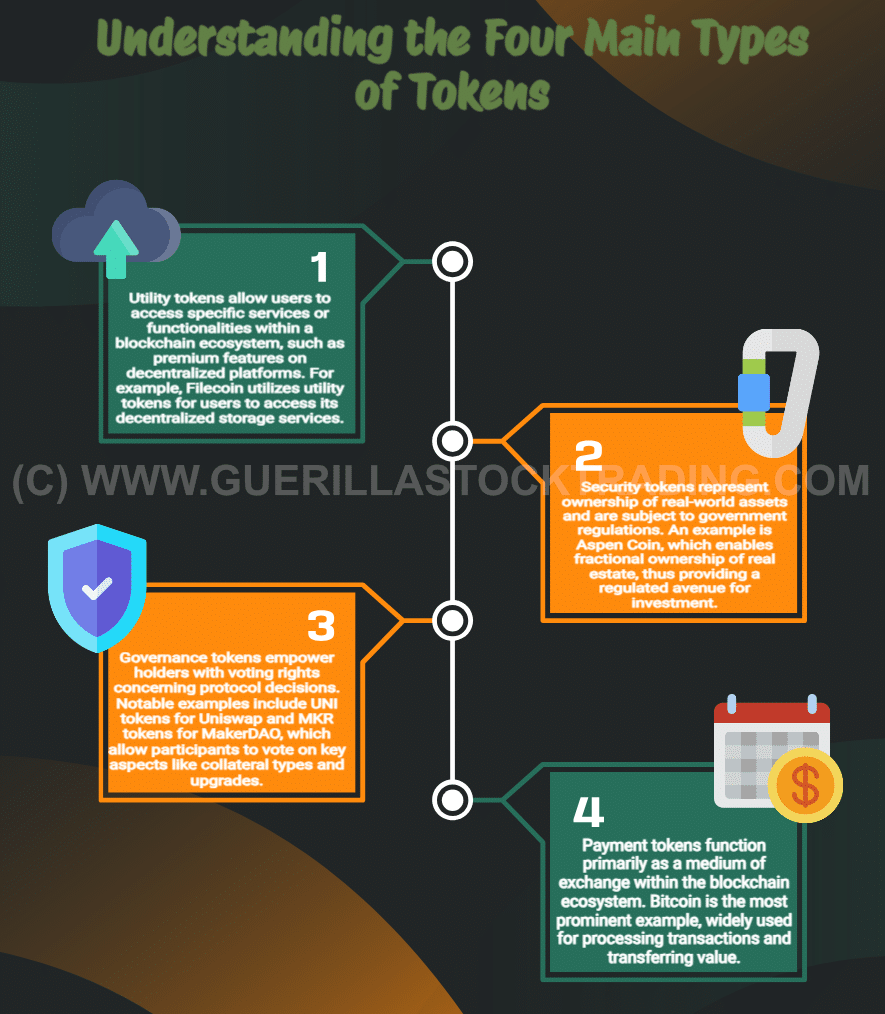
Tokens are broadly categorized into:
- Utility TokensUtility tokens are a type of digital asset that provides holders with access to a product or service within a blockchain ecosystem. For example, tokens like Binance Coin (BNB) allo…: Provide access to specific services or functions within a blockchain ecosystem (e.g., accessing premium features on a decentralized storage platform like FilecoinFilecoin (FIL) is an altcoin and a decentralized storage network that allows users to store, request, and transfer data in a decentralized manner. Here’s an overview of Filecoin: K…).
- Security TokensSecurity tokens are digital assets that represent ownership in an asset. These assets can be tangible, like real estate or physical commodities, or intangible, such as stocks, bond…: Represent ownership of an asset, subject to regulatory oversight (e.g., tokenized real estate shares such as Aspen Coin for fractional property ownership).
- Governance TokensGovernance tokens are a type of cryptocurrency that allows holders to participate in the decision-making processes of blockchain projects, decentralized applications (dApps), or de…: Grant holders voting rights on protocol decisions (e.g., UNI tokens for Uniswap governance or MKR tokens for MakerDAO, where holders vote on decisions like collateral types and protocol upgrades).
- Payment TokensPayment tokens are digital assets primarily used as a medium of exchange for goods and services, much like traditional currencies. Unlike fiat currencies, which are issued and regu…: Serve as a medium of exchange (e.g., BitcoinBitcoin is a decentralized digital currency that operates on a peer-to-peer network without a central authority or intermediaries like banks. Here are some key features and aspects… used for transactions).
Considerations:
- Regulatory Implications: Security tokensSecurity tokens are digital assets that represent ownership in an asset. These assets can be tangible, like real estate or physical commodities, or intangible, such as stocks, bond… often require compliance with financial laws. Examples include tokenized real estate and other asset-backed securities.
- Adoption and Utility: The value of utility tokensUtility tokens are a type of digital asset that provides holders with access to a product or service within a blockchain ecosystem. For example, tokens like Binance Coin (BNB) allo… depends on their real-world use cases. For example, Basic Attention Token (BAT) is used within the Brave browser ecosystem to reward users for viewing ads and to compensate content creators.
2. Token Supply Models
A. Fixed Supply
Tokens are capped at a predetermined maximum supply. This scarcity often influences value positively (e.g., BitcoinBitcoin is a decentralized digital currency that operates on a peer-to-peer network without a central authority or intermediaries like banks. Here are some key features and aspects…). Scarcity interacts with market dynamics by creating a sense of exclusivity, often driving speculative investments as participants anticipate future value increases. Additionally, scarce tokens are frequently viewed as a hedge against inflationInflation refers to the rate at which the overall price levels of goods and services increase, gradually reducing purchasing power over time. It is commonly measured using indices …, attracting long-term investors seeking stability in their portfolios.
B. Inflationary Supply
Tokens are continuously minted, often to reward network participants. Careful design is needed to avoid excessive inflationInflation refers to the rate at which the overall price levels of goods and services increase, gradually reducing purchasing power over time. It is commonly measured using indices ….
C. Dual-Token Models
Some ecosystems use two tokens to separate governance and utility functions (e.g., NEO and GAS).
D. Elastic Supply Models
Elastic supply models adjust the supply of tokens automatically based on market conditions to maintain a target price or value. This is often achieved through mechanisms like rebasing, where token balances in user wallets are automatically adjusted up or down in response to price deviations.
Advantages of Elastic Supply:
- Price Stability: Helps maintain a target price, making tokens more predictable for use cases like stable assets or pegged ecosystems.
- Market Adaptability: The system can dynamically respond to demand changes without manual intervention.
- Reduced Speculation: Elastic supply discourages extreme volatility, making tokens more attractive for broader adoption.
Disadvantages of Elastic Supply:
- User Confusion: Wallet balance changes can be confusing for users unfamiliar with the mechanism.
- Complexity: The underlying algorithms and mechanisms require robust design to avoid unintended consequences.
- Trust Dependency: Users must trust the protocol’s ability to manage supply effectively, which may be challenging during market stress.
Examples include Ampleforth (AMPL), which uses rebasing to maintain its target value. Rebasing adjusts the supply of AMPL tokens in user wallets based on deviations from its target price, usually pegged to a stable value like the US dollar. When the price is above the target, the supply increases (positive rebase), distributing more tokens to users, whereas when the price is below the target, the supply decreases (negative rebase), reducing token balances. This mechanism ensures that the value of individual tokens remains stable over time, even as their quantity changes dynamically.
3. Incentive Mechanisms
Incentives drive participation in blockchain networks. Key mechanisms include:
A. Staking
Participants lock tokens to secure the network and earn rewards. This process ensures network security by requiring validators to stake tokens as collateral, which can be forfeited in cases of dishonest or malicious activity. Staking encourages:
- Network Security: Validators, the entities responsible for verifying and validating transactions on the blockchain, are incentivized to act honestly. For instance, in Ethereum’s proof-of-stake system, validators are chosen to propose and validate new blocks based on the amount of ETH they have staked. Dishonest behavior, such as attempting to validate fraudulent transactions, results in penalties or loss of staked funds, ensuring the integrity and security of the network.
- Token Utility: Increased demand for staking increases token value.
B. Liquidity Mining
Users provide liquidity to decentralized exchanges and earn rewards. It promotes:
- Market Depth: Enhanced liquidity attracts more users.
- Token Distribution: Decentralized allocation of tokens.
C. Burn Mechanisms
Tokens are periodically destroyed to reduce supply, enhancing scarcity. Popular in deflationary models, notable examples include Binance Coin (BNB), which conducts quarterly token burnsToken burning refers to the process of permanently removing cryptocurrency tokens from circulation. This is done by sending the tokens to an unrecoverable or “burn” address (a wall… to decrease its total supply, and Shiba InuShiba Inu (SHIB) is a type of digital currency known as an altcoin, which is short for “alternative coin” to Bitcoin. Shiba Inu is also considered a meme coin. Here are some key po… (SHIB), which has implemented token burnsToken burning refers to the process of permanently removing cryptocurrency tokens from circulation. This is done by sending the tokens to an unrecoverable or “burn” address (a wall… to reduce its massive supply. Another example is Terra (LUNA), which used a burn mechanism to stabilize its ecosystem before its collapse, showcasing both the potential and risks of this approach.
Terra (LUNA) collapsed due to the failure of its algorithmic stablecoinA stablecoin is a type of cryptocurrency designed to maintain a stable value relative to a specific asset or basket of assets. Unlike traditional cryptocurrencies such as Bitcoin o…, UST, which was designed to maintain a 1:1 peg with the US dollar. The system relied on minting and burningToken burning refers to the process of permanently removing cryptocurrency tokens from circulation. This is done by sending the tokens to an unrecoverable or “burn” address (a wall… LUNA and UST to stabilize the price. However, a series of large withdrawals caused UST to lose its peg, leading to a death spiral where excess UST was burned, and new LUNA tokens were minted at an accelerating rate, flooding the market. This hyperinflation caused LUNA’s value to plummet. The burn mechanism alone could not save the system because the underlying trust in the stability mechanism was eroded, highlighting the risks of algorithmic stablecoinsA stablecoin is a type of cryptocurrency designed to maintain a stable value relative to a specific asset or basket of assets. Unlike traditional cryptocurrencies such as Bitcoin o… without sufficient collateral backing.
4. Stablecoins and Their Role in Tokenomics
StablecoinsA stablecoin is a type of cryptocurrency designed to maintain a stable value relative to a specific asset or basket of assets. Unlike traditional cryptocurrencies such as Bitcoin o… are a class of cryptocurrenciesA cryptocurrency is a digital or virtual form of currency that uses cryptography for security. Unlike traditional currencies issued by central banks, cryptocurrencies operate on de… designed to maintain a stable value, often pegged to a fiat currency like the US dollar, or other assets such as gold. Their stability makes them a critical component of tokenomics, particularly in reducing volatility and enhancing utility in blockchain ecosystems.
Types of Stablecoins:
- Fiat-Collateralized StablecoinsA stablecoin is a type of cryptocurrency designed to maintain a stable value relative to a specific asset or basket of assets. Unlike traditional cryptocurrencies such as Bitcoin o…: Backed by reserves of fiat currency held in banks (e.g., TetherTether (often referred to by its symbol USDT) is technically not an altcoin in the traditional sense, but it’s commonly discussed within the context of cryptocurrencies, including … (USDT), USD Coin (USDC)).
- Crypto-Collateralized StablecoinsA stablecoin is a type of cryptocurrency designed to maintain a stable value relative to a specific asset or basket of assets. Unlike traditional cryptocurrencies such as Bitcoin o…: Backed by other cryptocurrenciesA cryptocurrency is a digital or virtual form of currency that uses cryptography for security. Unlike traditional currencies issued by central banks, cryptocurrencies operate on de…, requiring over-collateralization to absorb volatility (e.g., DAI by MakerDAO).
- Algorithmic StablecoinsA stablecoin is a type of cryptocurrency designed to maintain a stable value relative to a specific asset or basket of assets. Unlike traditional cryptocurrencies such as Bitcoin o…: Maintain their peg through algorithms and smart contracts that control supply and demand (e.g., the now-defunct TerraUSD (UST)).
Importance in Tokenomics:
- Reduced Volatility: StablecoinsA stablecoin is a type of cryptocurrency designed to maintain a stable value relative to a specific asset or basket of assets. Unlike traditional cryptocurrencies such as Bitcoin o… provide a stable medium of exchange, enabling seamless transactions in decentralized finance (DeFiDeFi, short for Decentralized Finance, refers to financial services and applications built on blockchain technology that aim to recreate traditional financial systems (like banks, …) without the risks of extreme price fluctuations.
- Liquidity Provision: They serve as a bridge asset in trading pairs on decentralized exchanges, enhancing market efficiency.
- Global Accessibility: StablecoinsA stablecoin is a type of cryptocurrency designed to maintain a stable value relative to a specific asset or basket of assets. Unlike traditional cryptocurrencies such as Bitcoin o… enable cross-border payments and remittances with lower fees and faster processing times compared to traditional banking systems.
- Financial Inclusion: By providing access to digital dollars, stablecoinsA stablecoin is a type of cryptocurrency designed to maintain a stable value relative to a specific asset or basket of assets. Unlike traditional cryptocurrencies such as Bitcoin o… empower individuals in underbanked regions to participate in the global economy.
5. Governance and Decentralization
Token holders often participate in decision-making processes. Governance tokensGovernance tokens are a type of cryptocurrency that allows holders to participate in the decision-making processes of blockchain projects, decentralized applications (dApps), or de… play a pivotal role in enabling this participation by granting voting rights to holders. These tokens empower users by allowing them to propose and vote on major protocol changes, such as adjustments to fees, protocol upgrades, or resource allocation. This ensures that control is distributed among the community, reinforcing the core principle of decentralization. Effective governance models include:
- On-Chain Governance: Decisions are implemented directly through smart contracts (e.g., Tezos). For example, the DAO (Decentralized Autonomous Organization) famously faced a significant governance issue in 2016 when a vulnerability in its smart contract was exploited, leading to a controversial split of the EthereumEthereum is another major cryptocurrency platform known for its smart contract functionality, going beyond just being a digital currency. Here’s an overview of Ethereum: Key Featur… blockchain into EthereumEthereum is another major cryptocurrency platform known for its smart contract functionality, going beyond just being a digital currency. Here’s an overview of Ethereum: Key Featur… (ETH) and EthereumEthereum is another major cryptocurrency platform known for its smart contract functionality, going beyond just being a digital currency. Here’s an overview of Ethereum: Key Featur… Classic (ETC). This highlights the importance of designing governance mechanisms that are secure and adaptable to unforeseen challenges.
- Off-Chain Governance: Discussions and votes occur externally before on-chain execution (e.g., BitcoinBitcoin is a decentralized digital currency that operates on a peer-to-peer network without a central authority or intermediaries like banks. Here are some key features and aspects…).
Challenges:
- Voter Apathy: Low participation rates can centralize power.
- WhaleIn the world of investing, particularly in the stock market and cryptocurrency space, the term “whale” refers to an individual or institutional investor that holds a large quan… Dominance: Large holders may disproportionately influence decisions.
6. Game Theory and Tokenomics
Game theory plays a fundamental role in the design and operation of tokenomics by modeling the strategic interactions between participants in blockchain ecosystems. Understanding these interactions helps ensure that incentives align with desired behaviors and network stability.
Applications of Game Theory in Tokenomics:
- Staking Mechanisms:
- Game theory ensures validators act honestly by balancing rewards and penalties. For example, in a proof-of-stake system, validators are incentivized to validate blocks correctly because dishonest behavior leads to the loss of staked tokens (slashing).
- The Nash equilibrium here is for validators to behave honestly, as any deviation is punished more severely than potential gains from dishonesty.
- Liquidity Mining:
- Participants provide liquidity to decentralized exchanges (DEXs) in exchange for rewards. Game theory predicts that rational actors will contribute liquidity until the marginal cost of doing so equals the marginal reward.
- This ensures an optimal level of liquidity in the ecosystem, benefiting all participants.
- Token Distribution:
- Fair launch strategies often use game-theoretic principles to ensure equitable token distribution. Mechanisms like Dutch auctions or quadratic funding encourage broad participation by making it less advantageous for whalesIn the world of investing, particularly in the stock market and cryptocurrency space, the term “whale” refers to an individual or institutional investor that holds a large quan… to dominate early rounds.
- Governance Participation:
- Governance models employ game theory to prevent voter apathy or dominance by large token holders. For instance, quadratic voting weights votes to benefit smaller participants, ensuring balanced decision-making.
Advantages of Game-Theoretic Approaches:
- Predictable Behavior: Incentive structures designed with game theory can predict participant actions under various conditions.
- Enhanced Security: Rational actors are deterred from dishonest or malicious actions due to high penalties.
- Optimal Resource Allocation: Balances rewards and costs across participants, ensuring efficient use of network resources.
Challenges of Game Theory in Tokenomics:
- Assumptions of Rationality: Game theory assumes participants act rationally, which may not always be true in real-world settings.
- Complexity: Designing game-theoretic models for large, decentralized systems can be computationally intensive.
- Unintended Consequences: Poorly designed incentives can lead to emergent behaviors that harm the network.
By leveraging game theory, tokenomics can create robust and self-sustaining ecosystems where participants are incentivized to act in the network’s best interests.
7. Vesting Schedules in Tokenomics
A vesting schedule is a mechanism used in tokenomics to gradually release tokens to certain stakeholders over a predetermined period. It is commonly implemented to align incentives, prevent market manipulation, and maintain the stability of a token’s ecosystem.
How Vesting Schedules Work:
- Locked Tokens: Tokens allocated to stakeholders, such as team members, advisors, or early investors, are initially locked and inaccessible.
- Release Schedule: Tokens are released in increments according to a specified timeline. For example, tokens might vest monthly over two years, starting after a six-month cliff (a delay before the first release).
- Smart Contracts: The entire process is often automated via smart contracts to ensure transparency and eliminate manual intervention.
Advantages of Vesting Schedules:
- Market Stability: Gradual token releases prevent large, sudden sell-offs, reducing the riskIn stock and crypto trading, risk refers to the possibility of losing some or all of the capital invested in a trade. It represents the uncertainty about the future performance of … of market volatility.
- Incentive Alignment: Encourages long-term commitment from team members and stakeholders, aligning their interests with the project’s success.
- Trust Building: Demonstrates to the community and investors that stakeholders are committed to the project’s growth rather than seeking immediate profit.
Disadvantages of Vesting Schedules:
- Reduced Liquidity: Locked tokens are not available for immediate use, which may limit liquidity for stakeholders.
- Dependence on Execution: Poorly designed vesting schedules or contract vulnerabilities can lead to disputes or exploitation.
- Delays for Participants: Stakeholders may need to wait a long time to access their full allocation, which might discourage participation.
Example of Vesting:
Many blockchain projects implement vesting schedules. For instance, SolanaSolana is a blockchain platform designed to host decentralized, scalable applications. Here are some key aspects of Solana in the context of altcoins: Key Features: Scalability: … (SOL) allocated a portion of tokens to its team and early investors with a multi-year vesting period to prevent significant sell pressure as the project matured.
8. Real-World Applications
A. DeFi (Decentralized Finance)
Tokens power lending, borrowing, and trading platforms. Examples include:
- AaveAave is an altcoin and a decentralized finance (DeFi) protocol built on the Ethereum blockchain. Here are some key points about Aave: • Purpose: Aave allows users to engage in le… (AAVEAave is an altcoin and a decentralized finance (DeFi) protocol built on the Ethereum blockchain. Here are some key points about Aave: • Purpose: Aave allows users to engage in le…): Governance and staking rewards. These tokens create value by fostering trust in the ecosystem and incentivizing participation, as users are rewarded for securing the network or providing liquidity.
- Uniswap (UNI): Incentivizing liquidity providers and governance.
B. Gaming and NFTs
Tokens drive in-game economies and ownership of digital assets. Key projects include:
- Axie Infinity (AXS, SLP): Dual-token model for governance and gameplay rewards.
- Flow Blockchain: Optimized for NFTs and gaming applications. NFTs, or non-fungible tokens, are unique digital assets stored on a blockchain. They can represent ownership of various items, such as digital art, collectibles, music, and virtual real estate. For example, NBA Top Shot, built on Flow, allows fans to buy and trade officially licensed NBA highlights as NFTs. Another example is CryptoPunks, a series of 10,000 uniquely generated characters on the EthereumEthereum is another major cryptocurrency platform known for its smart contract functionality, going beyond just being a digital currency. Here’s an overview of Ethereum: Key Featur… blockchain, which have become highly sought-after digital collectibles, highlighting the cultural impact and financial value of NFTs.
Case Studies
Case Study 1: Ethereum (ETH)
- Economic Model: Inflationary with annual issuance capped.
- Use Cases: Gas fees, staking for EthereumEthereum is another major cryptocurrency platform known for its smart contract functionality, going beyond just being a digital currency. Here’s an overview of Ethereum: Key Featur… 2.0.
- Challenges: High gas fees during network congestion.
Case Study 2: Binance Coin (BNB)
Achievements: Consistently ranks among top tokens by market cap.
Economic Model: Deflationary through quarterly token burnsToken burning refers to the process of permanently removing cryptocurrency tokens from circulation. This is done by sending the tokens to an unrecoverable or “burn” address (a wall….
Use Cases: Reduced trading fees, payment for services.
Case Study 3: Cardano (ADA)
- Economic Model: Staking-based proof-of-stake consensus mechanism with a capped supply of 45 billion ADA tokens.
- Use Cases: Smart contracts, decentralized applications (dAppsdApps, short for decentralized applications, are a type of software program that runs on a blockchain or a peer-to-peer network of computers rather than a single centralized server…), and a focus on scalability and interoperability.
- Achievements: Cardano’s unique layered architecture separates the settlement and computation layers, enhancing flexibility and security.
- Challenges: Slower development compared to competitors has occasionally drawn criticism.
Case Study 4: Polkadot (DOT)
- Economic Model: Inflationary model to reward network participants while maintaining a focus on interoperability between blockchains.
- Use Cases: Facilitating cross-chain communication and hosting parachains for specialized use cases.
- Achievements: Known for its robust governance model, Polkadot allows token holders to vote on protocol upgrades and network decisions.
- Challenges: Parachain slot auctions can make onboarding expensive for smaller projects.
Case Study 5: Avalanche (AVAX)
- Economic Model: Limited supply of AVAX tokens with a focus on burningToken burning refers to the process of permanently removing cryptocurrency tokens from circulation. This is done by sending the tokens to an unrecoverable or “burn” address (a wall… transaction fees to reduce supply over time.
- Use Cases: Fast and scalable smart contract platform for decentralized applications.
- Achievements: Known for its subnets, which allow developers to create customized blockchain ecosystems with unique rules and parameters.
- Challenges: Intense competition with EthereumEthereum is another major cryptocurrency platform known for its smart contract functionality, going beyond just being a digital currency. Here’s an overview of Ethereum: Key Featur… and other layer-1 platforms.
Discussion Questions
Section 1: Token Classification
- What are the primary differences between utility and security tokensSecurity tokens are digital assets that represent ownership in an asset. These assets can be tangible, like real estate or physical commodities, or intangible, such as stocks, bond…?
- Why are governance tokensGovernance tokens are a type of cryptocurrency that allows holders to participate in the decision-making processes of blockchain projects, decentralized applications (dApps), or de… critical for decentralization?
Section 2: Token Supply Models
- How does a fixed supply model influence token value?
- What are the potential risks of an inflationary supply model?
Section 3: Incentive Mechanisms
- How does staking enhance network security?
- Why might a project choose to implement a token burnToken burning refers to the process of permanently removing cryptocurrency tokens from circulation. This is done by sending the tokens to an unrecoverable or “burn” address (a wall… mechanism?
Section 4: Governance and Decentralization
- Compare on-chain and off-chain governance models. What are the advantages and disadvantages of each?
- How can voter apathy be addressed in decentralized governance systems?
Section 5: Real-World Applications
- Discuss the role of tokens in the success of decentralized finance.
- How do gaming tokens enhance user engagement in blockchain-based games?
Answer Key
Section 1: Token Classification
- Utility tokensUtility tokens are a type of digital asset that provides holders with access to a product or service within a blockchain ecosystem. For example, tokens like Binance Coin (BNB) allo… provide access to services; security tokensSecurity tokens are digital assets that represent ownership in an asset. These assets can be tangible, like real estate or physical commodities, or intangible, such as stocks, bond… represent ownership and are regulated.
- Governance tokensGovernance tokens are a type of cryptocurrency that allows holders to participate in the decision-making processes of blockchain projects, decentralized applications (dApps), or de… allow decentralized decision-making and protocol evolution.
Section 2: Token Supply Models
- Fixed supply models create scarcity, potentially increasing value.
- Inflationary models riskIn stock and crypto trading, risk refers to the possibility of losing some or all of the capital invested in a trade. It represents the uncertainty about the future performance of … devaluing tokens if issuance outpaces demand.
Section 3: Incentive Mechanisms
- Staking secures the network by incentivizing honest participation.
- Token burnsToken burning refers to the process of permanently removing cryptocurrency tokens from circulation. This is done by sending the tokens to an unrecoverable or “burn” address (a wall… reduce supply, creating scarcity and potentially increasing value.
Section 4: Governance and Decentralization
- On-chain governance offers transparency but may lack flexibility; off-chain governance allows detailed discussions but risks centralization.
- Voter apathy can be mitigated by incentivizing participation or delegating votes to active participants.
Section 5: Real-World Applications
- Tokens enable liquidity, governance, and rewards in DeFiDeFi, short for Decentralized Finance, refers to financial services and applications built on blockchain technology that aim to recreate traditional financial systems (like banks, …, fostering ecosystem growth.
- Gaming tokens incentivize participation and create new revenue streams for players.
Key Concepts
Advanced tokenomics is a dynamic and complex field, requiring a deep understanding of economic principles, blockchain mechanisms, and user behavior. For practitioners, applying these principles effectively involves aligning token supply models with specific ecosystem goals, such as balancing scarcity and usability. For instance, implementing a well-designed staking program can secure the network while incentivizing active participation. Additionally, adopting robust governance mechanisms—such as on-chain voting systems—ensures transparency and decentralization. Real-world case studies, like Ethereum’s move to proof-of-stake or Binance Coin’s quarterly token burnsToken burning refers to the process of permanently removing cryptocurrency tokens from circulation. This is done by sending the tokens to an unrecoverable or “burn” address (a wall…, highlight actionable strategies for achieving both scalability and long-term sustainability in blockchain ecosystems. Mastery of these concepts is essential for creating impactful blockchain ecosystems that can adapt to evolving market conditions and user needs.