How to Identify Institutional Investors as Drivers of the Market Sell-Off on December 18, 2024 🏦
One way to determine that institutional investors played a key role in the market sell-off on December 18, 2024, is by analyzing activity in the dark poolsDark pools are private trading venues or exchanges where institutional investors, such as mutual funds, hedge funds, and pension funds, can trade large blocks of securities away fr…. These private exchanges, often used by institutional traders to execute large orders discreetly, revealed unusual volume in SQQQ, an inverse-leveraged ETF.
Understanding SQQQ and Its Role in the Market
SQQQ, or the ProShares UltraPro Short QQQ, is an inverse-leveraged Exchange-Traded Fund (ETF) designed to track the Nasdaq-100 Index. Specifically, it aims to deliver three times the inverse (-3x) of the daily performance of the Nasdaq-100. Established by ProShares in February 2010, SQQQ serves as a popular tool for traders and investors looking to capitalize on short-term bearish movements in the Nasdaq-100, a tech-heavy index featuring some of the largest non-financial companies in sectors like technology, telecommunications, and healthcare.
To achieve its inverse returns, SQQQ employs financial derivatives such as short positions and swaps. This makes it particularly attractive to those expecting declines in the Nasdaq-100.
Evidence from Dark Pool Activity on December 18, 2024
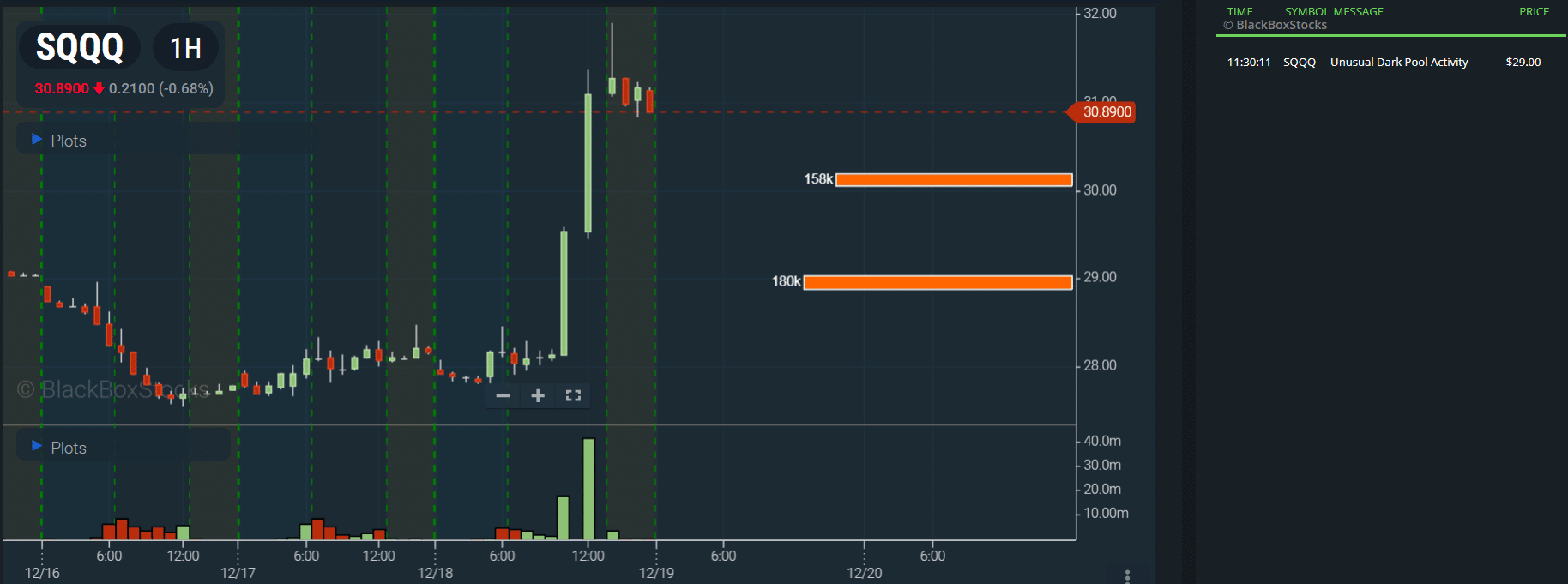
On December 18, two significant dark poolDark pools are private trading venues or exchanges where institutional investors, such as mutual funds, hedge funds, and pension funds, can trade large blocks of securities away fr… trades in SQQQ stood out:
- A trade of 180,000 shares at $29: This massive order cost approximately $5.22 million.
- A second trade of 158,000 shares at $31: This transaction amounted to roughly $4.89 million.
Together, these two trades accounted for over $10 million in purchases of SQQQ shares, executed toward the end of the trading day and into the after-hours market. Such large-scale activity is highly indicative of institutional participation, as retail traders typically lack access to dark poolsDark pools are private trading venues or exchanges where institutional investors, such as mutual funds, hedge funds, and pension funds, can trade large blocks of securities away fr… and the capital required to execute orders of this magnitude in such a short time frame.
What This Reveals About the Market Sell-Off
The Federal Reserve’s announcements on December 18 triggered significant market volatility. The substantial dark poolDark pools are private trading venues or exchanges where institutional investors, such as mutual funds, hedge funds, and pension funds, can trade large blocks of securities away fr… trades in SQQQ suggest that institutional investors anticipated further declines in the Nasdaq-100, positioning themselves to profit from the downturn. The sheer size and timing of the orders point to institutional players as the likely primary drivers of the sell-off.
Tracking Institutional Moves
For those interested in monitoring institutional investor activity during major market moves, tracking dark poolDark pools are private trading venues or exchanges where institutional investors, such as mutual funds, hedge funds, and pension funds, can trade large blocks of securities away fr… data provides valuable insights. Large trades in tools like SQQQ can signal where institutional capital is flowing during periods of heightened market uncertainty.
If you want to learn how to follow institutional investors and capitalize on their market moves, click here for a special offer.