Lecture 12: Inside Bar Volume Analysis: How To Read Institutional Participation And Confirm Signals | Trading Strategy Guides
Welcome to Day 12! You’ve learned advanced pattern recognition. Today, we’re adding the one indicator that reveals actual market participation: volume.
Volume is the truth serum of trading. Price can lie, indicators can mislead, but volume shows you exactly who’s participating and how serious they are about their moves.
Let me teach you how to read volume like a professional.
Why Volume Matters for Inside Bars
Inside bars represent market indecision, but volume tells you the quality of that indecision. Is it genuine institutional uncertainty, or just retail noise during slow periods?
High-quality inside bars show specific volume patterns that reveal institutional involvement. Low-quality inside bars show volume patterns that suggest random price action without serious money behind it.
The difference determines whether your inside bar leads to explosive moves or disappointing fakeouts.
The Perfect Volume Pattern
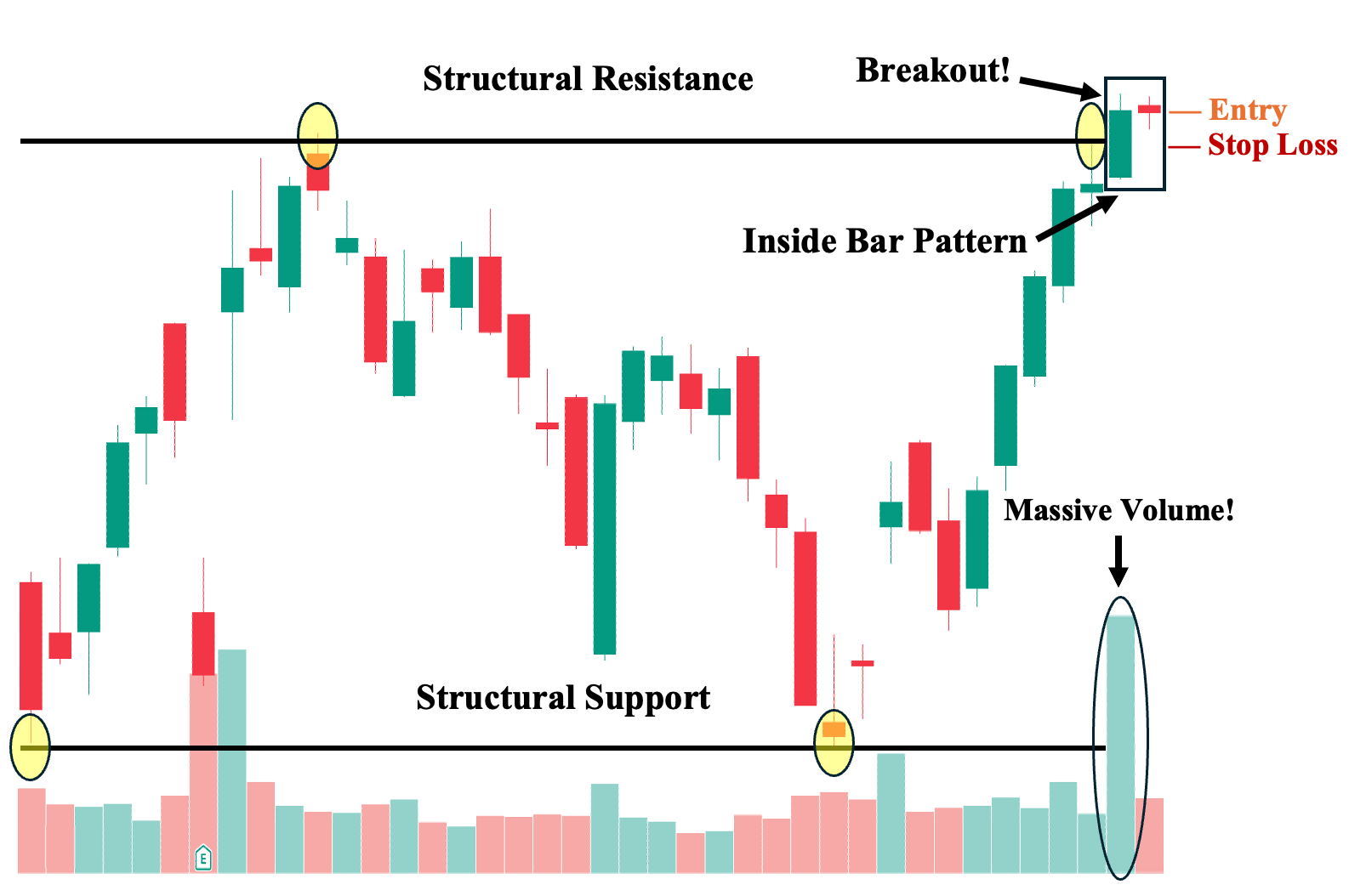
Here’s what institutional inside bar formation looks like on volume:
High volume on the mother bar shows institutions were actively participating in the initial move. Real money was behind that directional push.
Decreasing volume during inside bar formation indicates institutions are stepping back, creating the indecision that forms the pattern. Smart money is waiting and watching.
Volume expansion on breakout confirms institutions are back, pushing price decisively in the chosen direction.
This three-part pattern—high, low, high—is your blueprint for identifying inside bars with institutional backing.
Reading Institutional vs Retail Participation
Volume patterns reveal who’s driving price action during inside bar formation and breakout.
Institutional Volume Signatures:
- Steady, consistent volume on directional moves
- Volume spikes at key technical levels
- Volume expansion that sustains through price movements
- Above-average volume on trend continuation moves
Retail Volume Signatures:
- Erratic, inconsistent volume patterns
- Volume spikes followed by immediate drops
- High volume on reversals and panic moves
- Below-average volume on breakout attempts
Inside bars with institutional volume patterns are far more reliable than those driven by retail emotions.
The Volume Confirmation System
Before trading any inside bar, check its volume story using this simple system:
Grade A Volume: High mother bar volume + decreasing inside bar volume + expansion on breakout
Grade B Volume: Moderate mother bar volume + stable inside bar volume + some expansion on breakout
Grade C Volume: Low mother bar volume + inconsistent patterns + weak breakout volume
Grade F Volume: Avoid entirely
Only trade Grade A and B volume patterns. Grade C and F setups are volume traps that usually disappoint.
Volume-Based Entry Timing
Volume can improve your entry timing dramatically. Instead of entering immediately on range breaks, wait for volume confirmation.
If EUR/USD breaks above an inside bar range but volume is weak, wait. If volume expands significantly on the break, enter immediately. This simple filter eliminates many false breakouts.
The volume confirmation rule: No significant volume expansion = no entry, regardless of how perfect the pattern looks.
The Volume Divergence Warning
Sometimes, price breaks out of inside bars while volume actually decreases. This divergence warns of weak breakouts likely to fail.
If GBP/USD breaks an inside bar upward but volume drops below average, suspect a false breakout. The price move lacks conviction and institutional support.
Volume divergences often precede the strongest moves in the opposite direction as the weak breakout fails and smart money pushes the other way.
Session Volume Considerations
Volume patterns vary by trading session, affecting how you interpret inside bar signals.
Asian Session: Lower average volume makes volume analysis less reliable. Focus on higher timeframes where volume patterns are clearer.
London Session: Excellent volume patterns as European institutions participate. Volume analysis is highly reliable during this session.
New York Session: Highest volume provides the clearest institutional signals. Volume patterns during NY hours are most trustworthy.
Overlap Periods: Combined London/NY sessions show the strongest volume patterns and the most reliable institutional participation.
Volume Profile Applications
Advanced traders use Volume Profile to identify where most trading occurred during inside bar formation. High-volume nodes within the inside bar range often act as magnets during breakout attempts.
If most volume traded in the upper half of an inside bar range, upward breakouts often find support at that high-volume area during pullbacks.
Volume Profile also reveals whether institutional money accumulated near support or distributed near resistance during inside bar formation.
Common Volume Mistakes
Mistake 1: Ignoring volume entirely and focusing only on price patterns. This leads to trading many low-conviction setups.
Mistake 2: Expecting massive volume on every breakout. Sometimes, quality moves show steady volume increases rather than dramatic spikes.
Mistake 3: Using volume on timeframes too low to be meaningful. 5-minute volume is often just noise; daily volume tells the real story.
Mistake 4: Not adjusting volume expectations for different markets. Forex volume differs from stock volume in important ways.
Your Volume Analysis Assignment
Find three recent inside bar setups that have already resolved. For each one, analyze the volume pattern during mother bar formation, inside bar development, and eventual breakout.
Note which setups had the best volume patterns and correlate this with actual breakout success. This calibrates your volume reading skills.
The Volume Edge
Most traders ignore volume or use it incorrectly. By mastering volume analysis with inside bars, you gain a significant edge in identifying which setups have institutional backing.
This knowledge transforms inside bar trading from pattern recognition to institutional participation analysis – a much more sophisticated approach.
Tomorrow’s News Event Mastery
Tomorrow we’re exploring inside bar trading around news events. You’ll learn when news creates opportunities versus traps, and how to position for news-driven breakouts.
News events often trigger the most explosive inside bar moves, but they also create the most dangerous false signals.
But today, master volume analysis. Start seeing inside bars not just as price patterns, but as stories of institutional participation revealed through volume.
Remember: price shows you what happened, but volume shows you who made it happen and how serious they were about it.