MetaStock 58-Point Lab Test, Audit & Benchmarks 2026
Our 58-point scientific MetaStock lab test, audit, and benchmarks include speed, accuracy, value, and feature depth with data-driven precision.
MetaStock is an institutional-leaning technical analysis platform that prioritizes data fidelity, deterministic analysis, and fast rule-based testing over modern “social charting” or AI-native workflows.
In my benchmark lab test across 17 categories, MetaStock earns a Composite Lab Performance Score (CLPS) of 4.40, outperforming the Median competitor (4.21) largely because it excels in charting depth, pattern accuracy, backtesting speed, and professional-grade real-time news integration.
The trade-off is clear: it is not cost-efficient, and it’s not built around community-first discovery or broker execution.
Composite Lab Performance Score

The CLPS is my roll-up benchmark that reflects how a platform performs across the full spectrum of real trading needs: charting, scanning, alerts, pattern logic, backtesting, automation pathways, broker ecosystem, news, community, and support. The score matters because it approximates something traders feel viscerally: how often the platform helps versus how often it adds friction or blind spots.
| Metric | What It Measures | Calculation | MetaStock | High | Median | Low | Category Winner |
|---|---|---|---|---|---|---|---|
| Composite Lab Performance Score (CLPS) | Overall benchmark outcome | Avg of all ratings + 5× superpower boost | 4.40 | 4.75 | 4.21 | 2.90 | TradingView |
MetaStock scores 4.40, above the Median competitor (4.21) and close to the top of the field. Importantly, MetaStock doesn’t earn that score by being “broadly average.” It earns it by being exceptionally strong in a few high-impact categories—especially chart depth, pattern accuracy, backtesting fidelity, and news speed.
In Context: My audit notes see MetaStock as “institutional-grade plumbing.” If your edge relies on data integrity, rules-based analysis, and system testing, this is the kind of platform that can become a daily driver. If your edge relies on community discovery, low-cost access, or AI-driven assistance, you’ll want to complement it.
MetaStock Benchmarked Lab Scores
If you’re the kind of trader who values clean, verifiable signals and robust system testing—and you’re willing to pay for institutional-grade infrastructure—MetaStock’s strengths show up quickly. If you want a low-cost platform with broad broker ecosystems, AI tooling, or a massive idea-sharing community, you’ll feel the gaps.
Verdict
MetaStock is a high-performance technical analysis and system-testing platform designed for traders who prioritize data integrity, deterministic analysis, and evidence-backed strategy workflows. It’s not a low-cost all-in-one, and it won’t replace broker platforms for execution. But if you want a tool that can legitimately support professional charting + pattern logic + fast backtesting + real-time news, MetaStock earns its place—especially when paired with a broker-centric execution platform for live trading.
Reasons to Consider MetaStock
- Elite charting foundation: Chart Analysis Depth Index 4.83 with deep indicators and extensibility.
- High-confidence pattern tooling: Pattern Depth & Accuracy 3.70 with strong accuracy and meaningful breadth.
- Top-tier backtesting engine: Backtesting Performance 4.81 driven by extremely fast tests and strong reporting.
- Best-in-class news integration: Financial News Speed & Depth 5.00—a legitimate differentiator for catalyst-driven traders.
Reasons to Avoid or Pair With Another Tool
- Poor cost efficiency: Pricing & Value Index 1.00; you must actively use its professional strengths to justify the spend.
- Slower usability profile: Speed & Ease of Use 2.75; not ideal for traders who need instant charting all day.
- Limited execution ecosystem: Broker Connectivity 1.67 due to lack of integrated live trading/broker routing.
- Not an AI-native platform: AI Layer is 0.0; if AI-driven discovery matters, pair with TrendSpider/Trade Ideas/Tickeron.
Pricing & Value Index
Pricing & Value Index is not a “cheapness” score. It measures cost efficiency relative to feature coverage using effective monthly cost and cost-per-feature, then normalizes the results to a percentile-based rating. This matters because traders don’t just pay with money—they also pay with lock-in. If you’re committing to a higher-cost platform, it needs to return value in workflow impact or performance edge.
MetaStock’s Pricing & Value Index score is 1.00, well below the Median (2.50). The reason is straightforward: MetaStock’s cost structure reflects its professional-grade positioning and data/feed depth, which raises the effective monthly cost and cost-per-feature compared to most retail platforms.
| Metric | What It Measures | Calculation | MetaStock | High | Median | Low | Category Winner |
|---|---|---|---|---|---|---|---|
| Pricing & Value Index Rating | Relative cost efficiency | Cost-per-feature percentile score | 1.00 | 5.00 | 2.50 | 1.00 | TOS, MetaTrader |
| Cost-per-day | Daily cost baseline | $/day on annual plan (min viable + data) | $8.71 | $12.36 | $1.97 | $0.50 | ChartMill |
| $ per feature | Cost efficiency | Effective Monthly Cost / Total Features | $20.38 | $28.92 | $4.29 | $0.00 | Stock Rover |
| Effective Monthly Cost (EMC) | True monthly cost | Plan + data + required add-ons/month | $265.00 | $376.00 | $60.00 | $0.00 | AAII |
In Context: My audit notes support the same conclusion: MetaStock can be worth it if you actively use what you’re paying for—especially institutional-grade news and backtesting. If you don’t, the economics look harsh versus modern charting/scanning platforms.
Value Score (VP)
Value Score (VP) answers a different question than price: how structurally good the product is for what it offers. It weighs Feature Quality (60%), Feature Depth (30%), and Device Support (10%). This is important because many platforms have long feature lists, but the value comes from whether those features are reliable, deep, and usable in repeatable workflows.
MetaStock scores 3.26 versus a Median of 2.82. That indicates MetaStock delivers meaningful product value—just not cost efficiency. In other words, it’s a strong tool, but not a “value bargain.”
| Metric | What It Measures | Calculation | MetaStock | High | Median | Low | Category Winner |
|---|---|---|---|---|---|---|---|
| Value Score (VP) | Overall product value | 60% Quality + 30% Depth + 10% Device | 3.26 | 4.37 | 2.82 | 1.70 | TradingView |
| Value Rank | Relative standing | Percentile ranking | 3.50 | 5.00 | 2.50 | 1.00 | TradingView |
| Feature Quality | Reliability and polish | Avg of feature-quality ratings | 3.43 | 4.16 | 2.97 | 2.00 | TrendSpider |
| Feature Breadth | Coverage of core features | Count of meaningful core features | 13 | 17 | 12 | 9 | TradingView, Trade Ideas |
| Feature Depth | Depth vs competitors | Percentile ranking | 3.00 | 4.75 | 3.00 | 1.00 | TradingView, Trade Ideas |
| Device Support Depth | Cross-device usability | Web/PC/iOS/Android points | 3.00 | 5.00 | 2.00 | 1.00 | TradingView, TC2000 |
In Context: My audit notes describe MetaStock as a platform where the “core” is strong—charting, indicators, rule logic, testing. If your workflow depends on those, VP reads as credible. If you need mobile-first execution or a broad multi-device lifestyle workflow, device support is not where MetaStock shines.
Speed & Ease of Use
Speed & Ease of Use is a trader’s “friction tax” score. It measures how long it takes to open a decision-ready chart, how smoothly multiple charts sync, and whether common tasks stay within a minimal-click workflow. This matters because speed isn’t about comfort—it’s about missed entries, delayed confirmations, and reduced discipline under pressure.
MetaStock scores 2.75, below the Median (3.75). The key driver is startup/time-to-chart, not multi-chart latency. Once running, MetaStock can behave like a serious workstation—but getting to that “ready” state is slower than web-first competitors.
| Metric | What It Measures | Calculation | MetaStock | High | Median | Low | Category Winner |
|---|---|---|---|---|---|---|---|
| Speed & Use Index Rating | Practical speed/usability | Avg of time-to-chart, multichart, 3-click | 2.75 | 5.00 | 3.75 | 2.50 | TradingView, Seeking Alpha, Motley Fool |
| Time to Chart Speed (Seconds) | Time to usable chart | Click → loaded chart + indicators | 17.03s | 17.03s | 4.70s | 1.60s | TradingView |
| Time to Chart Performance | Speed points | Threshold scoring | 3.00 | 5.00 | 4.50 | 3.00 | Multiple tools (tie) |
| Multi-Chart Latency (ms) | Multi-chart sync delay | Delay syncing 4 charts | 667ms | 667ms | 209ms | 10ms | TC2000 |
| Multimonitor Chart Speed | Latency points | Threshold scoring | 2.00 | 5.00 | 3.50 | 0.00 | TradingView, TC2000, eSignal |
| 3-Click Rule Test | Workflow friction | Clicks to trade/launch scan | 3 | 6 | 3 | 2 | Multiple tools (tie) |
| 3 Click Rule: Ease of Use | Friction score | Penalty beyond 3 clicks | 3.25 | 5.00 | 3.25 | 0.30 | Multiple tools (tie) |
In Context: My audit notes call out MetaStock’s “institutional stack” feel—slower ramp-up, but strong workstation behavior once loaded and authenticated to data. If you trade fast intraday and need instant chart access repeatedly, this is a real drawback. If you trade swing/position and you use the platform for longer sessions, the startup penalty matters less.
Chart Analysis Depth Index
Chart Analysis Depth measures whether the platform can support advanced technical work without forcing compromises: chart variety, indicator depth, and extensibility via custom logic. The reason it matters is simple: your analysis style evolves. A shallow tool eventually forces you to simplify—or switch.
MetaStock scores 4.83, materially above the Median (3.17) and near the ceiling of the benchmark set. This is one of MetaStock’s signature strengths: deep indicator coverage and custom logic support suitable for serious technical workflows.
| Metric | What It Measures | Calculation | MetaStock | High | Median | Low | Category Winner |
|---|---|---|---|---|---|---|---|
| Chart Analysis Depth Index | Overall charting depth | Avg chart + indicators + coding | 4.83 | 5.00 | 3.17 | 0.50 | TradingView |
| Chart Types | Chart variety | Total count | 15 | 38 | 10 | 1 | Optuma |
| Chart Depth | Chart variety score | 0.3 points per chart | 4.50 | 5.00 | 3.00 | 0.30 | TradingView, eSignal, Optuma (tie) |
| Indicators | Built-in indicators | Total count | 300 | 400 | 116 | 0 | TradingView, TOS (tie) |
| Indicator Depth | Indicator score | 0.025 points per indicator | 5.00 | 5.00 | 2.90 | 0.00 | TradingView, MetaStock, Stock Rover (tie) |
| Custom Indicator Coding | Extendability | Available = 5 points | 5.00 | 5.00 | 2.50 | 0.00 | Multiple tools (tie) |
In Context: My audit notes point to MetaStock’s formula language and deterministic indicator environment as a reason professionals stick with it. If you rely on custom indicators, proprietary logic, and repeatable analysis templates, MetaStock is one of the stronger “technical foundations” in the entire benchmark field.
Chart Pattern Depth & Accuracy
Pattern engines only help if they do two things: (1) cover enough meaningful patterns, and (2) stay accurate enough that traders trust them. Too many platforms either under-deliver on breadth (so the feature is irrelevant) or over-trigger (so it becomes noise).
MetaStock scores 3.70, above the Median (2.73). The balance is what stands out: a meaningful pattern library, strong trend/price pattern coverage, and high accuracy. This is the kind of pattern stack you use to confirm and filter, not just to “hunt.”
| Metric | What It Measures | Calculation | MetaStock | High | Median | Low | Category Winner |
|---|---|---|---|---|---|---|---|
| Pattern Recognition Efficacy & Accuracy | Pattern automation utility | Avg depth + accuracy points | 3.70 | 4.88 | 2.73 | 0.00 | TrendSpider |
| Total Patterns | Pattern breadth | Count of patterns recognized | 80 | 226 | 57.5 | 0 | TrendSpider |
| Pattern Recognition Depth | Breadth score | 0.33 points per pattern | 2.64 | 5.00 | 1.90 | 0.00 | TrendSpider |
| Candle Patterns Recognized | Candlestick set | Count | 30 | 172 | 20 | 0 | TrendSpider |
| Chart Price & Trend Patterns Recognized | Trend/price patterns | Count | 50 | 54 | 16 | 0 | TrendSpider |
| Accuracy | Correctness | Percent accurate | 95% | 95% | 89% | 0% | TradingView, TrendSpider, Trade Ideas, MetaStock (tie) |
| Pattern Recognition Accuracy | Accuracy points | 0.05 per % accurate | 4.75 | 4.75 | 4.48 | 0.00 | TradingView, TrendSpider, Trade Ideas, MetaStock (tie) |
In Context: My audit notes describe MetaStock’s pattern tooling as “serious” rather than decorative—especially useful when you want automated pattern overlays that you can validate with your own rules and indicators, instead of treating patterns as standalone trade signals.
Scanning Performance
Scanning is where many traders either gain leverage or waste time. The benchmark measures raw scan speed, the expressiveness of the scan criteria set, and whether you can code custom scan logic. This matters because the scanner is often your opportunity engine: it determines what you see and how fast you see it.
MetaStock scores 3.71, above the Median (3.38). The nuance is important: scanning can be acceptable, but it depends heavily on the data setup. My audit notes highlight a stark difference between online data (slow) and locally stored data (materially faster).
| Metric | What It Measures | Calculation | MetaStock | High | Median | Low | Category Winner |
|---|---|---|---|---|---|---|---|
| Market Scanning Latency & Depth | Overall scanning capability | Avg speed + criteria + code | 3.71 | 5.00 | 3.38 | 0.80 | Stock Rover |
| Scanner Performance (ms) | Raw scan time | S&P 500 across 5 criteria | 1434ms | 2500ms | 300ms | 7ms | TradingView |
| Scanning Speed (Points) | Speed score | Threshold scoring | 3.00 | 5.00 | 4.00 | 1.00 | TradingView, Benzinga Pro, Stock Rover (tie) |
| Scanning Criteria Count | Strategy expressiveness | Total criteria fields | 251 | 675 | 200 | 30 | Stock Rover |
| Scanning Criteria & Depth (Points) | Criteria score | 0.0125 points per criterion | 3.14 | 5.00 | 2.50 | 0.80 | TrendSpider, Stock Rover (tie) |
| Custom Code Scanning | Programmability | Exists = 5 points | 5.00 | 5.00 | 5.00 | 0.00 | Multiple tools (tie) |
In Context: My audit notes make this practical: if scanning speed is mission-critical for you, MetaStock’s scanner performance is heavily influenced by how you provision data. If you’re a swing/position trader scanning end-of-day, it’s often “good enough.” If you’re scanning intraday for momentum, you’ll likely prefer a scanner-first platform.
Backtesting Performance
Backtesting Performance measures whether a tool can turn strategy ideas into tested evidence: raw speed, zero-code testing availability, coded flexibility, reporting depth, and multi-stock testing. This matters because confidence in a strategy is rarely emotional—it’s usually statistical.
| Metric | What It Measures | Calculation | MetaStock | High | Median | Low | Category Winner |
|---|---|---|---|---|---|---|---|
| Quantitative Backtesting Fidelity | Overall backtesting depth | Avg of 5 sub-scores | 4.81 | 4.90 | 3.38 | 0.00 | Portfolio123 |
| Backtesting Speed (ms) | Raw simulation speed | 10y daily / 2m 5-min | 51ms | 6000ms | 302ms | 7ms | TradingView |
| Backtesting Speed (Points) | Speed points | Threshold scoring | 5.00 | 5.00 | 4.25 | 0.00 | TradingView, MetaStock, TOS, Stock Rover (tie) |
| No Coding Required | No-code testing | 5 points if yes | 0.00 | 5.00 | 5.00 | 0.00 | Multiple tools (tie) |
| Flexible Coding Backtesting | Coded testing | Exists = 5 points | 5.00 | 5.00 | 5.00 | 0.00 | Multiple tools (tie) |
| Backtesting Report Quality (Percent) | Reporting completeness | % reporting criteria covered | 85% | 100% | 70% | 0% | TrendSpider |
| Backtesting Report Quality (Points) | Reporting depth score | 0.05 points per 1% | 4.25 | 5.00 | 2.25 | 0.00 | Portfolio123 |
| Multi-Stock Basket Backtesting | Portfolio simulation | Exists = 5 points | 5.00 | 5.00 | 5.00 | 0.00 | Multiple tools (tie) |
MetaStock scores 4.81, comfortably above the Median (3.38) and close to the top of the field. The standout is speed: MetaStock’s benchmark backtest time is extremely fast, which changes how you work. Faster testing means you iterate more—and iteration is how strategies improve.
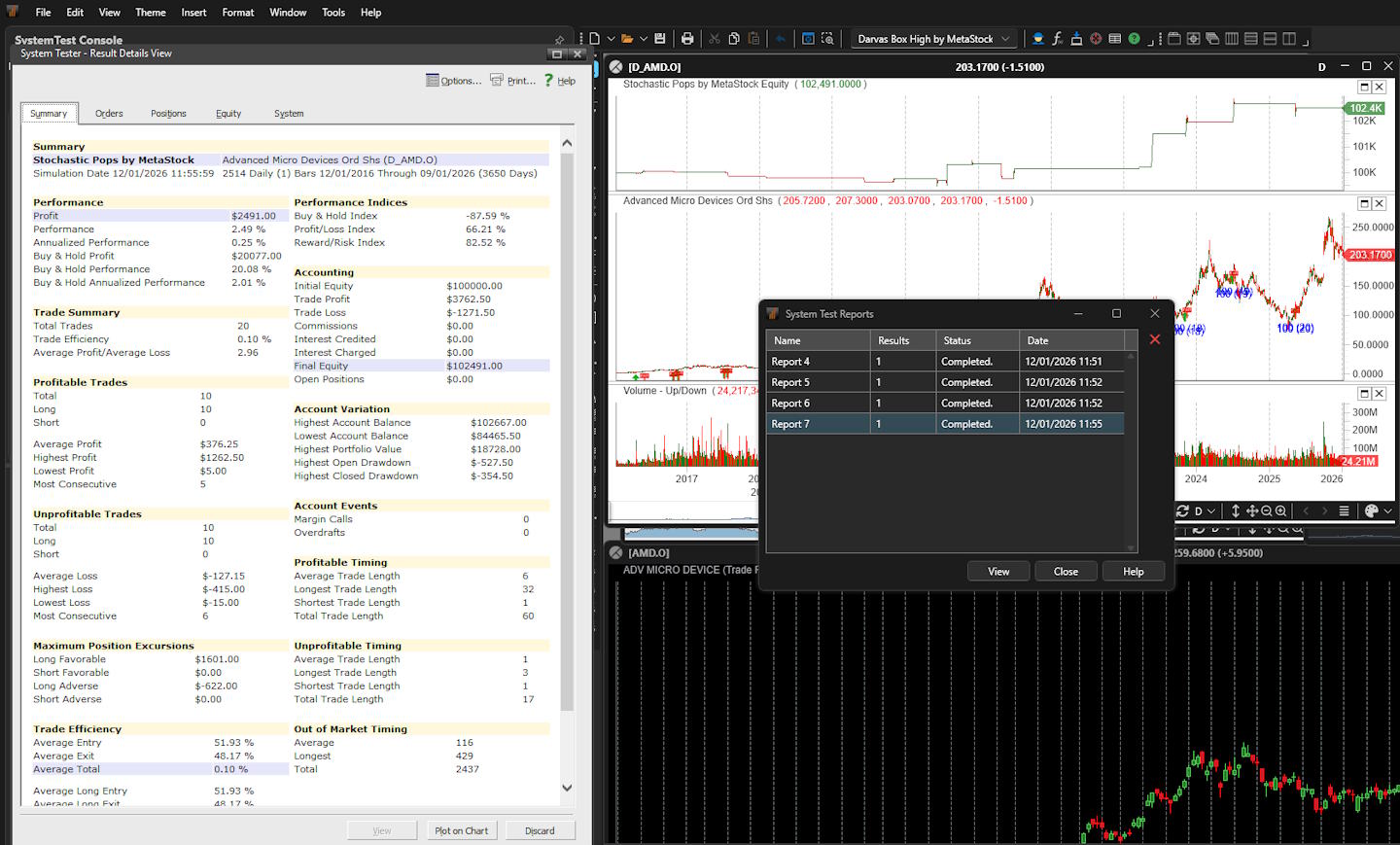
In Context: My audit notes describe MetaStock’s backtesting environment as “serious system testing,” not a marketing checkbox. The drawback is usability: if you want drag-and-drop strategy building with a minimal learning curve, other platforms are easier. If you’re comfortable expressing strategy logic and you care about speed and determinism, MetaStock is one of the stronger testing engines in the benchmark set.
Trading Bot & Auto-Trading Reliability
This category measures automation reality, not automation hype: how you actually go from signal to execution, how sophisticated the logic layer is, and whether the vendor demonstrates operational assurance (SLA/credits, incident posture). This matters because automation without reliability creates a different kind of risk: execution errors.
MetaStock scores 2.50, right at the Median (2.50). The reason it doesn’t go higher is not lack of logic—it’s the absence of a modern execution pathway (native broker-linked automation, webhook-driven bot stacks, and published operational guarantees).
| Metric | What It Measures | Calculation | MetaStock | High | Median | Low | Category Winner |
|---|---|---|---|---|---|---|---|
| Automated Execution & Bot Reliability | Automation readiness | Sum of 3 sub-metrics | 2.50 | 4.50 | 2.50 | 0.00 | TrendSpider |
| Automation Path | How automation is executed | 0–2 rubric | 1.0 | 2.0 | 1.0 | 0.0 | Trade Ideas, TC2000 (tie) |
| Strategy/Bot Sophistication | Logic depth | 0–2 rubric | 1.5 | 2.0 | 1.5 | 0.0 | TradingView, TrendSpider, Trade Ideas (tie) |
| Operational Assurance | Reliability posture | 0–1 rubric | 0.0 | 1.0 | 0.0 | 0.0 | TrendSpider |
In Context: My audit notes position MetaStock as “automation-adjacent”—excellent rules and alerts, but not a bot-execution platform. If your goal is systematic execution, you’ll want a broker-linked ecosystem. If your goal is system testing and signal validation, MetaStock’s strengths are still relevant.
AI & Algo Index
AI & Algo Index distinguishes algorithmic depth (rules, models, backtests), the presence of a true AI layer, and transparency. This matters because “AI” claims are common; what traders need is repeatable value and explainability.
MetaStock scores 2.50, above the Median (2.00) largely due to strong algorithmic depth and transparency—while the AI layer itself is not a core feature in the benchmark sense.
| Metric | What It Measures | Calculation | MetaStock | High | Median | Low | Category Winner |
|---|---|---|---|---|---|---|---|
| Algorithmic Intelligence & AI Tier Index | Overall AI/algo tier | Algo depth + AI + transparency | 2.50 | 5.00 | 2.00 | 1.00 | TrendSpider |
| Algo Depth | Strategy/model depth | 0–2 rubric | 1.5 | 2.0 | 1.5 | 1.0 | TradingView, TrendSpider, Trade Ideas (tie) |
| AI Layer | AI presence | 0–2 rubric | 0.0 | 2.0 | 0.0 | 0.0 | TrendSpider |
| Transparency | Explainability | 0–1 rubric | 1.0 | 1.0 | 1.0 | 0.0 | Multiple tools (tie) |
In Context: My audit notes frame MetaStock’s “intelligence” as deterministic: it’s strong because your logic is explicit and testable. If you want AI-native discovery, forecasting, or agentic strategy synthesis, this isn’t MetaStock’s lane.
Alert Speed
Alerts compress attention and reduce screen fatigue. The benchmark evaluates alert capacity, delivery-path richness, and speed posture. This matters most when alerts become your workflow backbone—when you rely on them for entries, exits, and risk management.
MetaStock scores 3.67, matching the Median (3.67). The headline is “capability with ambiguity”: MetaStock has strong alerting potential, but the modern published limits and delivery depth are less standardized than alert-first platforms.
| Metric | What It Measures | Calculation | MetaStock | High | Median | Low | Category Winner |
|---|---|---|---|---|---|---|---|
| Alert Trigger Latency & Delivery Speed | Overall alert utility | Avg of 3 scores | 3.67 | 4.67 | 3.67 | 2.30 | TradingView |
| Concurrent Alerts | Capacity score | 1 point per 50 (max 5) | 5.00 | 5.00 | 5.00 | 5.00 | Multiple tools (tie) |
| Concurrent Alert Count | Raw capacity | Count / Unlimited | Unlimited | 2000 | 875 | 400 | Trade Ideas, Benzinga Pro, Finviz (tie) |
| Alert Streams Richness | Delivery breadth | 1 point per stream (max 5) | 2.00 | 5.00 | 2.00 | 1.00 | TrendSpider |
| Alert Speed Rating | Practical speed | 0–5 rating | 4.00 | 5.00 | 3.00 | 1.00 | TradingView, Benzinga Pro (tie) |
In Context: My audit notes highlight that MetaStock’s alert speed is heavily dependent on your real-time feed and configuration. If you want a platform where alerting is a first-class product (including richer delivery paths and published limits), TradingView or TrendSpider tend to feel more “modern.”
Trade Signal Quality
Trade Signal Quality measures whether the platform provides audited, actionable signals as a built-in feature (versus simply providing tools to generate your own). Many traders want signals; many prefer control. The benchmark tells you what you’re buying.
MetaStock scores 2.50, which indicates the presence of systemic buy/sell gauges or model-style signals rather than audited “trade call” engines like AI signal platforms.
| Metric | What It Measures | Calculation | MetaStock | High | Median | Low | Category Winner |
|---|---|---|---|---|---|---|---|
| Signal Alpha & Predictive Efficacy | Built-in signals | Audited signals vs gauges | 2.50 | 5.00 | 0.00 | 0.00 | Trade Ideas, Tickeron, Motley Fool, Seeking Alpha |
In Context: My audit notes support a practical interpretation: MetaStock is strongest when you define the rules and validate them. If you want a platform to hand you trade calls, the leaders are elsewhere.
Broker Connectivity & Ecosystem Depth
This category measures whether you can execute trades directly, how many brokers are integrated, and how broad the platform’s market/data coverage is. This matters because execution friction is real: even great analysis loses value if it cannot translate into efficient action.
MetaStock scores 1.67, below the Median (2.00). The reason is structural: MetaStock is not positioned as a broker-integrated execution platform. It can still have broad data coverage, but execution remains external.
| Metric | What It Measures | Calculation | MetaStock | High | Median | Low | Category Winner |
|---|---|---|---|---|---|---|---|
| Asset & Data Coverage Index | Overall connectivity | Avg of live trading, broker integration, coverage | 1.67 | 5.00 | 2.00 | 0.70 | TradingView, MetaTrader |
| Live Trading | Can execute trades | 5 points if yes | 0.00 | 5.00 | 5.00 | 0.00 | Multiple tools (tie) |
| Total number of brokers integrated | Broker breadth | Raw count | 0 | 1200 | 2 | 0 | MetaTrader |
| Broker Integration | Broker depth score | 0.1 point per broker (max 5) | 0.00 | 5.00 | 0.20 | 0.00 | TradingView, MetaTrader |
| Asset & Data Coverage | Market breadth | Stocks/Options/FX/US/Intl | 5.00 | 5.00 | 2.00 | 2.00 | TradingView, TrendSpider, MetaStock, MetaTrader (tie) |
In Context: My audit notes make this a clean buying decision: if you want analysis + execution in one place, MetaStock is not the best fit. If you want analysis + testing with professional data—and you’re fine executing elsewhere—it’s viable.
Portfolio Tool Performance
Portfolio tooling measures the depth of risk analytics and reporting: correlation, portfolio health, dividend and risk metrics, and how complete the “investor cockpit” feels. This matters for swing/position traders and investors who manage multi-position exposure over time.
MetaStock scores 2.60, slightly below the Median (2.80). It can support watchlists and portfolio organization, but it is not a dedicated portfolio analytics leader.
| Metric | What It Measures | Calculation | MetaStock | High | Median | Low | Category Winner |
|---|---|---|---|---|---|---|---|
| Portfolio Health & Risk Analytics | Overall portfolio depth | Category score | 2.60 | 4.80 | 2.80 | 2.00 | Stock Rover, Portfolio123 |
| Health Check & Reporting Depth | Coverage of critical metrics | % critical metrics covered | 33/80 (41.2%) | 76/80 (95.0%) | 36/80 (45.0%) | 20/80 (25.0%) | Stock Rover |
In Context: My audit notes suggest MetaStock’s center of gravity is technical analysis and testing, not portfolio optimization. If you require deep portfolio analytics (correlation matrices, advanced risk dashboards, Monte Carlo, rebalancing workflows), pair MetaStock with a dedicated portfolio tool.
Financial News Speed & Depth
News is only “useful” if it arrives fast enough and is filterable enough to act on. The benchmark score rewards real-time alerting, breadth of sources, filtering controls, and practical integration into trading workflows.
MetaStock scores 5.00, far above the Median (2.30) and at the ceiling. This is one of MetaStock’s clearest category wins: it is built to support traders who care about professional news flow.
| Metric | What It Measures | Calculation | MetaStock | High | Median | Low | Category Winner |
|---|---|---|---|---|---|---|---|
| Financial News Speed & Quality Rating | News trading utility | Weighted rubric | 5.00 | 5.00 | 2.30 | 0.00 | MetaStock, Benzinga Pro, eSignal, Scanz |
| Delay vs primary wires | Raw speed range | App vs Bloomberg/Reuters feeds | 60s–300s | Hours/Days | MetaStock |
In Context: My audit notes align with the score: if your trading style is catalyst-driven—earnings, macro headlines, analyst actions—MetaStock’s news integration can materially improve decision timing. This category alone can justify the platform for the right trader.
Community Utility Index (CUI)
CUI measures whether a community produces usable “alpha” resources: strategies, code, scanners, workflows, and high-signal discussion. This matters because good communities accelerate learning and reduce time-to-competence.
MetaStock scores 3.25, matching the Median (3.25). The community is present and useful, but it is not the kind of massive, always-on ecosystem that social charting or broker megaplatforms produce.
| Metric | What It Measures | Calculation | MetaStock | High | Median | Low | Category Winner |
|---|---|---|---|---|---|---|---|
| Community Utility Index | Overall community value | Avg size + contribution | 3.25 | 5.00 | 3.25 | 1.80 | TradingView, MetaTrader |
| Active Community Size | Crowd density | 0–5 scale | 3.00 | 5.00 | 3.00 | 2.00 | TradingView, MetaTrader |
| Quality of Community Contribution | Practical IP quality | 0–5 scale | 3.50 | 5.00 | 3.50 | 1.50 | TradingView, Trade Ideas, MetaTrader |
In Context: My audit notes position MetaStock’s community as “professional niche” rather than “mass social.” That’s not inherently bad—professional communities can be higher signal. The trade-off is less breadth and fewer shared resources compared to open ecosystems.
Support Infrastructure & SLA Audit
Support is operational risk management. This benchmark scores how quickly you can reach a human and how strong the communication channels are. This matters most when the platform is part of a daily trading workflow, because downtime or unresolved issues can translate into real trading losses.
MetaStock scores 4.00, above the Median (3.75). It’s not the benchmark leader, but it’s strong and credible—especially for a professional platform.
| Metric | What It Measures | Calculation | MetaStock | High | Median | Low | Category Winner |
|---|---|---|---|---|---|---|---|
| Support SLA Audit: Time-to-Human Benchmarks | Overall support posture | Avg channels + response | 4.00 | 5.00 | 3.75 | 1.00 | TC2000, TrendSpider |
| Support Communication Channels | Access scale | 0–5 rubric | 4.00 | 5.00 | 3.50 | 1.00 | TC2000, TOS, TrendSpider |
| Support Response Times | Time-to-human | 0–5 rubric | 4.00 | 5.00 | 4.00 | 1.00 | TC2000, TrendSpider |
| Stated SLA & Tested Outcomes | Real-world outcome | Raw stated/tested | 5–10 Minutes | – | – | – | – |
In Context: My audit notes emphasize that support quality matters more when the platform is complex and data-dependent. MetaStock’s support posture reduces that risk, but if “instant time-to-human” is a deciding factor, TC2000 and TrendSpider set the benchmark ceiling.