Naked Puts Vs Bull Put Spreads: Which Options Strategy Is Right for You?
Options trading offers various strategies for generating income, but two of the most popular approaches are naked puts and bull put spreads.
While both strategies aim to generate income from premium collection, they differ significantly in terms of risk, capital requirements, and potential returns.
In this comprehensive guide, we’ll compare naked puts vs bull put spreads, analyze their risk-reward profiles, and provide real-world examples to help you determine which strategy aligns with your trading goals and risk tolerance.
Contents
A naked put (also known as a cash-secured put) is an options strategy where you:
- Sell a put option without owning the underlying stock
- Collect premium upfront from the option sale
- Accept the obligation to buy the stock if assigned
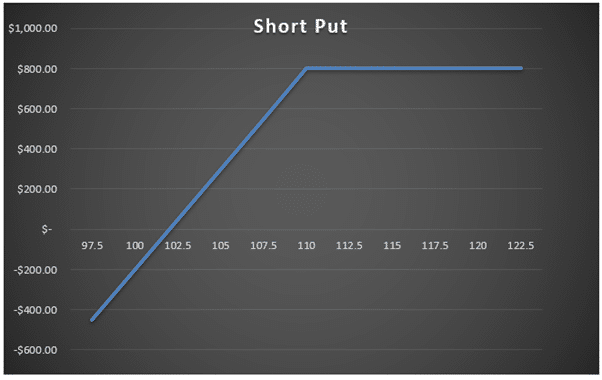
- Face unlimited downside risk until the stock reaches zero
Naked puts are attractive to many traders because they offer higher premium collection compared to spread strategies.
However, this higher income potential comes with significant drawbacks.
The unlimited risk exposure means that your potential losses can be substantial if the underlying stock experiences a major decline.
Additionally, naked puts require a high capital requirement, as you must have enough cash in your account to purchase 100 shares of the underlying stock if assigned.
This capital-intensive nature makes naked puts less accessible to traders with smaller accounts.
A bull put spread is a more conservative income strategy that involves:
- Selling a put option at a higher strike price
- Buying a put option at a lower strike price for protection
- Collecting net premium (difference between premiums)
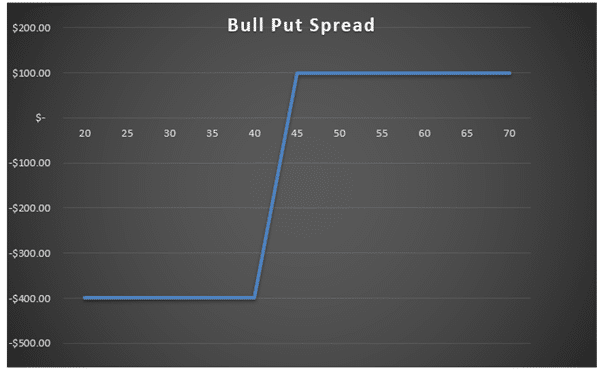
- Limiting maximum loss to the spread width minus net premium
Bull put spreads represent a more conservative approach to income generation through options trading.
By purchasing a protective put at a lower strike price, you effectively create a floor for your losses while still collecting net premium.
This strategy appeals to traders who want to generate income but prefer having clearly defined risk parameters.
The limited risk exposure makes bull put spreads particularly attractive during volatile market conditions, when unlimited-risk strategies become too dangerous for most traders’ comfort levels.
Naked Puts Risk Analysis
The unlimited risk nature of naked puts requires careful consideration of worst-case scenarios.
Your maximum loss equals the full value of 100 shares minus the premium you received, which can be substantial for high-priced stocks.
For example, if you sell a naked put on a $150 stock and collect $400 in premium, your maximum loss could approach $14,600 if the stock becomes worthless.
Your break-even point is the strike price minus the premium received, and you’ll need capital equal to the full cost of 100 shares to secure the position properly.
Bull Put Spreads Risk Analysis
Bull put spreads provide a more predictable risk environment that many traders find appealing.
Your maximum loss is calculated as the difference between strike prices multiplied by 100, minus the net premium received.
This creates a scenario where you know your exact risk before entering the trade.
The break-even point equals the higher strike price minus the net premium received, and your capital requirement is simply the maximum loss amount, making position sizing much more manageable.
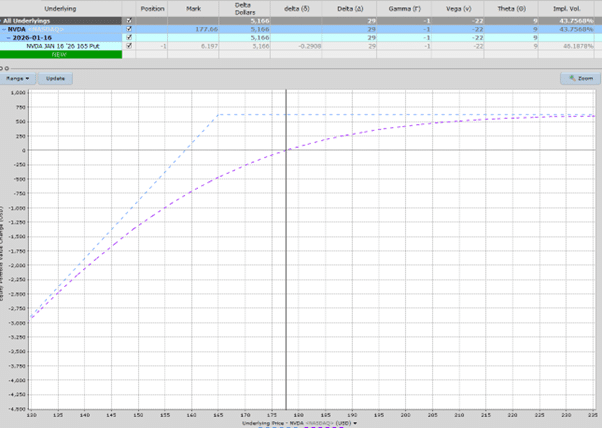
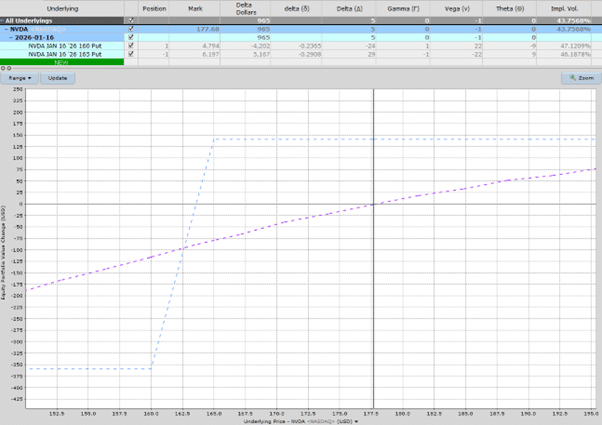
Let’s examine a practical comparison using NVIDIA (NVDA) with a 51-day expiration and 29 delta options:
Naked Put Example:
- Strike Price: $165
- Premium Received: $620
- Maximum Risk: $15,880
- Return on Capital: 3.90%
Bull Put Spread Example:
- Short Put: $165 (premium received: $620)
- Long Put: $160 (premium paid: $480)
- Net Premium: $140
- Maximum Risk: $360
- Return on Capital: 38.89%
The capital efficiency comparison reveals why many professional traders prefer bull put spreads over naked puts.
When selling naked puts, you’re essentially tying up a large portion of your trading capital for relatively modest returns.
This approach limits your ability to diversify across multiple positions and can leave you overexposed to a single stock’s performance.
The high capital requirements also make naked puts inaccessible to traders with smaller accounts, as you might need $10,000 to $50,000 or more just to secure a single position.
Bull put spreads, on the other hand, offer exceptional capital efficiency by requiring only the maximum loss amount as collateral.
This means you can deploy the same capital across multiple positions, spreading your risk while potentially increasing your overall returns.
The lower capital requirements also make this strategy accessible to traders with accounts of various sizes, democratizing access to income-generating options strategies.
Effective risk management strategies differ significantly between these two approaches.
When trading naked puts, you can roll positions to later expiration dates to avoid assignment, but this strategy has limitations and may not always be profitable.
If assigned, you must be prepared to own the underlying stock, meaning you must have a long-term investment thesis for the company.
Market volatility can quickly turn profitable naked put positions into significant losses, leaving a large portion of your account at risk and making recovery challenging.
Bull put spreads offer more straightforward risk management since your maximum loss is defined from the outset.
This clarity allows for better position sizing and enables you to manage multiple positions simultaneously without overwhelming risk exposure.
You can close positions early to capture partial profits, and implementing stop losses becomes more practical with clearly defined risk parameters.
The predictable nature of bull put spreads makes them easier to incorporate into systematic trading approaches.
Choose Naked Puts When:
- You have substantial capital available
- You’re comfortable owning the underlying stock
- You prefer higher premium collection
- You can manage a potential assignment
Choose Bull Put Spreads When:
- You have limited capital
- You want defined risk exposure
- You prefer a higher return on capital
- You want to manage multiple positions
Both strategies have similar tax treatment:
- Premium received is taxed as short-term capital gains
- Assignment may trigger additional tax consequences
- Consult with a tax professional for specific situations
Naked Put Mistakes:
- Underestimating capital requirements
- Ignoring assignment risk
- Poor strike price selection
- Inadequate diversification
Bull Put Spread Mistakes:
- Choosing spreads too narrow
- Ignoring liquidity in both strikes
- Poor timing of entry and exit
- Neglecting commission costs
Both naked puts and bull put spreads can be effective income-generating strategies, but they serve different purposes and risk profiles.
Bull put spreads offer superior capital efficiency and defined risk, making them more suitable for most traders.
Naked puts, while generating higher absolute premiums, require significantly more capital and carry unlimited risk.
The key to successful options trading lies in understanding your risk tolerance, capital constraints, and trading objectives.
Consider starting with bull put spreads to gain experience before moving on to naked puts, if your account size and risk tolerance permit.
Remember that options trading involves significant risk and is not suitable for all investors.
Always conduct thorough research, practice with paper trading, and consider consulting with a financial advisor before implementing any options strategy.
Q: Which strategy is better for beginners?
A: Bull put spreads are generally more suitable for beginners due to their defined risk and lower capital requirements.
Q: Can I convert a naked put to a bull put spread?
A: Yes, you can “leg into” a bull put spread by buying a lower strike put for protection.
Q: What happens if I’m assigned a naked put?
A: You’ll be required to purchase 100 shares of the underlying stock at the strike price.
Q: How do I choose the right strike prices for a bull put spread?
A: Consider the stock’s support levels, your risk tolerance, and desired return on capital when selecting strikes.
Understanding the differences between naked puts and bull put spreads is just the beginning.
Whether you’re generating a few hundred dollars per month or building toward a consistent five-figure income stream, mastering put-selling strategies separates successful options traders from those who blow up their accounts during the next market correction.
If you’re interested in learning more about systematic approaches to selling options for income:
Options Income Mastery: Learn the foundational strategies for selling puts and spreads with proper risk management techniques that protect your capital ($397)
The Accelerator Program: Advanced training covering position sizing, adjustment techniques, and portfolio-level management for serious options income traders ($997)
We hope you enjoyed this article on naked puts and put spreads.
If you have any questions, please send an email or leave a comment below.
Trade safe!
Disclaimer: The information above is for educational purposes only and should not be treated as investment advice. The strategy presented would not be suitable for investors who are not familiar with exchange traded options. Any readers interested in this strategy should do their own research and seek advice from a licensed financial adviser.

Source link


![[WEBINAR] Algorithmic Trading with Python: Integrating with Various Brokers and Platforms](https://dcgreferral.com/wp-content/uploads/2024/06/WEBINAR-Algorithmic-Trading-with-Python-Integrating-with-Various-Brokers-and-768x402.png)