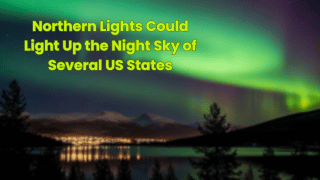
Northern Lights Could Light Up the Night Sky of Several US States
The Northern Lights might light up the night sky across several US states, and I am not being subtle about it. The aurora borealis is one of the best free shows on Earth. Even better, strong events can shove that glow into lower latitudes, so the “only Alaska” myth finally takes a seat. First, here is why this window matters. When the Sun cranks up solar activity, it blasts out faster solar wind and sometimes launches eruptions. That incoming flow carries a magnetic signature, and when it turns the “right” way, it boosts geomagnetic activity and brightens auroras. Then the aurora can push farther from the poles.
Next, the big mover is a geomagnetic storm. NOAA explains that stronger storms make auroras brighter and shift them away from polar regions. NOAA also notes that around Kp index 6 to 7, people near the northern edge of the United States may spot aurora. So yes, several states can realistically get in on the action. Meanwhile, the glow does not magically cover the whole map. It follows the auroral oval, which expands when conditions intensify. The University of Alaska Fairbanks tracks that oval and explains it can grow during enhanced geomagnetic activity, bringing sightings to lower latitudes. So timing matters, and so does where you stand. Finally, do not guess. Use NOAA’s aurora forecast tools like the viewline and short term updates. They rely on near real time solar wind measurements, so they can adjust as conditions change. Pair that with dark skies, and this Northern Lights window turns from hype into a plan.
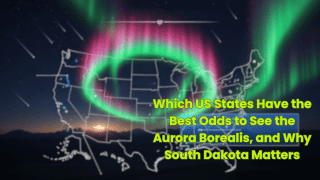
Which US States Have the Best Odds to See the Aurora Borealis, and Why South Dakota Matters
Let us talk about the US map without pretending every state is equal. Alaska is always the MVP for auroral displays. The northern tier is next, like Washington, Idaho, Montana, North Dakota, Minnesota, Wisconsin, Michigan, New York, Vermont, New Hampshire, and Maine. Now add one smart move. Check NOAA’s aurora viewline and the kp index before you even grab your keys. Now for the spicy part. During stronger events, places like Nebraska, Iowa, Illinois, Indiana, Ohio, Pennsylvania, and Massachusetts can get a shot. South Dakota sits in a sweet spot for some storms. It can be close enough to the auroral oval, but still feels like a surprise. And NOAA backs the idea that higher Kp can push viewing toward the northern edge of the US. So South Dakota matters when storms expand the oval.
The aurora borealis is basically physics doing visual art. The Sun sends charged particles toward Earth. Those particles interact with earth’s magnetic field and slide along invisible tracks. This glow forms high above you, in the upper atmosphere. NSF notes auroras can occur roughly 85 to 600 km up. Those tracks are magnetic field lines and field lines. They guide energy toward high latitude skies. When particles hit the upper atmosphere, atoms and molecules light up. That light becomes the curtains, waves, and streaks you observe. During very active times, NOAA says the auroral oval can expand into places that rarely see aurora. So here is the play. Use NOAA’s short-term aurora forecast, since it updates with near real-time solar wind inputs. Then pair it with a dark, open view north. Keep city lights behind you, and let your eyes adapt. If the oval swells, South Dakota can deliver a real “wait, that is the Northern Lights” moment.
READ ALSO: Miami Tourist Destination Spots You’re Sleeping On
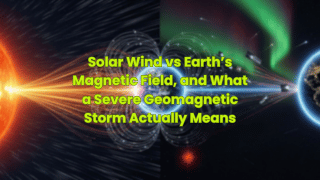
Solar Wind vs Earth’s Magnetic Field, and What a Severe Geomagnetic Storm Actually Means
The solar wind is a stream of particles flowing outward from the Sun. It carries a magnetic imprint called the interplanetary magnetic field. When that magnetic direction fights or aligns with ours, things get interesting. NOAA notes that faster solar wind plus a southward turning magnetic field can ramp up geomagnetic activity and push aurora farther from the poles. Earth is wrapped in a magnetic field that acts like a shield. But it is not a hard wall. When the incoming flow is strong, it can press and shake the shield. That shaking is the start of heightened geomagnetic activity. NASA explains that this interaction can trigger magnetic reconnection, which helps funnel energy and particles toward aurora zones.
A geomagnetic storm happens when Earth’s magnetic system gets disturbed for hours. You will hear levels like G1 to G5. A severe geomagnetic storm is near the top of that scale. It can mean the glow expands quickly. NOAA defines geomagnetic storms as major magnetosphere disturbances driven by efficient energy transfer from the solar wind. Big storms can also bring annoyances. GPS can wobble, radio can fade, and satellites can get stressed. Still, for skywatchers, large geomagnetic storms are the golden ticket. They can deliver brighter intensity and broader reach. NOAA’s storm scale links stronger levels to broader aurora visibility and increased tech impacts, so yes, the drama comes with receipts. So if you want to play this smart, lean on real time solar wind feeds and short-range aurora tools. NOAA tracks solar wind from spacecraft near the L1 point, and its 30-minute aurora forecast uses that travel time to update visibility. That is how you catch the spike, not the recap.
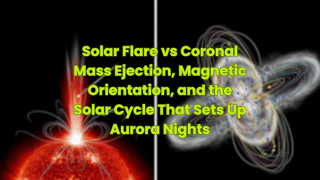
Solar Flare vs Coronal Mass Ejection, Magnetic Orientation, and the Solar Cycle That Sets Up Aurora Nights
The two troublemakers, solar flare and coronal mass ejection. A solar flare is a flash of energy from the Sun. It can create radio issues on the day side of Earth. It also signals that the Sun’s active regions are in a spicy mood. NOAA links those radio issues to stronger X-ray and EUV that boost ionization on Earth’s sunlit side. A coronal mass ejection is the bigger mover for aurora nights. It is a blob of coronal mass and magnetized plasma launched from the sun’s atmosphere. If that blob is aimed right, it can reach earth and drive a storm. NOAA describes CMEs as large expulsions of plasma and magnetic field from the Sun’s corona. That embedded field matters for impact and timing.
The magnetic orientation trick that decides your night. Here is the detail most people skip, and it matters. The incoming cloud has its own magnetic setup. The magnetic orientation can either connect smoothly or clash with ours. NOAA explains that when the interplanetary magnetic field turns southward, geomagnetic activity rises. Then aurora gets brighter and moves farther from the poles. If the cme’s magnetic field points south for a while, Earth absorbs more energy. That can raise auroral activity fast. It is why forecasts can swing. That southward stretch often boosts energy transfer into Earth’s magnetosphere. So you can go from “maybe” to “wow” quickly. Solar cycle basics, and why the timing still favors aurora chasers. The Sun runs in an about 11 year rhythm called the solar cycle. Activity rises and falls, with more sunspots during peak years. More sunspots usually means more storms. It is that simple. NASA and NOAA tie solar maximum to higher sunspot counts and increased solar activity, which raises the odds of flare and CME headlines.
READ ALSO: Greatest Adventure Plans That Will Make You Pack Fast
KP Index, Auroral Oval, and Timing: How to Catch the Glow on the Northern Horizon
The kp index is a quick way to describe how disturbed Earth’s magnetic environment is. It runs from 0 to 9. Higher numbers generally mean better chances farther south. It is not perfect, but it is useful. NOAA uses the planetary K index to describe geomagnetic disturbance, and it helps guide alerts for users affected by it. If you want a rough feel, KP 4 to 5 can help northern states. KP 6 to 7 can push the auroral zone lower. KP 8 to 9 is when people in unexpected places start texting, “Is that the Northern Lights?” and yes, sometimes it is. Meanwhile, do not treat KP like a guarantee. Instead, treat it like a hype meter that tells you when it is worth driving.
The auroral oval is the ring shaped zone around the poles where auroras are most common. It expands and contracts with geomagnetic activity. NOAA explains that during very active times, the oval expands away from the poles. That expansion can reach places where aurora rarely shows up. The auroral zone is the ground based way people talk about that region. On calm nights, it hugs the high latitudes. On stormy nights, it stretches. That stretch is what brings visible aurora to more states. The University of Alaska Fairbanks also notes the oval expands during enhanced activity, which helps lower latitudes get a shot. Many displays peak around local midnight, but storms can flare earlier or later. Stay flexible. Face north and scan the northern horizon first. Early displays can look like a low, pale glow. Then the show can climb higher. If you get lucky, you can even catch an aurora overhead, which feels unreal. NOAA also reminds viewers to pair geomagnetic activity checks with dark skies away from city lights.
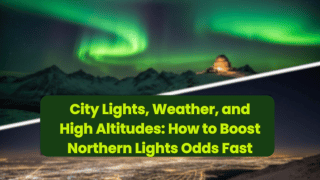
City Lights, Weather, and High Altitudes: How to Boost Northern Lights Odds Fast
When you chase the Northern Lights, your biggest enemies are usually the boring ones: glare, clouds, and bad sightlines. NOAA says it must be dark, so you should get away from city lights before you judge the glow. It also warns that a bright moon can reduce what you notice, even when the aurora stays strong. City lights are the enemy of subtle auroras. Light pollution washes out faint structures. Your eyes cannot adapt well, and your photos look sad. It is not you, it is the parking lot floodlights.
Get away from bright streets and big signs. Find a dark region with open sky. Rural fields, lakes, and quiet hills help. Give your eyes time, because the human eye improves after 15 to 30 minutes in darkness. NPS explains that light pollution blocks full dark adaptation, and it notes night vision builds after about 20 minutes in low light. Clouds can ruin the best storm. That is the cruel truth. Check the local forecast, and do not ignore wind and haze. Clear air matters as much as storm strength.
High altitudes can help you get above low haze and some fog. A ridge or a high plain can open the sky. This is where factors combined matters. You want darkness, clarity, and strong activity at the same time. The Geophysical Institute in Alaska also suggests a hill away from city lights with a clear view of the horizon, because the aurora can show up across the sky. So plan like you mean it. First, pick a dark spot and arrive early. Next, protect your night vision, and use dim red light if needed. Then watch the northern horizon, because bright aurora can show from far away when conditions line up.
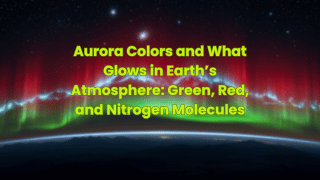
Aurora Colors and What Glows in Earth’s Atmosphere: Green, Red, and Nitrogen Molecules
Most people picture a green glow, and that is fair. Green is common because oxygen emissions happen at certain heights. It is often the first color you notice with the naked eye. A red aurora is special, and it can show up during stronger events. It comes from higher altitude emissions and can spread across large areas. You might also see red emissions near the horizon, like a weird sunrise at night. Here is the extra detail that makes the colors click. NOAA explains that green often comes from atomic oxygen at 557.7 nm. It also notes that oxygen can produce deep red at 630.0 nm. Red shows up higher, where air stays thinner and collisions happen less. That gives red a better chance to glow, especially during stronger events.
Auroras form in earth’s atmosphere, but not near your backyard height. The action is mostly in the upper atmosphere. Particles collide with gases, and that energy becomes light. Nitrogen molecules can contribute blue or purple tones, especially in brighter bands. Oxygen creates green and red. There are also other atoms and ions involved, but the main idea is simple. Energy goes in, light comes out, and the sky gets dramatic. Also, do not let your eyes bully you. Your phone camera often catches reds and purples better than you can. Meanwhile, your eyes lock onto green faster in low light. So if you “only” see pale green, you might still capture a full rainbow in photos. That is not cheating, that is physics being petty.
READ ALSO: Longest Beach in the World: Even Your GPS Gets Tired
Directly Overhead vs Near the Horizon, and How to Use an Aurora Forecast Like a Pro
People often expect a giant ribbon right away. Sometimes you get that. Sometimes you get a low glow that looks like thin cloud. Do not rage quit too early. When activity grows, structures can climb higher. During stronger storms, the aurora can be directly overhead. That is when your whole sky becomes a dome of light. It is also when your brain forgets to blink. Here is the sneaky detail: perspective changes everything. If the strongest auroral activity sits north of you, it can look low on the horizon. If it shifts closer, the same display can climb and spread overhead. The Geophysical Institute explains that a display overhead in one location can appear much lower on the northern horizon from another town.
Start with an aurora forecast from a serious source. NOAA tools are a solid baseline. Yes, I mean the National Oceanic and Atmospheric Administration space weather pages. They track conditions and summarize storm levels. Then use the right tool at the right time. NOAA’s Aurora 30-Minute Forecast uses the OVATION model to predict location and intensity over the next 30 to 90 minutes. NOAA also offers an Aurora Viewline map for tonight and tomorrow night, which helps you decide if a drive makes sense.
Look for short term updates too. Many dashboards show real time data from solar wind monitors. NOAA explains that real-time solar wind comes from spacecraft upstream of Earth, usually near the L1 point. That upstream data gives you precious lead time. Finally, add proof from the sky. NOAA shares all-sky aurora examples, and the Geophysical Institute posts forecast visuals too. Combine those with your local cloud forecast, and you get a better plan.
Space Weather Alerts for Satellites, and the Southern Lights Across Both Hemispheres
Here is why tech people care, even when you only want pretty skies. Space weather alerts come from real impacts. NOAA explains that geomagnetic storms can disrupt GNSS navigation and trigger geomagnetically induced currents in power systems. The UK Met Office also links stronger storms to risks for spacecraft operations and power networks. A strong storm is not just pretty. It is a measurable event in space that can affect systems. Satellites can experience drag changes and charging issues. Power grids can see induced currents in some cases.
This is why agencies monitor space weather closely. They watch solar wind speed, density, and magnetic direction. They also track disturbances in Earth’s field. Your aurora night is closely related to the same physics that engineers worry about. Auroras are not only a north thing. The northern and southern hemispheres both get polar light shows. In the south, it is called the aurora australis, or the southern lights. The southern show is harder for most people to chase because of geography. Still, it follows the same rules. Incoming energy interacts with magnetic fields and lights up the atmosphere. Different places, same science, and both are stunning. So yes, the vibe stays magical, but the stakes stay real. Use official alerts and treat them like a weather app for space. Then plan your viewing like a pro: dark skies, clear horizons, and smart timing. If the storm ramps up, you might catch northern lights up north and aurora australis far south, on the same energetic wave.
READ ALSO: 2026 Holiday Destinations Everyone Will Copy
A Practical Northern Lights Game Plan for Tonight, and What to Do If You Miss It This Season
First, pick a dark spot with a clear view of the northern sky. Then arrive before peak darkness, so you are not rushing. Turn off car headlights, stop staring at your phone, and let your eyes adjust. Your patience is part of the setup. NOAA says the best action often hits between 10 PM and 2 AM local time. Also, use a red light, because it protects night vision better than white light.
Second, keep checking updates, but do not obsess. Watch for changes in the KP index and storm alerts. If activity dips, wait a bit. Storms pulse. If it spikes, get ready, because things can turn from faint to wild quickly. Use NOAA’s Aurora 30-Minute Forecast and Aurora Viewline to track fast shifts and southern reach. Third, take a few photos, then look up again. Phones can capture color your eyes miss. But your memory will be better if you actually watch. I promise your camera roll does not need 400 shaky green blobs.
Aurora nights come in waves, and the Sun does not follow your schedule. More activity can arrive in the next days or weeks. That is especially true in active phases of the cycle. Keep your gear ready, but keep your life too. If you want the best odds long term, learn the patterns. Watch for active sunspot regions, look for CME alerts, and track storm windows. The sun will keep sending energy. Earth will keep responding, and the sky will keep surprising us. Light on the horizon can be rare, but it is worth chasing. When conditions align, the aurora can feel like the planet is showing off. So pick your night, pick your spot, and keep your expectations smart. The night can still deliver a glow you will never forget.
The Northern Lights Are Not Just for Alaska, and Tonight Could Prove It
If the Northern Lights show up, treat it like a real window, not a vibe. The aurora borealis does not “visit” random places for fun. It moves when solar wind, magnetic orientation, and geomagnetic activity line up. That is why this moment matters for several US states. When the auroral oval expands, the northern edge of the country gets a real shot. And yes, that includes surprise winners like South Dakota. The smartest move is simple, and it is not glamorous. Use NOAA tools first, then plan your drive. Check the aurora viewline, then watch the short-term updates.
Track the KP index, but do not worship it. Instead, treat it like a signal to pay attention. Pair it with real-time solar wind changes, because storms can pulse fast. That is how you catch the spike, not the story later. Then do the practical things that actually work. Get away from city lights, because light pollution kills faint structure. Pick an open northern view, then arrive early. Let your eyes adapt, and keep your phone dim. Watch the horizon first, because early aurora can look like pale cloud. If activity grows, the bands can climb and even go overhead.
And if you miss it, do not spiral. The solar cycle keeps sending chances, and space weather never follows your schedule. Keep your setup ready, keep your expectations smart, and keep checking credible alerts. When the sky finally lights up, it feels like Earth is showing off, and honestly, it deserves the applause.
UP NEXT: When Is Super Bowl 2026? Everything You Need to Know
Source link